
Who owns retrieval quality on your team?
Who owns retrieval quality on your team when you build AI, RAG, or agent-memory systems and an assistant answers with confidence from the wrong document? Teams often target the prompt or model, even when the system found missing, stale, or unauthorized context before generation began. A better prompt can't recover evidence it never received.
Retrieval quality is the ability to find and supply useful, permitted, current evidence for a task. One named owner must be accountable for that outcome, but no AI engineer, retrieval engineer, data engineer, ML engineer, or product manager can control every input alone. The main catch is that dashboards can show recall, latency, or freshness, but they can't choose an acceptable trade-off or stop a risky release.
Quick answer
Name one person accountable for retrieval outcomes, then assign evaluation, monitoring, debugging, and release approval to specific contributors. When a RAG answer is wrong, check the retrieved context before blaming the LLM.
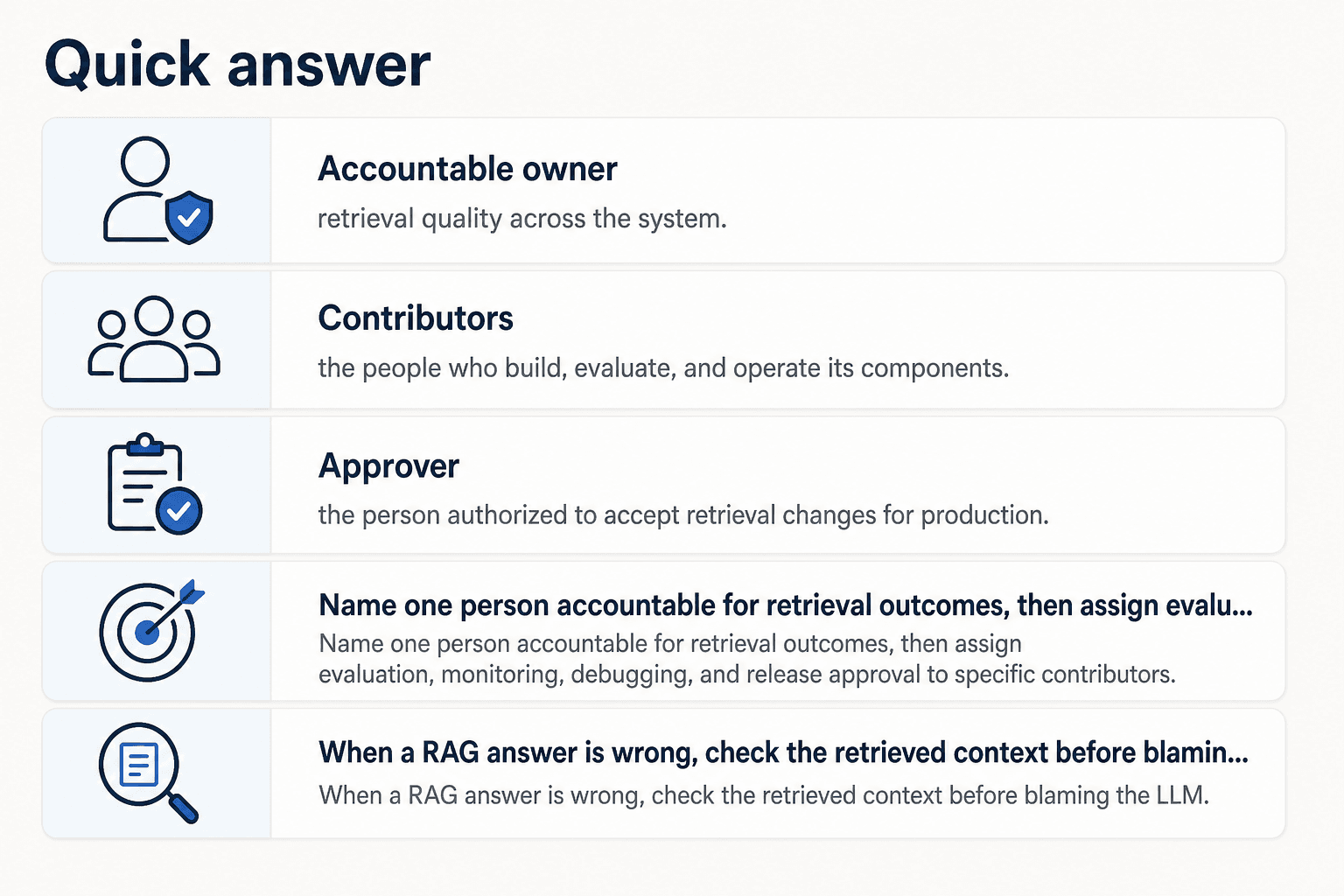
- Accountable owner: retrieval quality across the system.
- Contributors: the people who build, evaluate, and operate its components.
- Approver: the person authorized to accept retrieval changes for production.
Who owns retrieval quality on your team?
One person should be accountable for retrieval quality, while AI, retrieval, data, ML, and product contributors each own parts of the work. Retrieval quality means your system supplies relevant, current, permitted context quickly enough and at a cost you can accept for the task.
What retrieval quality includes: relevance, coverage, freshness, permissions, latency, and cost
This is broader than search relevance. Coverage asks whether the system can find needed sources, while freshness asks whether they are current. Permissions, latency, and cost matter too. A fast answer from a source a user cannot access is still a retrieval failure.
Why a good LLM cannot repair missing or wrong source context
An LLM can phrase supplied context well, flag uncertainty, or decline to answer. It can't recover a document that wasn't retrieved, know a stale record is stale, or safely turn unauthorized context into an answer. Fluent output can hide the gap.
Accountable owner versus responsible contributors
Name one DRI to own the outcome, evaluation standards, and the call to stop a risky release. That person doesn't run every system. Data owners manage sources and access, retrieval and ML engineers tune retrieval, AI engineers handle application behavior, and product sets the task and trade-offs. Shared execution is not shared accountability.
How should retrieval ownership change as the team grows?
| Factor | Small startup | Larger team |
|---|---|---|
| Accountability | Name one person, even if they hold several roles. | Name one accountable owner across the contributing teams. |
| Operational work | Assign evaluation, monitoring, and debugging explicitly. Roles may overlap. | Assign those duties to named roles or teams, with clear handoffs. |
| Release approval | Identify who can approve retrieval changes for production. | Define an approval path that includes the accountable owner and required reviewers. |
| Tooling | Use tools to surface evidence, not to decide who owns outcomes. | Use tools for shared visibility, not to replace decision rights. |
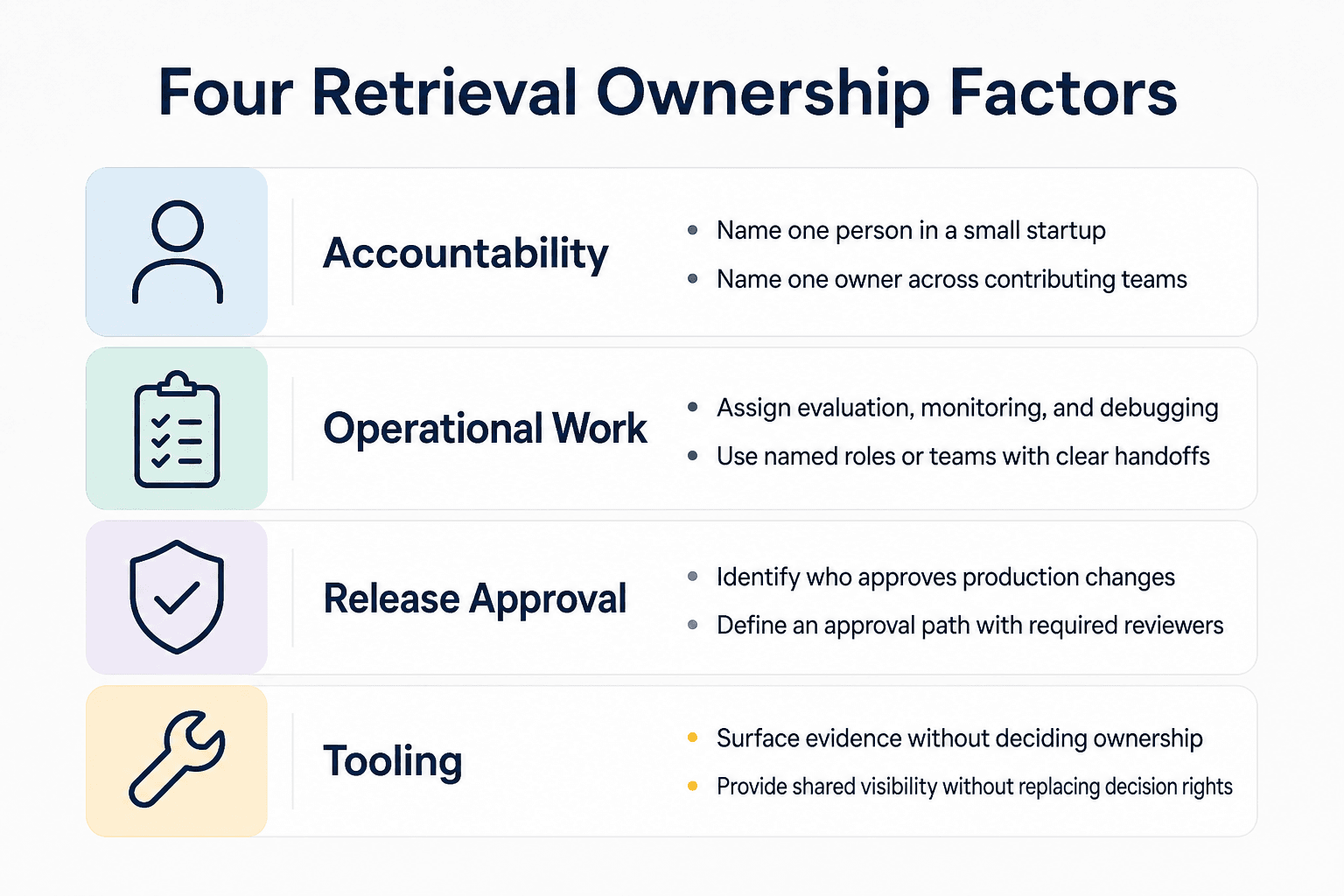
How retrieval quality ownership works across RAG roles
A DRI needs clear handoffs, not a vague promise that everyone cares. Each role should own decisions it can control, surface regressions it can see, and escalate trade-offs it can't settle alone.
[!tip] For an agent-memory failure, capture the memory candidates retrieved and the context passed to the model before changing prompts. This helps the team separate retrieval problems from generation problems.
AI engineers: application behavior, prompts, citations, and user-facing fallbacks
AI engineers own how retrieved context reaches the model, how answers cite it, and what happens when evidence is weak or absent. They can't fix a source that never entered the index. Make sure your fallback doesn't turn a no-result problem into a confident guess.
Retrieval engineers: indexing, query construction, ranking, reranking, and retrieval experiments
Retrieval engineers own the path from a user task to ranked candidates: chunking choices, query construction, search settings, ranking, reranking, and retrieval experiments. This is where you inspect why the right document lost. They can't decide which stale content should remain available or what user risk is acceptable.
Data engineers: source ingestion, document quality, metadata, freshness, and access-control inputs
Data engineers own reliable source ingestion, document structure, metadata, freshness signals, and the access-control inputs retrieval relies on. Bad metadata can make a good ranking system look broken. They can't judge whether retrieved context lets a user complete the intended task.
ML engineers: embedding and reranker evaluation, model changes, and experiment reliability
ML engineers should own sound evaluation for embedding and reranker changes, repeatable experiments, and model-version control. A model change may improve one retrieval measure while harming latency or permission-sensitive behavior. ML alone can't approve that trade-off.
Product teams: task success definitions, risk tolerance, user feedback, and release trade-offs
Product teams define what success means, which errors are unacceptable, and when user feedback signals a real failure rather than an edge case. They also choose between competing goals such as speed, cost, freshness, and answer coverage. Product can't diagnose an indexing fault from feedback alone.
Recommended model: one retrieval-quality DRI, named contributors, and a release approver
Name one retrieval-quality DRI. Give each contributor a written area to maintain, then name a release approver for changes that alter user risk. The DRI gathers the evidence, but the approver makes the ship-or-stop call when a retrieval change trades one failure mode for another.
Who owns retrieval quality on your team: a step-by-step guide
- Name one person accountable for retrieval quality across the user-facing system.
- List the retrieval stages your system depends on, such as indexing, retrieval, filtering, and context assembly.
- Assign a contributor to evaluate each relevant stage and record what evidence they use.
- Specify who monitors retrieval in production and who investigates reports of missing, stale, irrelevant, or unauthorized context.
- Define who approves retrieval changes and what checks are required before release.
- Write down an escalation path for cases where retrieval appears correct but the generated answer is still wrong.
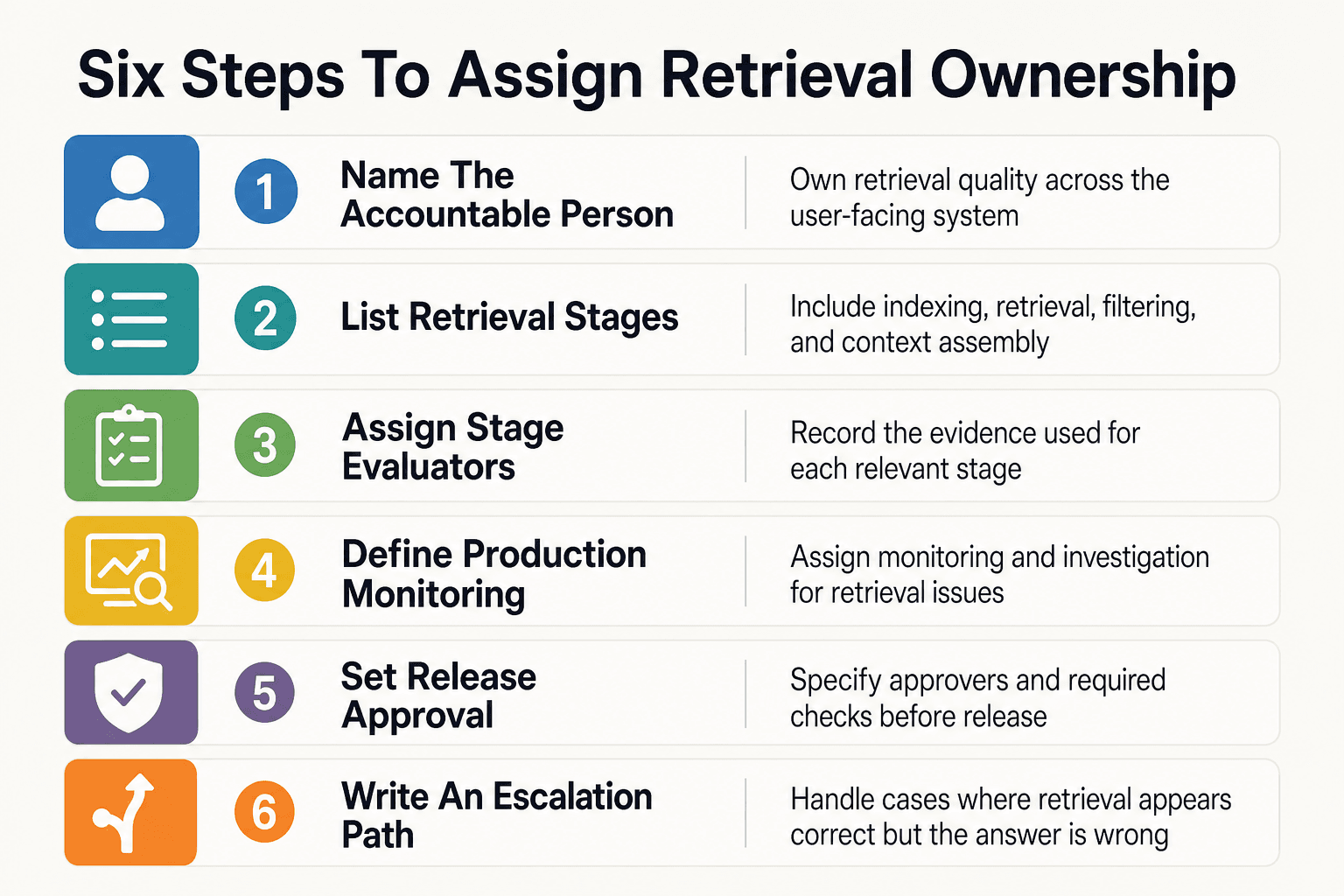
Set retrieval KPIs before you assign evaluation and release owners
Metrics without a decision owner become dashboard noise. Start by defining the signals that say retrieval is good enough for a user task, then assign who maintains each signal, who investigates a miss, and who can stop a release.
[!note] A retrieval-quality owner coordinates outcomes across the system. They don't need to implement every retrieval component or approve every change.
Offline KPIs: retrieval recall, precision at k, context relevance, source coverage, and permission correctness
Use an evaluation set with known tasks and acceptable source material. Measure recall, whether the needed source appears in the candidate set, and precision at k, whether high-ranked results are useful.
Also check context relevance, source coverage across task types, and permission correctness. A result that is relevant but visible to the wrong user is a failure.
Production KPIs: no-result rate, latency, retrieval cost, freshness failures, citation use, and task completion signals
Offline scores can't show every production problem. Monitor no-result rate, latency, retrieval cost, freshness failures, citation use where citations are part of the product, and task completion signals tied to the user's goal.
Keep the signals separate. A lower no-result rate isn't a win if it comes from returning weak or unauthorized context.
Who owns the evaluation set, metric definitions, alert thresholds, and regression review
The retrieval-quality DRI should own metric definitions and the review rhythm. Retrieval, data, ML, and application contributors should maintain the evaluation cases and monitoring inputs that match their systems.
Name an escalation path. A permission failure goes first to the owner of access-control inputs, while a ranking regression goes to the retrieval owner. The DRI coordinates the user impact.
Release gates: what must improve, what may trade off, and when a change should not ship
Set release gates before the experiment starts. Define which measure must improve, which trade-off is allowed, and which failures block release regardless of a gain elsewhere.
Don't ship a change that weakens permission correctness or breaks a critical task. The release approver makes that call from the agreed evidence, not the loudest opinion.
Retrieval failures often get blamed on the LLM
A fluent wrong answer can start the wrong debate. If the system never found the needed evidence, changing the prompt or model may improve the wording while leaving the user-facing failure in place.
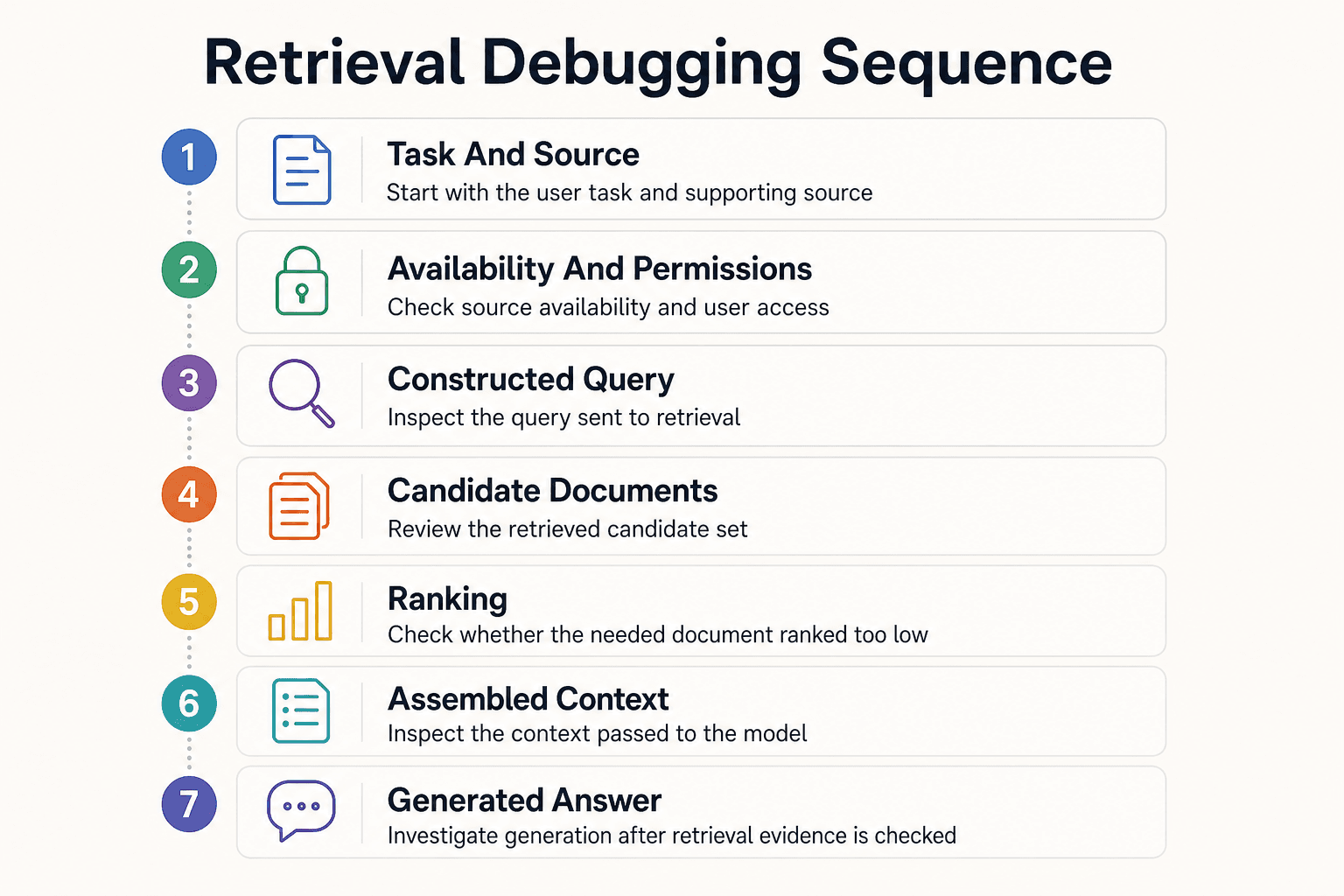
Scenario: the answer sounds fluent, but the relevant document was never retrieved
A user asks about a policy, and the assistant gives a plausible answer from older, less relevant material. The LLM may be following its context correctly. The failure started earlier: the right document was absent from the candidate set, ranked too low, filtered out, or never indexed.
Check retrieval before rewriting prompts. You need the query, retrieved candidates, ranks, and final context to see where the evidence disappeared.
Scenario: an agent remembers an outdated fact because memory selection or expiry is wrong
Agent memory has the same problem. A system can select an old preference, decision, or account detail because the memory rule favors similarity over recency, or because expired records remain eligible for retrieval.
The answer may sound consistent. It isn't current.
Scenario: a data-source or metadata change quietly damages retrieval after launch
A source migration can change document IDs, fields, access tags, or update times without changing the chat interface. If no one watches source availability, freshness, and permission results after release, retrieval can degrade quietly until users report bad answers.
Deployment isn't the finish line.
Debugging sequence: inspect task, source availability, permissions, query, candidates, ranking, context, and generation
Start with the user's task and the source that should support it. Then inspect source availability, permissions, the constructed query, candidate documents, ranking, assembled context, and only then the generated answer.
That order matters. It stops the team from treating generation as the cause when the model received incomplete, stale, or forbidden evidence.
What tools can provide: evidence and observability, not accountability or a release decision
Tools can log queries, compare rankings, flag missing sources, and show regressions. They can't decide whether a freshness trade-off is acceptable, who fixes a broken metadata feed, or whether a risky change should ship.
The retrieval-quality DRI still needs to call the owner, review the evidence, and involve the release approver when a failure affects users.
Assign retrieval ownership for a startup or a larger team
The main catch is that shared work can still produce no owner. Name the person who must bring the evidence together and make the call when retrieval quality conflicts with another goal.
Small startup: one technical DRI, one product partner, and a recurring retrieval review
Give one technical builder the DRI role, even if they also write application code. Pair them with a product partner who defines which failed tasks matter most. Review bad queries, stale sources, permission misses, latency, and cost on a fixed cadence.
Keep it light. A short recurring review is enough if decisions and follow-ups have named owners.
Larger team: accountable owner, RACI-style responsibilities, escalation path, and change-review cadence
Use a simple RACI-style map: one accountable retrieval-quality owner, responsible contributors for data, ranking, and application behavior, consulted security and product partners, and informed release stakeholders. Set an escalation path for access-control failures, source outages, and regressions that block release.
Resolve conflicts among relevance, freshness, latency, cost, access control, and product usefulness
It depends on what the user task requires and what risk the product can accept. Don't let lower latency or cost hide missing permissions or outdated evidence. The accountable owner should document the trade-off and ask the release approver to accept it.
A practical first-week checklist for assigning ownership
Name the DRI and release approver. List source, data, ML, application, and product contributors. Set the review cadence, escalation route, and release gate. Then answer "who owns retrieval quality on your team" in one visible document before the next failure forces the question.
Frequently asked questions
Who should be accountable for retrieval quality in a RAG team?
Choose one person accountable for retrieval outcomes across the system. Assign evaluation, monitoring, debugging, and release approval to named contributors or approvers so accountability doesn't depend on an assumed team boundary.
Can an AI engineer own retrieval quality without a dedicated retrieval engineer?
Yes, a team can assign an AI engineer as the accountable owner when no dedicated retrieval role exists. Make clear which people contribute to evaluation, production monitoring, and release decisions.
What retrieval quality metrics should a RAG team monitor?
Monitor measures that reflect your system's failure modes and user needs. These can include retrieval recall, precision at k, context relevance, source coverage, permission correctness, no-result rate, latency, retrieval cost, freshness failures, citation use, and task completion signals.
Who approves a retrieval pipeline change for production?
Assign a named person or role the authority to approve retrieval changes. Define the required checks and reviewers rather than assuming the implementer or retrieval owner has release authority.
How can you tell whether a RAG failure is caused by retrieval or the LLM?
Inspect the retrieved context and the context passed to the model. If relevant context is missing, stale, irrelevant, or unauthorized, investigate retrieval. If the context is appropriate but the answer is still wrong, investigate generation as well.
How should startups assign retrieval quality ownership?
Name one accountable owner and explicitly assign evaluation, monitoring, debugging, and release approval, even if one person covers multiple duties. Revisit assignments as the team and system change.
About GigaRAG
GigaRAG helps you share agent memory like you share Google Docs. It connects your AI agents to a central Hive Mind, with access controls for what each agent can use. Developers, vibe coders, and teams can keep project knowledge available across sessions and tools, so agents can pick up where work left off without rebuilding context or managing a full RAG stack.


