SLA Design for a Retrieval Service
SLA design for a retrieval service starts with a failure RAG pipeline and agent-memory builders know too well: the endpoint returns HTTP 200, yet the agent gets stale or incomplete context and gives a bad answer. That request counts as available. It isn't reliable in the way your users need.
SLAs are essentially the promise you make to your end users about how long a system will remain unavailable during an emergency.; SLOs are the internal targets you aim for, and SLIs are the measures that show whether either is being met. Uptime alone can't tell you if documents were missing, an index lagged, or a reranker timed out. The honest answer is that no SLA can guarantee perfect semantic relevance, zero stale results, or a correct model answer.
Process overview
A retrieval API can be available while still returning results that are slow, stale, incomplete, or irrelevant. Design the SLA to separate measurable service commitments from quality goals it can't guarantee.
- Define the user outcome and service scope.
- Choose separate measures for availability, latency, freshness, completeness, and relevance quality.
- Set illustrative targets and terms based on your requirements and observed performance.
- Specify how measurements, incidents, and remedies differ by audience.
SLA design for a retrieval service: define the outcome first
A retrieval SLA can't promise perfect relevance, complete context, or zero lost data. It can promise how the service will measure and respond to defined failures.
What an SLA, SLO, and SLI each mean
SLAs are essentially the promise you make to your end users about how long a system will remain unavailable during an emergency. An SLO is the target you operate toward. An SLI is the measured signal, such as successful retrievals within a stated time. SLIs make the target checkable.
Why retrieval uptime is not retrieval usefulness
HTTP 200 only shows the endpoint answered. It doesn't show that needed documents were searchable, filters worked, or reranking returned useful context. A reachable API can still feed an agent stale or incomplete evidence. That distinction changes what you monitor.
Set the service boundary: query, retrieval, reranking, and index state
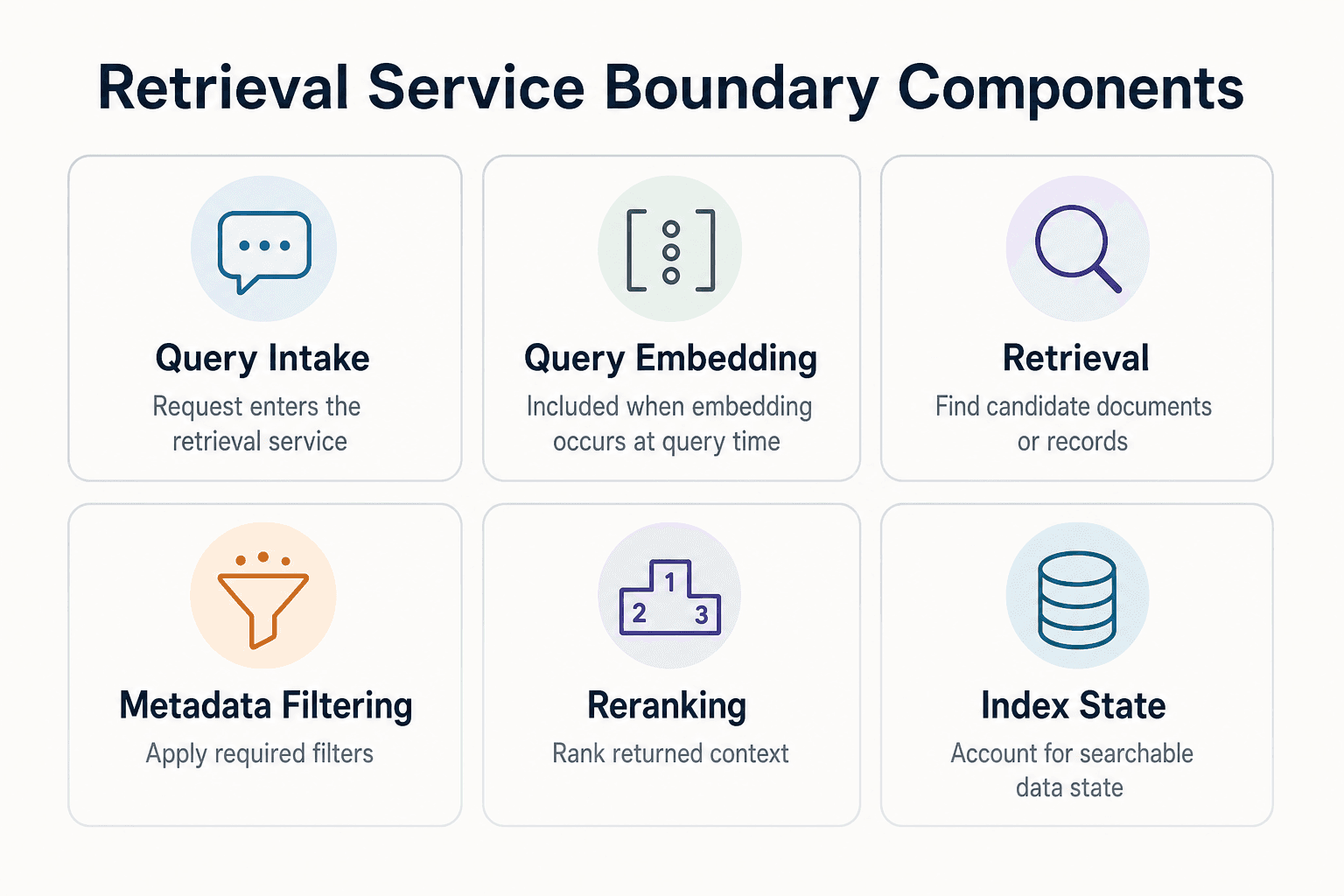
Draw the request path before choosing a target: query intake, embedding when it occurs at query time, retrieval, metadata filtering, reranking, and index state. Name dependencies and exclusions, including customer-side data feeds. Say who owns each handoff during an incident.
What the SLA cannot promise: perfect relevance or zero data loss
Relevance depends on the query, corpus, embeddings, ranking rules, and user judgment. Track evaluation quality and data loss separately, but don't guarantee perfect meaning or zero loss. Those outcomes aren't fully under service control.
Internal retrieval SLO vs customer-facing SLA
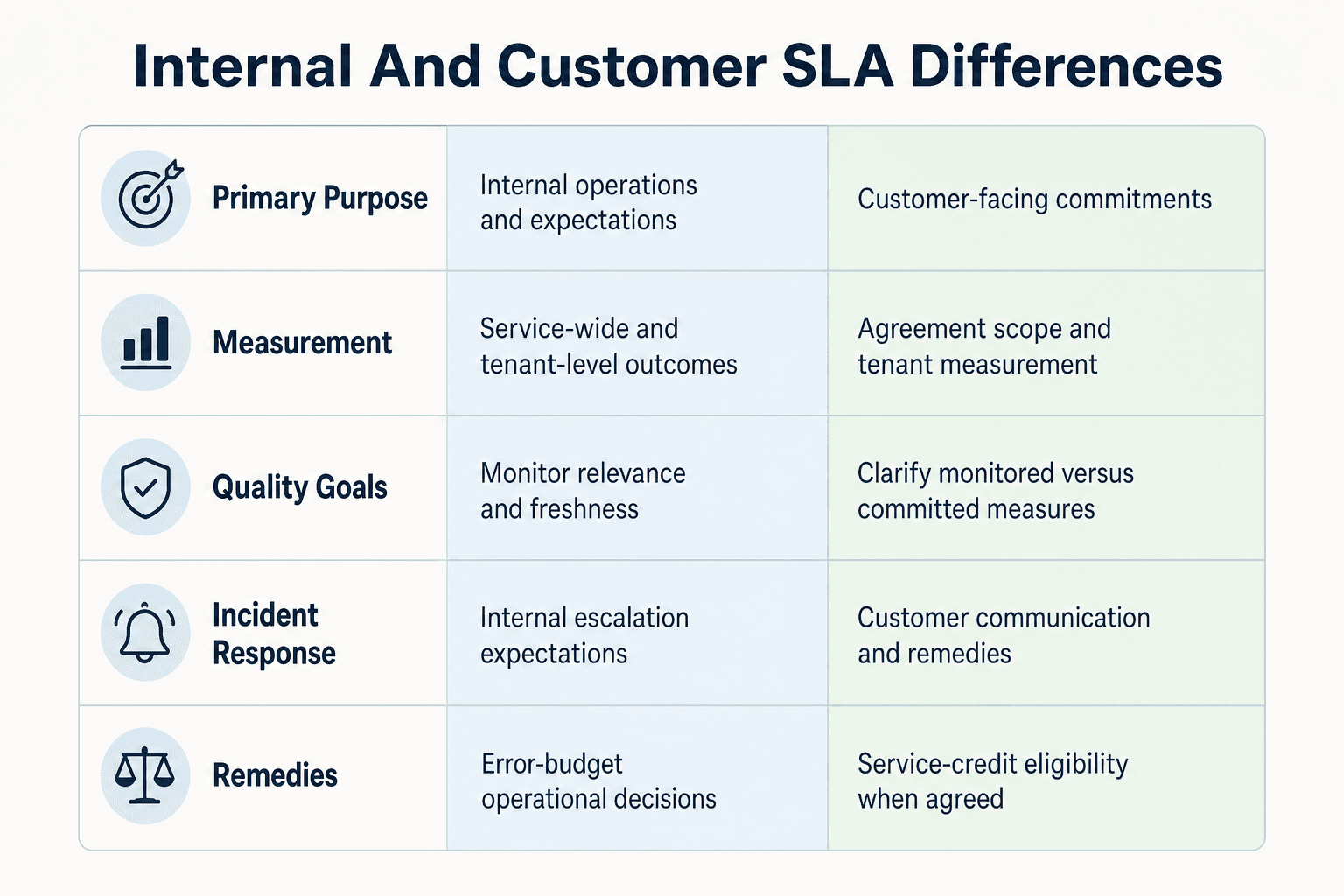
| Factor | Internal platform users | External customers |
|---|---|---|
| Primary purpose | Guide platform operations and internal expectations | Define customer-facing service commitments |
| Measurement | Track service-wide and, where useful, tenant-level outcomes | Define scope and tenant-level measurement in the agreement |
| Quality goals | Monitor relevance and freshness as goals, not guarantees | Clarify which quality measures are monitored versus contractually committed |
| Incident response | Set escalation and communication expectations with internal teams | Document customer communication and any agreed remedies |
| Remedies | Use error-budget or prioritization decisions to guide operational work | Specify whether service credits apply and how eligibility is assessed |
Step 1: Choose retrieval SLIs that expose real failures
Start with observable failures. A single uptime number can hide slow queries, stale indexes, failed filters, and empty result sets that still return HTTP 200.
Availability versus successful query handling
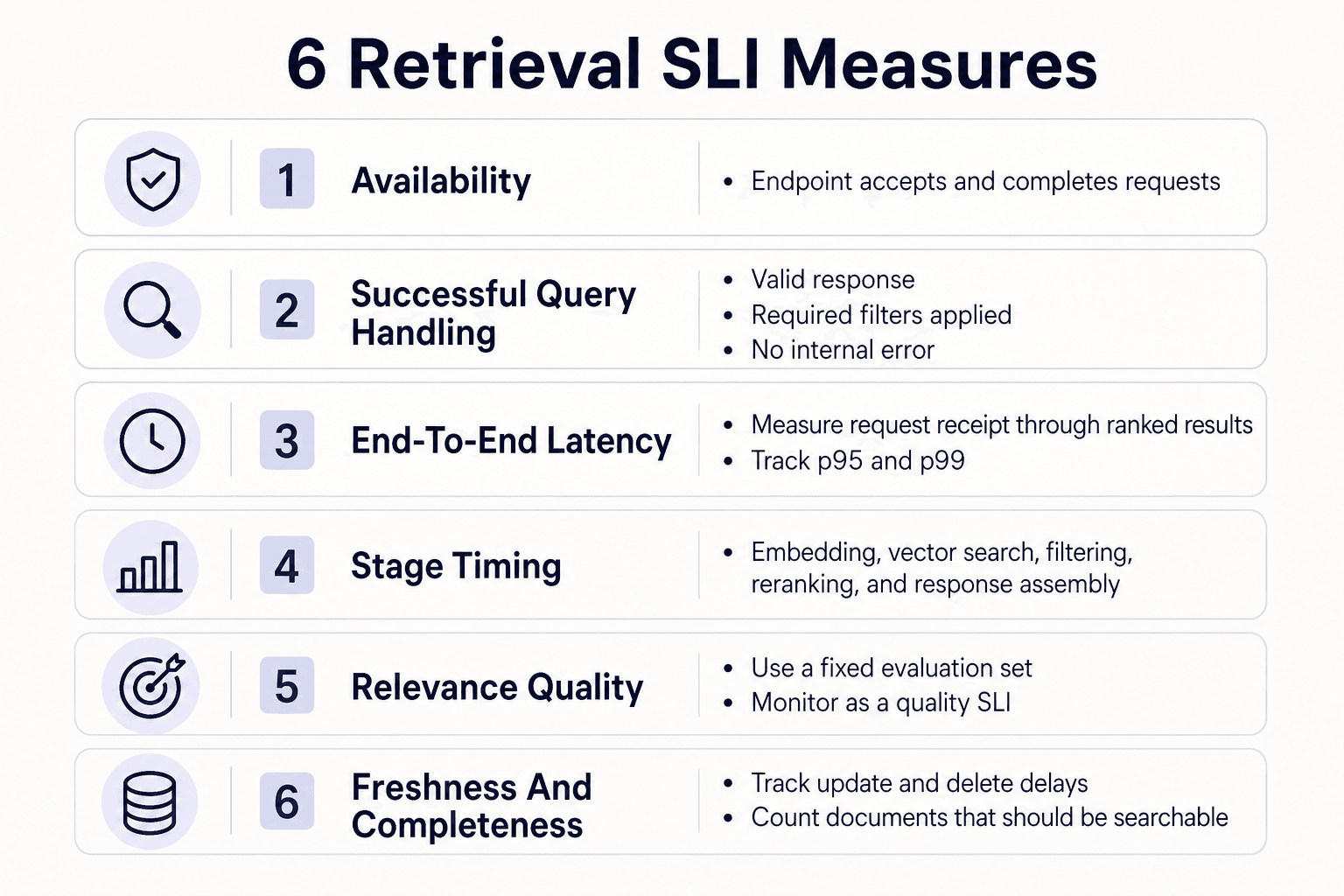
Measure availability as whether the retrieval endpoint accepts and completes requests. Track successful query handling separately: the request must return a valid response, apply required filters, and avoid an internal error. A live endpoint isn't enough.
Measure p95 and p99 end-to-end latency, not only API response time
Use end-to-end latency from request receipt to ranked results returned. Track p95 for the slow tail most users notice, and p99 for rare but painful delays that can break agent workflows. Don't rely on an average.
Break down embedding, vector search, filtering, and reranking delays
Record timing for each stage: query embedding, vector search, metadata filtering, reranking, and response assembly. An end-to-end breach tells you a user was delayed, but stage timing tells you which dependency or workload caused it.
Track relevance quality without treating it as a hard availability promise
Use a fixed evaluation set to monitor whether expected documents appear in the returned results. Keep this as a quality SLI, not an availability guarantee. Relevance changes with the corpus, query mix, and ranking design.
Measure freshness, delayed updates, delayed deletes, and missing documents
Track time from an accepted update to searchability, and separately track time from a delete request to removal from results. Count documents that should be searchable but aren't. A result can be relevant and still be wrong because its source is old.
When to calculate SLIs per tenant, index, region, or query class
It depends on where workloads differ. Calculate separate SLIs when one tenant, index, region, or query class can suffer without shifting the aggregate enough to trigger an alert. Keep interactive reads apart from batch indexing because their failure patterns and user impact aren't the same.
SLA design for a retrieval service: a step-by-step guide
- Identify the retrieval workflows, users, tenants, and dependencies in scope.
- Define how each request is counted and what qualifies as a successful retrieval.
- Choose separate indicators for availability, latency, freshness, completeness, and relevance.
- Use observed service behavior and user needs to propose clearly labeled illustrative targets.
- Separate contractual commitments from monitored quality goals and state exclusions explicitly.
- Document tenant-level reporting, incident escalation, and any service-credit decision rules.
- Review measurements and terms with the teams responsible for operating and consuming the service.
[!note] An availability commitment describes whether the service responds under agreed measurement rules. It doesn't by itself guarantee relevant, complete, fresh, or semantically correct content.
Step 2: Turn SLIs into realistic SLOs, budgets, and terms
An SLI only tells you what happened. An SLO states the outcome you aim to meet over a stated window, while an SLA is the narrower promise you can defend to customers.
[!tip] For an internal platform, agree with each consuming team on the retrieval workflow and failure definition before setting targets. For customer-facing use, write down how results and any remedies are assessed per tenant.
Use illustrative targets, not copied universal numbers
Don't copy another team's numbers. Your targets depend on query volume, corpus size, regions, dependencies, and what a delayed or stale result costs your users.
Example target set: availability, p99 latency, success rate, and ingestion-to-searchability delay
Start with labeled examples: 99.9% monthly availability, p99 retrieval latency below 2 seconds, 99.5% successful query handling, and 95% of accepted updates searchable within 15 minutes. These are illustrative, not universal benchmarks.
Set separate targets for interactive RAG, batch indexing, and agent-memory reads
Interactive RAG needs prompt results. Batch indexing can often tolerate longer completion windows, while agent-memory reads may need a tighter latency target if each delay blocks a workflow.
Internal SLOs versus customer-facing SLA commitments
Set internal SLOs first. They can cover stage timings, relevance checks, and per-tenant performance you need for operations but can't safely promise in a contract. Keep external SLA terms measurable and narrow.
Error-budget rules and when feature releases should slow down
A 99.9% monthly availability SLO leaves a 0.1% error budget. Define what consumes it, such as failed requests or latency breaches, then set a rule: when the budget is nearly spent, slow risky releases until performance recovers.
Service credits, exclusions, and the cost of tighter recovery commitments
Service credits aren't always worth offering. Exclude planned maintenance, customer-side faults, and dependencies outside your boundary, and measure any commitment per tenant where possible. The closer you get to a zero-loss number in RTO and RPO, the higher the cost of the overall solution., so promise only what your architecture and budget can sustain.
Step 3: Measure, escalate, and troubleshoot the full retrieval path
A green API check isn't enough. You need evidence that a known document can enter the pipeline, become searchable, survive filters and reranking, and return within the expected time.
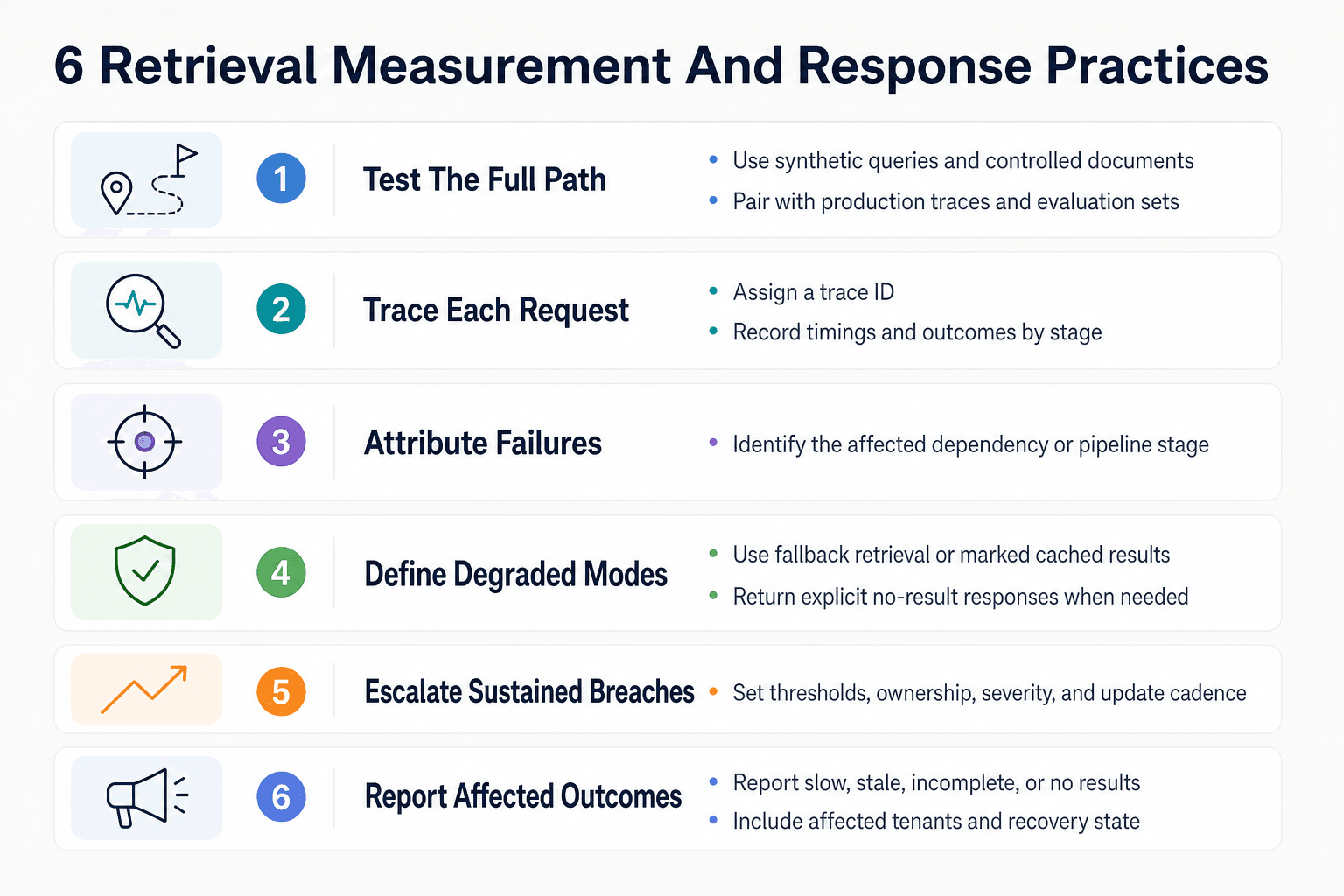
Instrument synthetic queries, production telemetry, and relevance evaluation sets
Run synthetic queries against controlled documents at each stage. Pair them with production traces and a fixed evaluation set, so you can spot a broken path without treating every unusual user query as an outage.
Attribute failures to the API, vector store, embedding provider, reranker, metadata filter, or ingestion pipeline
Give every request a trace ID. Record timings and outcomes for query embedding, vector search, metadata filtering, reranking, and index lookup. Record ingestion acceptance, embedding completion, and searchability separately.
Define degraded modes: fallback retrieval, cached results, or explicit no-result responses
Don't hide degradation behind HTTP 200. A fallback lexical search or clearly marked cached result may be useful. If neither can meet the need, return an explicit no-result response rather than stale context.
Escalation policy: alert thresholds, ownership, severity, and update cadence
Alert on sustained breaches, not one slow request. Assign an owner for each dependency, define severity by affected tenant outcome, and set an update cadence before an incident starts.
Troubleshoot high latency, stale results, missing documents, and tenant-specific regressions
Start with the affected stage. High latency may sit in reranking or an embedding backlog; stale results point to ingestion or index delay; missing documents may be a filter, delete, or tenant-isolation fault.
Report incidents by affected outcome, not only by infrastructure status
Report how many tenants received slow, stale, incomplete, or no results, plus the time window and recovery state. That gives customers the impact they need to judge their own response.
Put the retrieval SLA into practice
Don't publish a promise because it sounds reassuring. Start with outcomes you can measure, ownership you can name, and exclusions your customers can understand.
A first-draft SLA checklist
Define the request path, affected tenants, and reporting window. Commit to availability, successful handling, latency, and freshness only where your telemetry can measure them. State what isn't covered: perfect relevance, every unusual query, and failures in excluded dependencies. Keep internal quality goals separate from customer terms.
Review targets after workload and incident evidence
Run the draft against real query classes, ingestion volume, and incidents before making it contractual. Tighten a target only when you understand its cost and the dependency limits behind it. Good SLA design for a retrieval service changes with evidence, not wishful numbers.
Frequently Asked Questions
What is an SLA for a retrieval service?
It is an agreement defining the service scope, measurable commitments, and how performance or incidents are assessed. For retrieval, make clear which measures are contractual and which are operational quality goals.
How is retrieval availability different from general application uptime?
An available endpoint may still return results that are slow, stale, incomplete, or irrelevant. Define availability using explicit request and success criteria, then measure those other outcomes separately.
Should a retrieval SLA guarantee relevance or answer quality?
Avoid promising perfect relevance or semantic correctness. State which quality measures you monitor, how you evaluate them, and whether they are goals rather than contractual guarantees.
What p95 and p99 latency metrics should a RAG service track?
Choose percentile measures that match the service's user experience and define the request scope, measurement window, and service boundary. Set illustrative targets using your requirements and observed performance rather than treating a generic value as universal.
How should an SLA measure stale or missing retrieval results?
Define what freshness and completeness mean for the data and workflow in scope, then specify how each is measured. Keep these measures distinct from endpoint availability and document upstream dependencies that affect them.
What is the difference between a retrieval SLO and an error budget?
An SLO is an internal target for a defined service measure. An error budget is an operational way to reason about how much measured failure is compatible with that target. Document how your team uses it rather than treating it as a customer remedy.
Should internal and customer-facing retrieval services have different guarantees?
They can have different commitments because their users, operational expectations, and remedies differ. Define scope and measurement for each audience, including whether outcomes are assessed per tenant.
About GigaRAG
GigaRAG helps you share agent memory like you share Google Docs. It connects your AI agents to a central Hive Mind, with access controls for what each agent can use. Developers, vibe coders, and teams can keep project knowledge available across sessions and tools, so agents can pick up where work left off without rebuilding context or managing a full RAG stack.


