Retrieval Strategies Explained: A Practical Guide for RAG and Agent Memory Builders
Retrieval strategies explained for RAG pipeline builders and agent memory developers starts with a distinction most guides skip. When educators say "retrieval strategies," they mean flashcards and spaced recall for human learners. When you say it, you mean how a system finds the right chunks of knowledge to feed a model before it generates an answer. That's the version this guide covers. The honest answer is that retrieval strategies alone won't save a broken pipeline. Bad embeddings stay bad. Context windows stay limited. No re-ranking trick fixes dirty data. What they do is determine whether your system pulls the right context or the wrong context, and that's the whole game. GigaRAG handles much of this under the hood for agent memory and RAG pipelines, but you still need to know what's happening behind the scenes.
| At a glance | Details |
|---|---|
| Primary focus | RAG pipelines and agent memory |
| Core idea | Match retrieval strategy to query and data |
| Common strategies | Dense, sparse, hybrid, reranking, multi-hop |
| Key trade-off | Recall vs. latency and cost |
| Biggest limitation | Cannot fix missing or poorly chunked data |
| Evaluation essential | Measure retrieval quality before generation |
In This Guide
- What Are Retrieval Strategies?
- Dense Retrieval vs. Sparse Retrieval: Which Should You Use?
- The Core Retrieval Strategies for RAG Pipelines
- Retrieval Strategies Explained: A Step-by-Step Guide
- Retrieval Strategies for Agent Memory Systems
- How to Implement Retrieval Strategies Step by Step
- Common Mistakes When Implementing Retrieval Strategies
- What You Cannot Do with Retrieval Strategies
- How to Choose the Right Retrieval Strategy
- Example: Retrieval-Based Learning in a RAG Pipeline
- Final Thoughts on Retrieval Strategies Explained
What Are Retrieval Strategies?
Retrieval strategies are the rules and techniques a system uses to find and return relevant information from a knowledge base when a query arrives. In RAG and agent memory, they decide what gets pulled into the context window and what stays out.
Cognitive retrieval vs. computational retrieval
Cognitive retrieval practice is a learning technique: you force yourself to recall information from memory, and that act of recall strengthens the memory. It's about humans getting better at remembering.
Computational retrieval is different. The system isn't trying to learn. It's trying to find. A retrieval strategy in a RAG pipeline is a set of decisions: how to encode the query, how to score candidate chunks, how many to return, and in what order. The goal is relevance, not retention.
The role of retrieval in RAG pipelines
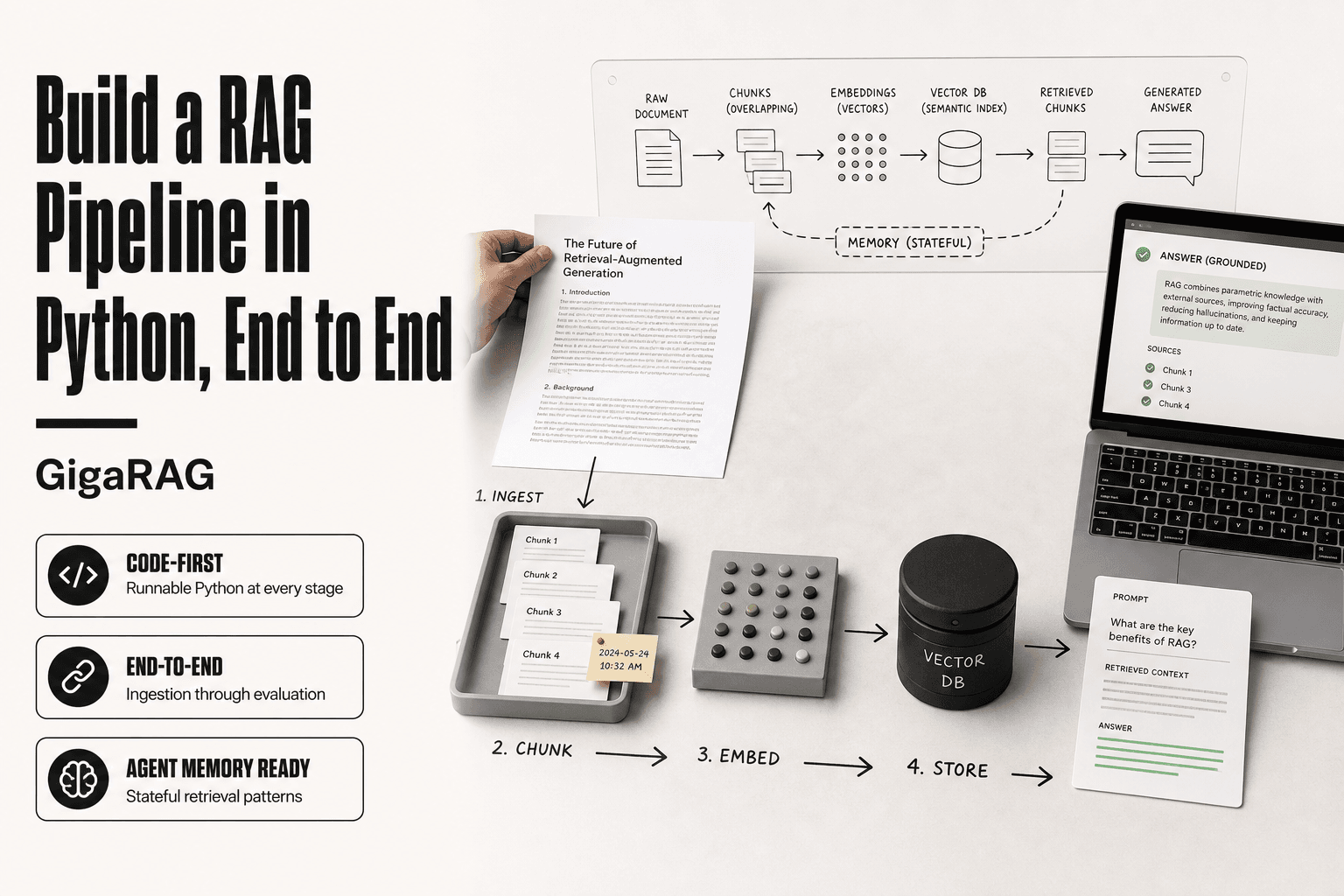
A RAG pipeline has three stages: retrieve, augment, generate. Retrieval is the first and most fragile. If the wrong chunks come back, the generator produces a confident answer built on irrelevant text. Retrieval quality sets a ceiling on everything downstream. You can't generate your way out of a bad retrieval.
The role of retrieval in agent memory
Agent memory systems use retrieval differently. Instead of answering a single query, the agent retrieves past interactions, task outcomes, and learned preferences to inform ongoing behaviour. The retrieval strategy here decides what the agent "remembers" at any given moment. Memory that's never retrieved might as well not exist.
[!note] Retrieval strategies for RAG are not the same as cognitive retrieval practice in education; the former is about computational search over a knowledge base, while the latter is a learning technique for humans.
Dense Retrieval vs. Sparse Retrieval: Which Should You Use?
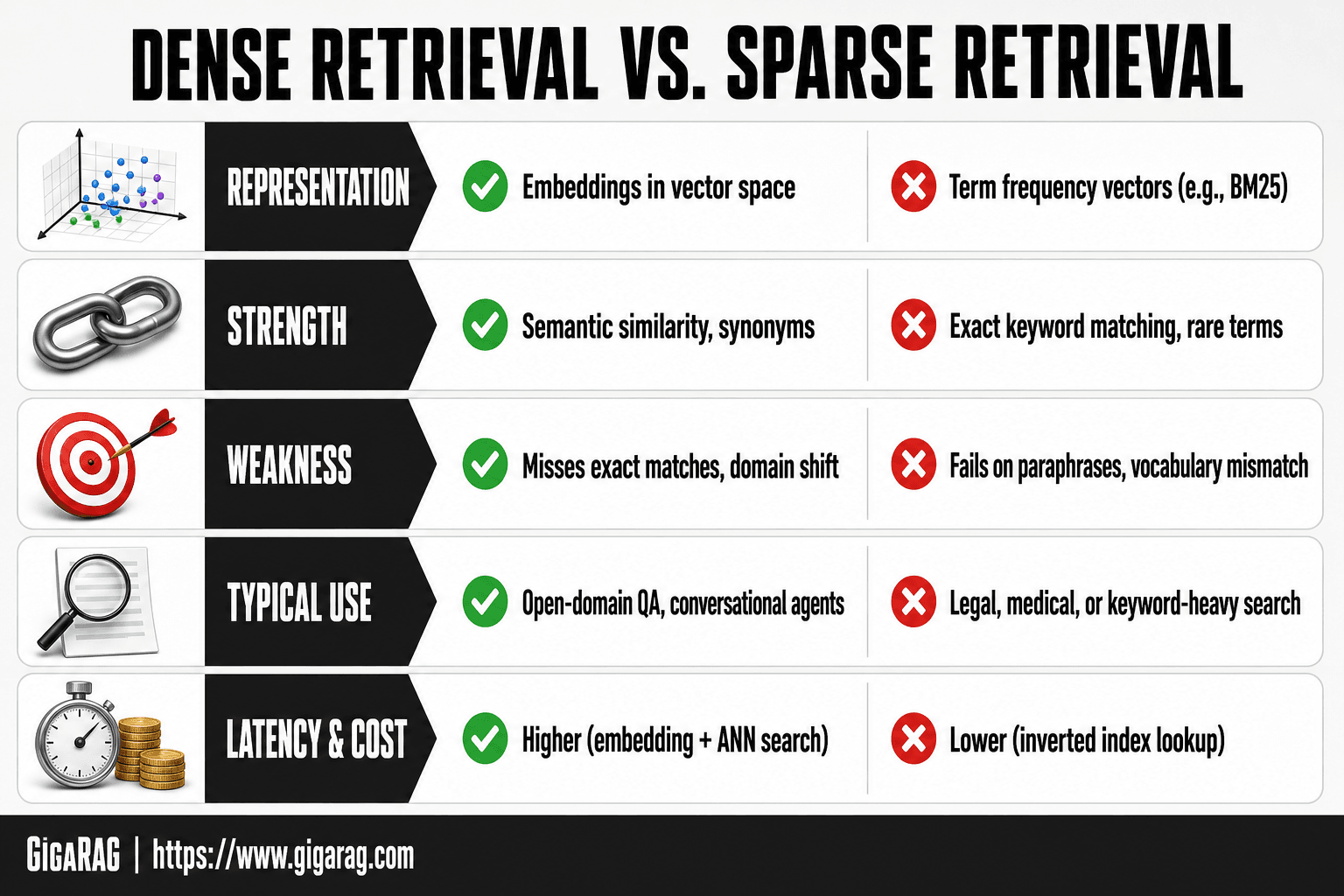
| Factor | Dense Retrieval | Sparse Retrieval |
|---|---|---|
| Representation | Embeddings in vector space | Term frequency vectors (e.g., BM25) |
| Strength | Semantic similarity, synonyms | Exact keyword matching, rare terms |
| Weakness | Misses exact matches, domain shift | Fails on paraphrases, vocabulary mismatch |
| Typical use | Open-domain QA, conversational agents | Legal, medical, or keyword-heavy search |
| Latency & cost | Higher (embedding + ANN search) | Lower (inverted index lookup) |
The Core Retrieval Strategies for RAG Pipelines
Four strategies cover most production systems. You'll combine them more often than you'll pick one.
Dense retrieval with embeddings
Dense retrieval turns text into vectors using an embedding model. The query becomes a vector, each chunk becomes a vector, and you return the chunks with the highest cosine similarity to the query. It catches semantic matches: "how do I reset my password" retrieves chunks about password recovery even when the words don't overlap.
The catch is precision. Dense retrieval returns plausible-sounding neighbours that aren't actually relevant. It also needs a decent embedding model. A weak model produces vectors that cluster by topic, not by meaning, and you get back noise.
Sparse retrieval with BM25
BM25 scores chunks by term frequency and inverse document frequency. Exact keyword matches win. It's fast, deterministic, and needs no training. For queries with rare, specific terms like error codes or product names, BM25 often beats dense retrieval outright.
It fails on paraphrase. Ask "how do I cancel my account" and BM25 won't surface a chunk that says "close your subscription" unless those words appear.
Hybrid search and reciprocal rank fusion
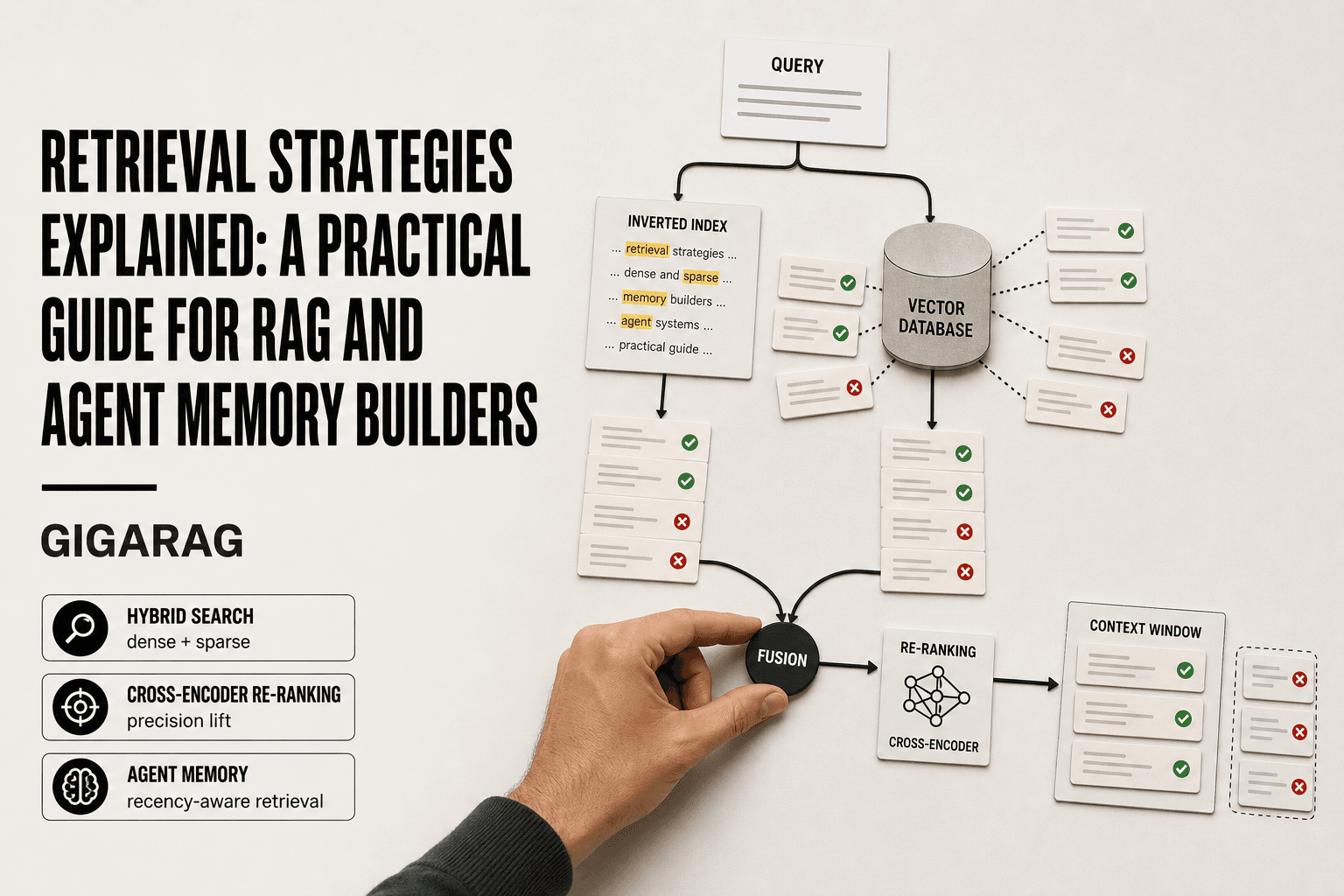
Hybrid search runs dense and sparse retrieval in parallel, then merges the results. Reciprocal rank fusion (RRF) is the simplest merge: score each chunk by the sum of 1/(rank + k) across both lists, with k typically 60. Chunks that rank high in both lists float to the top.
This fixes the main weakness of either method alone. You get semantic recall from dense and exact-match precision from sparse. The cost is latency: you run two retrieval passes per query.
Re-ranking with cross-encoders
A cross-encoder takes the query and a candidate chunk together, passes them through a transformer, and outputs a relevance score. It's much slower than a bi-encoder, so you only run it on the top 50 to 100 candidates from the first stage.
The gain is real. Cross-encoders catch relevance signals that cosine similarity misses because they attend to the query and chunk jointly. Expect a 10 to 20 point lift in precision at top-k in most pipelines. The trade-off is latency: re-ranking 100 candidates adds 50 to 200 milliseconds per query, depending on model size.
[!tip] For agent memory builders: log every retrieval query and its top results during development. This makes it easy to spot when the retriever is returning irrelevant chunks due to embedding mismatch or poor chunking, and to tune before scaling.
Retrieval Strategies Explained: A Step-by-Step Guide
- Define your retrieval goal: what queries will your system handle, and what does a correct answer look like?
- Choose a baseline strategy: start with dense retrieval using a pre-trained embedding model, or sparse retrieval if exact terms matter.
- Chunk your documents thoughtfully: test different chunk sizes and overlaps, and consider semantic chunking for structured content.
- Add a reranker: use a cross-encoder to reorder top candidates and improve precision before generation.
- Evaluate retrieval quality: measure recall@k and mean reciprocal rank (MRR) on a labeled query set.
- Iterate with hybrid or multi-hop: if baseline fails on specific query types, combine dense and sparse or add query decomposition.
- Monitor in production: track retrieval latency, hit rate, and user feedback to detect drift and adjust.
Retrieval Strategies for Agent Memory Systems
Agent memory changes the retrieval problem. A RAG pipeline retrieves from a static corpus. An agent retrieves from its own accumulated experience, and that experience changes every turn.
Episodic vs. semantic memory in agents
Episodic memory stores specific events: what the user asked, what the agent did, what happened next. Semantic memory stores distilled facts: user preferences, learned rules, stable knowledge about the domain.
Retrieval differs for each. Episodic retrieval is time-sensitive and context-heavy. You want the most recent relevant interaction, not the most semantically similar one. Semantic retrieval works like standard RAG: embed the fact, match by meaning, return the closest chunk.
The honest answer is most agents need both. Episodic memory handles "what did I tell you last week about my budget." Semantic memory handles "what do I know about this user's preferences." They live in separate stores and use separate retrieval paths.
Memory consolidation and retrieval timing
Consolidation is the step most builders skip. Raw interactions pile up, and retrieval quality degrades because the store fills with noise.
Consolidation means periodically summarizing raw episodes into semantic facts. A nightly job takes the day's interactions, extracts durable statements, and writes them to the semantic store. The episodic store keeps the raw log for a retention window, then drops or archives it.
Timing matters. Consolidate too often and you burn compute on trivial updates. Too rarely and the semantic store goes stale. Daily works for most agent workloads. Real-time consolidation is rarely worth it.
Retrieval cues and context windows
Agents retrieve with cues, not just queries. A cue includes the current user message plus recent conversation state, active goals, and any constraints the agent is operating under. This cue becomes the retrieval query.
The context window is the hard limit. Whatever you retrieve has to fit alongside the system prompt, the conversation history, and the agent's working memory. Retrieving 20 chunks when the window holds 8 means truncation, and truncation means the agent acts on partial information.
Keep retrieved context small. Three to five chunks is a working default for agent memory. More than that and you're trading recall for coherence.
How to Implement Retrieval Strategies Step by Step
You can implement a working retrieval pipeline in an afternoon. A good one takes longer. The steps below assume you're building from scratch, not retrofitting an existing system.
Step 1: Chunk your documents
Chunking is the first decision, and it's the one most people get wrong. Split documents into pieces small enough to fit your context window but large enough to carry meaning. A paragraph is a reasonable default. A sentence is usually too small. A full page is too big.
Overlap matters. If you split at 500 tokens, add 50 tokens of overlap so a concept spanning the boundary doesn't get cut in half. Test different sizes. The right chunk size depends on your documents, not on a blog post.
Step 2: Choose an embedding model
Start with a general-purpose model. Something like OpenAI's text-embedding-3-small or a comparable open model handles most English text well enough. Don't fine-tune until you have a baseline.
The model determines your vector dimensions. That's a one-way door. Changing embedding models later means re-embedding your entire corpus. Pick carefully, then stick with it.
Step 3: Set up your vector database
Any mainstream vector database works: Pinecone, Weaviate, Qdrant, pgvector. The database is not where retrieval quality is won or lost. It's plumbing.
Store the chunk text, the embedding, and metadata. Metadata is what lets you filter later. Document ID, source, date, section heading. You'll need it for hybrid search and debugging.
Step 4: Implement hybrid search
Dense retrieval alone misses exact matches. Sparse retrieval alone misses paraphrases. Run both and merge the results.
Reciprocal rank fusion is the simplest merge: take the rank of each result in both lists, combine them, sort by the combined score. It's not fancy. It works.
Step 5: Add re-ranking
Retrieve 50 candidates, re-rank the top 20 with a cross-encoder, keep the top 5. The cross-encoder reads the query and document together, so it's slower but more accurate than the bi-encoder that produced the initial results.
Re-ranking is where most of the quality gain comes from. Don't skip it.
Step 6: Evaluate with precision and recall
Precision measures how many retrieved chunks are actually relevant. Recall measures how many relevant chunks you found. Both matter, and they trade off against each other.
Build a small test set: 50 to 100 queries with known relevant chunks. Run your pipeline, compute both metrics, and track them every time you change a parameter. Without this, you're guessing.
Common Mistakes When Implementing Retrieval Strategies
Most retrieval failures aren't exotic. They come from four predictable mistakes, and each one is fixable before you ship.
Poor chunking strategy
Chunk size is the first decision, and the most common error is treating it as an afterthought. Chunks that are too large bury the relevant sentence inside a wall of irrelevant text. Chunks that are too small strip context and leave the embedding model guessing. There's no universal size. It depends on your documents: legal contracts need larger chunks than FAQ entries. Test three sizes on a small sample before committing.
Ignoring metadata filtering
Metadata is not optional plumbing. It's the difference between retrieving "something about pricing" and "the pricing page for the enterprise tier, updated last month." When you skip metadata, you force the vector search to do work it's bad at. Filter by date, source, document type, or customer tier before you run semantic search. The filter narrows the candidate pool. The embedding ranks what's left.
Over-relying on dense retrieval
Dense retrieval is good at paraphrase. It's bad at exact matches: product codes, error numbers, proper names. If your corpus contains SKUs or API error strings, dense-only search will miss them. Run BM25 alongside your embeddings. Hybrid search costs a little more latency and buys back the exact-match failures.
Neglecting evaluation metrics
You can't improve what you don't measure. Precision and recall on a 50-query test set take an afternoon to build and catch regressions before your users do. Skip this, and every tuning decision is a guess.
What You Cannot Do with Retrieval Strategies
Retrieval strategies are not a repair kit. They route queries to stored content. They don't fix what's already broken upstream, and they don't stretch what the model can hold.
Cannot fix bad embeddings
If your embedding model doesn't understand your domain, no retrieval strategy saves you. A medical corpus embedded with a general-purpose model will return near-misses no matter how clever your hybrid search or re-ranking gets. The embeddings are the floor. Retrieval only sorts what the embeddings already captured. Swap the model before you tune the strategy.
Cannot overcome context window limits
You can retrieve the top 50 chunks, but the model can only read so many tokens. Retrieval narrows the candidate set. It doesn't expand the window. If the answer needs 40,000 tokens of context and your model holds 8,000, you're truncating or summarizing, and that's a generation problem, not a retrieval one.
Cannot guarantee relevant results
Retrieval returns what's most similar to the query. Similar isn't the same as correct. A well-tuned pipeline still returns irrelevant chunks 5 to 10 percent of the time. Re-ranking reduces the error rate. It doesn't eliminate it. Plan for fallbacks: a "no good match" threshold, a clarification prompt, or a human handoff.
Cannot replace good data hygiene
Duplicate documents, stale pages, and contradictory entries poison retrieval before the first query runs. If your knowledge base says two different things about the same policy, retrieval will happily surface both. The strategy doesn't know which one is true. Clean the source data first. Then retrieval has something worth finding.
How to Choose the Right Retrieval Strategy
The right strategy depends on four things: what you're building, what your data looks like, how fast you need answers, and how wrong you can afford to be.
Use case: question answering vs. agent memory
Question answering is stateless. Each query stands alone, so dense retrieval with re-ranking works well. Agent memory is stateful. The agent needs to recall past interactions, user preferences, and decisions it made three turns ago. That requires retrieval cues tied to the current context, not just semantic similarity to the query. Build memory retrieval around recency and relevance scores, not raw embedding distance.
Data type: structured vs. unstructured
Structured data (product catalogs, user records, transaction logs) calls for metadata filtering first, retrieval second. Filter by category, date, or status before you run vector search. Unstructured data (docs, tickets, chat logs) needs chunking and embedding, with hybrid search to catch exact terms like error codes or SKUs that embeddings blur.
Latency vs. accuracy trade-offs
Dense retrieval is fast: 10 to 50 milliseconds per query on typical vector databases. Adding re-ranking with a cross-encoder adds 50 to 200 milliseconds per candidate. If you're serving a chatbot, that's fine. If you're doing real-time agent decisions, skip re-ranking or cap candidates at 20.
When to use hybrid search vs. dense only
Use dense only when your corpus is homogeneous and your queries are conversational. Use hybrid when your data contains identifiers, jargon, or rare terms that embeddings miss. Hybrid costs more to run. It's worth it when precision matters more than speed.
Example: Retrieval-Based Learning in a RAG Pipeline
Here's a concrete example. It shows how the pieces fit together, not a tutorial you can copy line by line.
Scenario: building a customer support agent
You're building a support agent for a SaaS company with 4,000 help docs, 12,000 past tickets, and a product that changes every two weeks. Users ask things like "why did my invoice fail" and "can I change my plan mid-cycle." The agent needs to pull the right doc, the right past ticket, and the right policy, then answer in one shot.
Chunking and embedding the knowledge base
You split each help doc into chunks of 300 to 500 tokens with 50-token overlap. Past tickets get chunked the same way, but you add metadata: product area, plan tier, ticket status, resolution date. You embed everything with a model like text-embedding-3-small and store it in a vector database with a BM25 index alongside.
Retrieval and re-ranking in action
A user asks: "I upgraded to Pro last week but my invoice still shows Basic."
The pipeline runs hybrid search: BM25 catches "invoice" and "Pro" as exact terms, dense retrieval catches the semantic idea of a plan change not reflected in billing. You merge results with reciprocal rank fusion, take the top 30, then re-rank with a cross-encoder. The top hit is a past ticket from another user with the same issue, resolved by a manual plan sync. The agent retrieves that ticket, the billing policy doc, and the upgrade FAQ, then answers with the fix and a link.
That's retrieval-based learning in practice: the system doesn't memorize answers. It retrieves the right context at query time and builds the response from it.
Final Thoughts on Retrieval Strategies Explained
Retrieval strategies are not a single choice. They're a stack: chunking, embedding, indexing, search, fusion, re-ranking. Each layer changes what comes back, and none of them can be tuned in isolation.
The honest answer is that most pipelines fail at the boring layers. Bad chunking destroys good embeddings. Missing metadata makes filtering impossible. Skipping evaluation means you never know if a change helped. The flashy parts, hybrid search and cross-encoder re-ranking, only pay off once the foundation is solid.
What you cannot expect: retrieval strategies won't fix a broken knowledge base, won't overcome a context window that's too small for the retrieved chunks, and won't guarantee the right answer every time. They improve the odds. That's the whole job.
If you're building agent memory or a RAG pipeline and want to skip the plumbing, GigaRAG handles chunking, embedding, hybrid search, and re-ranking in one platform. It won't make your data better, but it removes most of the integration work so you can focus on the retrieval strategy itself.
Frequently Asked Questions
What are retrieval strategies?
In the context of RAG and agent memory, retrieval strategies are the methods used to fetch relevant information from a knowledge base given a query. They include dense retrieval (embeddings), sparse retrieval (keyword-based), hybrid approaches, and multi-step techniques like reranking or multi-hop retrieval.
What are the best retrieval practice strategies?
There is no single best strategy; it depends on your data and queries. For semantic search, dense retrieval with a reranker often works well. For exact-match needs, sparse retrieval like BM25 is strong. Hybrid methods combine both and are a common robust choice.
What are the methods of retrieval?
Common methods include dense vector search (using embeddings), sparse lexical search (e.g., TF-IDF, BM25), hybrid search that fuses both, reranking with cross-encoders, and multi-hop retrieval that iteratively gathers evidence. Each has trade-offs in recall, latency, and complexity.
Can you give me an example of retrieval-based learning?
In education, retrieval-based learning is when a student actively recalls information, such as using flashcards. In RAG, an analogous example is an agent that retrieves relevant documents from a vector database to answer a user query, then generates a response based on those documents.
How do I choose between dense and sparse retrieval?
Choose dense retrieval when your queries are natural language and you need semantic understanding. Choose sparse retrieval when exact terms, rare words, or specific identifiers are critical. Often, a hybrid approach gives the best of both worlds.
What are the limitations of retrieval strategies in RAG?
Retrieval cannot fix missing or poorly chunked data, and it may return irrelevant results if the embedding model does not match your domain. It also adds latency and cost. Always evaluate retrieval quality separately from generation.
Do I need a reranker for my RAG pipeline?
A reranker is not always necessary, but it can significantly improve precision by reordering the top retrieved documents. If your baseline retrieval already returns highly relevant results in the top positions, a reranker may add little. Test with and without to decide.
About GigaRAG
GigaRAG is for agent memory and RAG pipeline builders. get this right. Whether you are working through retrieval strategies explained or something adjacent, we publish what we have actually tested, including where it falls short.