Shipping retrieval changes without regressions
Shipping retrieval changes without regressions is the goal for RAG pipeline builders, search engineers, and agent-memory developers, but it isn't a promise you can prove. A new embedding model, chunking rule, reranker, or filter can shift more than top-k relevance: it can change citations, agent choices, latency, cost, and the trust users place in an answer.
No offline test can show that every unknown production query will stay safe. That's the main catch. You can, however, make harm measurable, bound exposure, and reverse the change before it spreads. Freeze a versioned baseline, judge candidate results against representative queries, set failure thresholds before rollout, then use shadow traffic, canaries, monitoring, and a feature-flag rollback.
Quick answer
You cannot prove that a retrieval change will leave every unknown production query unaffected. Reduce risk by comparing it with a recorded baseline on representative queries, then monitor it under controlled production exposure with clear stop and rollback criteria.
- Define relevance criteria and downstream signals before testing.
What shipping retrieval changes without regressions actually means
Shipping retrieval changes without regressions means releasing a new retrieval configuration with evidence-based checks, limited exposure, and a rollback path. It does not mean proving that no future query will fail. You can reduce, bound, and detect harm, but unknown production traffic can still expose it.
[!tip] For RAG and agent-memory changes, review cases where retrieved documents appear relevant but the resulting answer or agent behavior worsens. Retrieval-only checks can miss those failures.
A retrieval change can affect more than ranking
A new embedding model, chunking rule, filter, reranker, or vector index can change which documents reach the model. That can alter citations, agent actions, latency, and cost even when the top result still looks relevant.
Here's what happens behind the scenes: retrieval sets the evidence available to the generator. A weak change can therefore cause a good prompt and model to produce a worse answer.
What counts as a regression
A retrieval regression is a meaningful loss against your current baseline for a query class or task. It may mean a relevant document is missing from the top results, an outdated source appears first, retrieval slows, or an agent recalls the wrong memory.
Generation regressions are different. Retrieved documents may be acceptable while the final answer becomes less correct, less grounded, or less useful.
What teams cannot prove before production
No offline test suite can cover every future query, document update, user goal, or rare failure path. A passing evaluation shows performance on the cases you chose, not a guarantee for all production traffic.
That is why rollback matters.
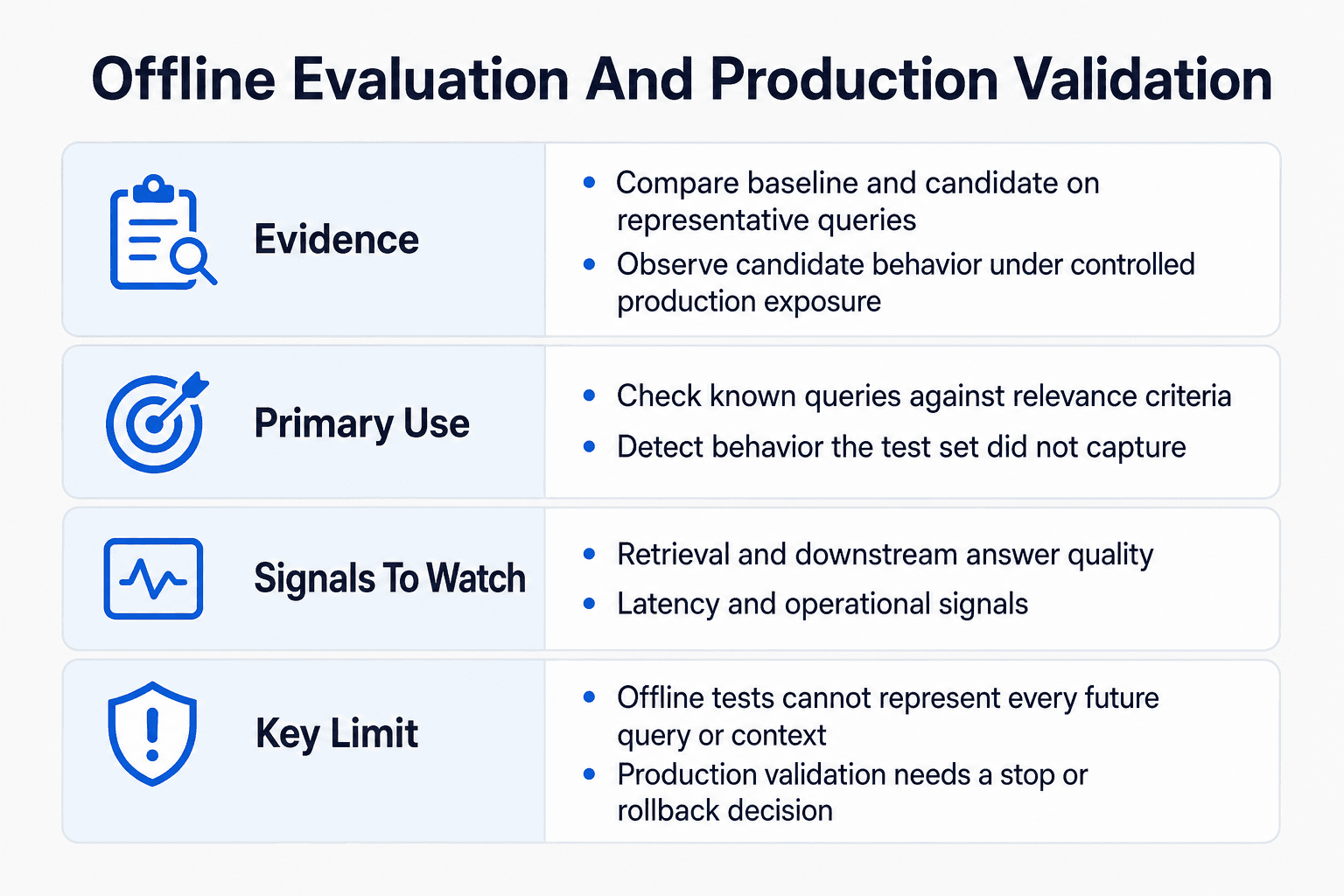
Offline evaluation vs. production validation
| Factor | Offline evaluation | Production validation |
|---|---|---|
| Evidence | Run baseline and candidate on a representative query set | Observe candidate behavior under controlled production exposure |
| Useful for | Checking known queries against relevance criteria | Detecting behavior that the test set did not capture |
| Watch | Retrieval quality and downstream answer quality | Retrieval, answer quality, latency, and operational signals |
| Limit | Cannot represent every future query or context | Requires monitoring and a predefined stop or rollback decision |
How a regression-safe retrieval release works
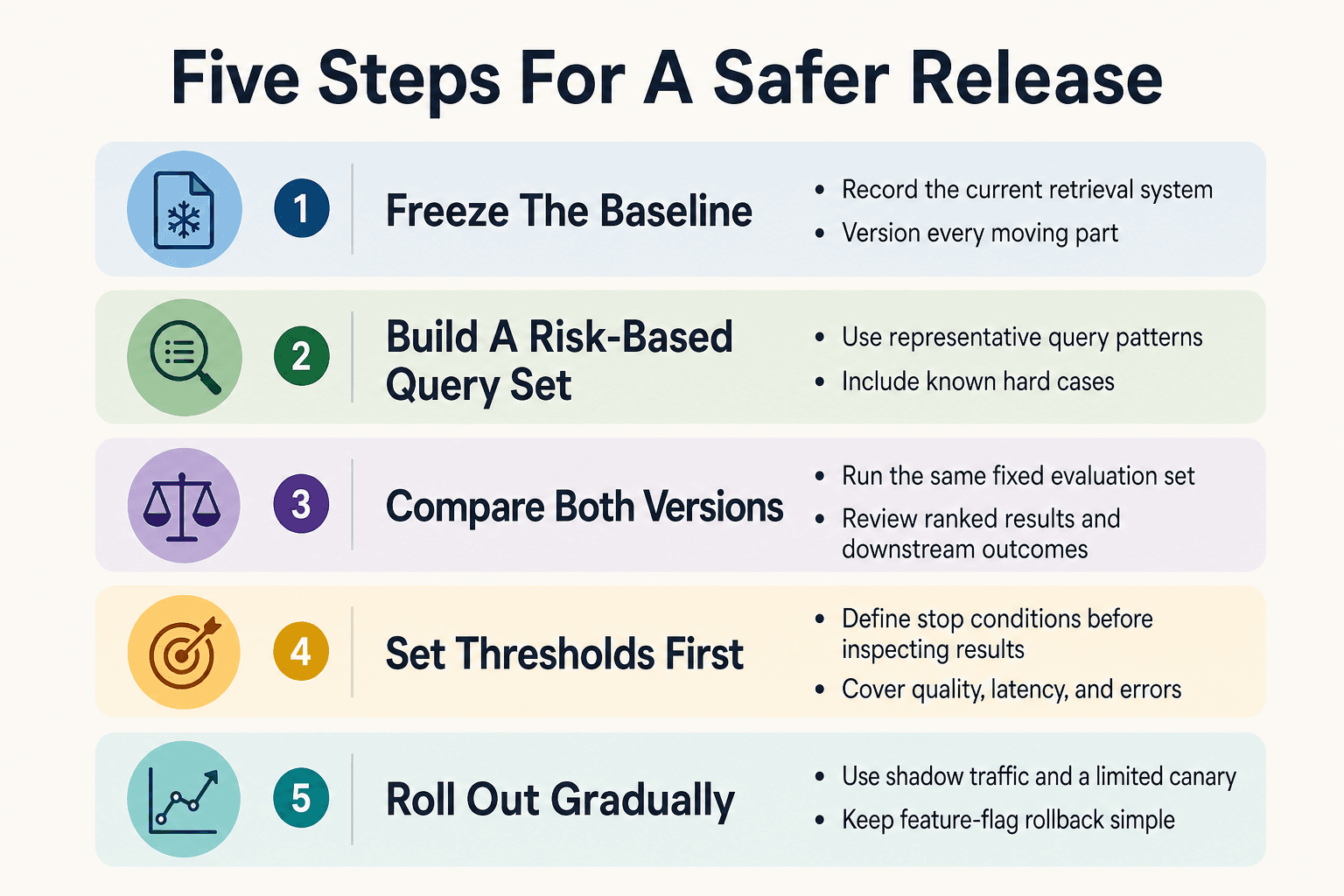
Freeze the baseline and version every moving part
Start with the system users have now. Record the embedding model, index, chunking rules, filters, reranker, prompts, retrieval settings, and corpus snapshot.
Small changes stack up. If you cannot name what changed, you cannot tell what to reverse when quality drops.
Build a query set that represents production risk
Use real query patterns where you can review them safely, then add known hard cases: rare terms, fresh documents, permissions boundaries, multi-step agent tasks, and queries where a wrong citation would matter.
Label what good retrieval means for each query. A relevant document in the top five may be enough for one task, while another needs the current policy as the first result.
Compare candidate and baseline retrieval results
Run both versions against the same fixed set. Compare ranked results, missing evidence, latency, failures, and downstream answer or agent outcomes when they are part of the user flow.
Don't rely on one average score. Break results out by query class so a gain on common, easy searches does not hide damage to high-risk cases.
Set thresholds before looking at outcomes
Decide what stops the release before you inspect the candidate. Set acceptable loss limits for critical queries, latency, error rate, and grounded-answer checks.
The main catch is judgment. Your thresholds depend on the cost of a wrong result in that workflow.
Use shadow traffic, canaries, and feature flags
Send production-shaped requests to the candidate without serving its results first. Then expose a small, reversible share of live traffic through a feature flag and watch for retrieval and downstream failures.
Keep rollback simple: restore the versioned baseline, preserve logs, and stop exposure when a pre-set condition is crossed.
Shipping retrieval changes without regressions: a step-by-step guide
- Record the current system version and its results on representative queries.
- Define relevance criteria, query classes, and downstream answer signals before comparing versions.
- Run the baseline and candidate against the same evaluation set and inspect both retrieval results and generated answers.
- Set explicit stop conditions for unacceptable quality, latency, or operational changes.
- Use shadow testing or a limited canary to gather production evidence without assuming offline results cover every query.
- Monitor the agreed signals during rollout and roll back when a predefined trigger is met.
- Add important failures to the evaluation set and rerun the comparison before a future release.
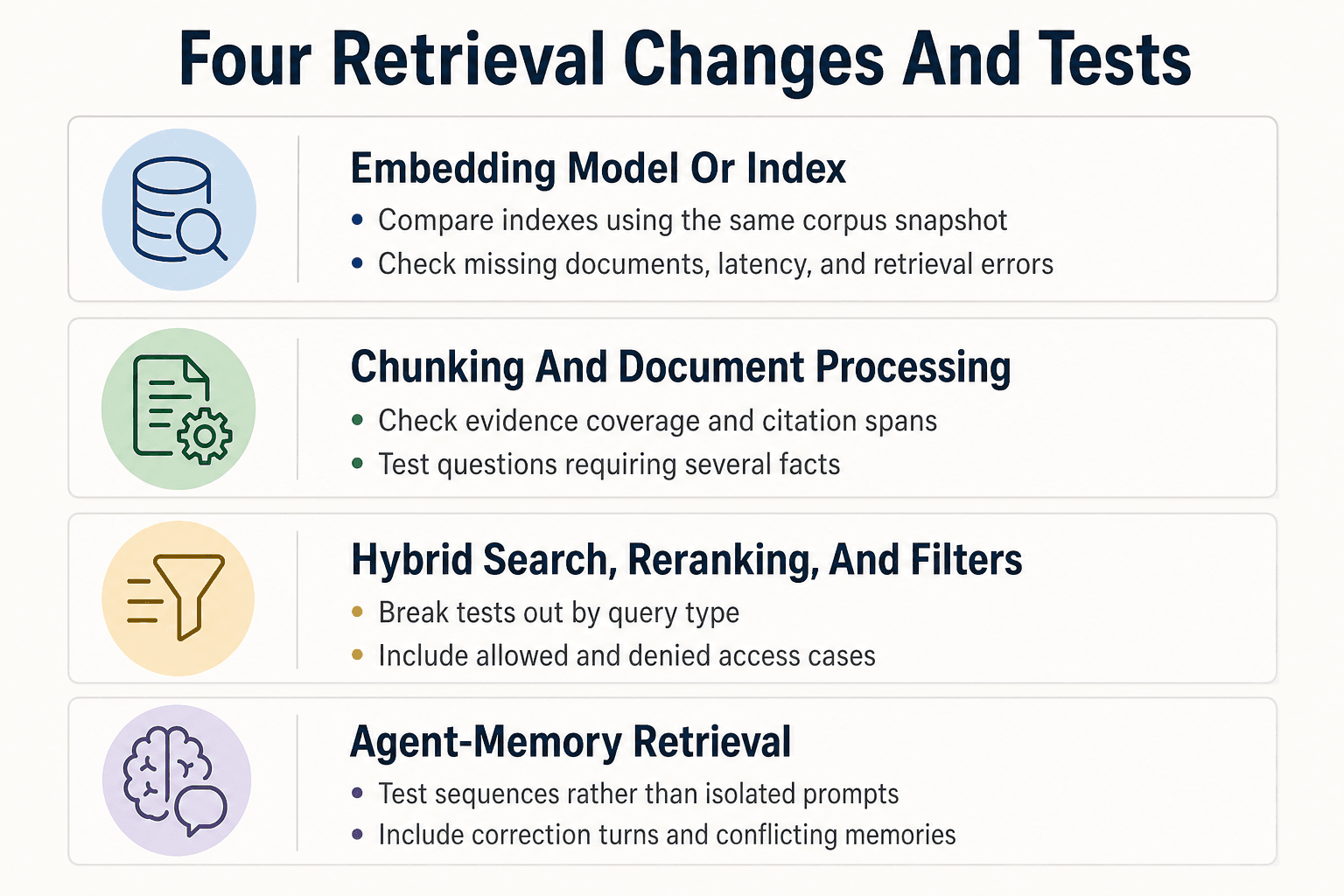
Examples of retrieval changes that need different tests
A generic relevance score won't catch every failure. Test the changed part of the pipeline, then check the user outcome it can alter.
Embedding-model or index changes
Compare the same queries against both indexes, with the same corpus snapshot and top-k setting. Review which known-good documents disappear, which new ones enter, and whether rare terms, names, and older wording now fail.
Also check latency and retrieval errors. A ranking gain isn't worth a release if the new index cannot meet your serving limits.
Chunking and document-processing changes
Judge evidence coverage, not just document IDs. A new chunk rule can retrieve the right source while splitting away the sentence, table, or surrounding context that makes it useful.
Use questions that need several facts from one document. Check citation spans and answer grounding, because a smaller chunk may improve matching but leave the generator without enough context.
Hybrid search, reranking, and filter changes
Break tests out by query type: exact terms, natural-language questions, fresh content, and queries with strict metadata or permission rules. Hybrid search can recover a keyword match while pushing a conceptually better result down the list.
For filters, include allowed and denied cases. A result that looks relevant but crosses an access boundary is a release blocker.
Agent-memory retrieval changes
Test sequences, not isolated prompts. Memory retrieval depends on what the agent stored earlier, the current task, and whether stale details override newer instructions.
Include correction turns and conflicting memories. The main catch is that retrieved memories may look plausible while still steering the agent toward the wrong next action.
Common misconceptions about retrieval regression testing
Tests reduce release risk. They cannot prove that no unknown production query, new document, or unusual user path will regress.
[!note] Offline evaluation can reveal regressions on the queries and criteria you test, but it cannot establish that every unknown production query will be unaffected.
A better average score does not protect every important query
An average can rise while a small group of high-value queries gets worse. That group might include account questions, safety-sensitive requests, or the exact terms your support team uses every day.
Break results out by query class and importance. Set a no-regression rule for critical cases rather than accepting their loss as the cost of a better aggregate score.
Offline relevance is not the same as a better final answer
A retrieved result can look relevant but still fail to support the answer. It may omit a key qualifier, contain stale facts, conflict with another chunk, or arrive too late in the context window.
Check downstream behavior for representative tasks: answer grounding, citation accuracy, abstentions, and agent actions. A retrieval metric alone can't tell you whether the system made a safe decision.
Shadow traffic does not show every user-impacting failure
Shadow traffic lets a candidate pipeline process real queries without changing what users receive. That's useful for comparing rankings, latency, errors, and cost under live load.
However, it doesn't show how users react to changed answers, and it may not reproduce stateful agent paths or follow-up turns. Use it to find mismatches before exposure, not as proof that a canary is unnecessary.
A rollback plan is not optional operational overhead
A feature flag and a known prior version make a bad release reversible. Without them, your team may need to rebuild an index, restore configuration, or wait through a deployment while users keep seeing the failure.
Define rollback triggers before launch: critical query failures, access-control mistakes, answer-quality drops, error growth, or serving limits breached. If you can't reverse the change quickly, the release carries more risk than its test results can cover.
A practical release checklist for RAG and agent memory
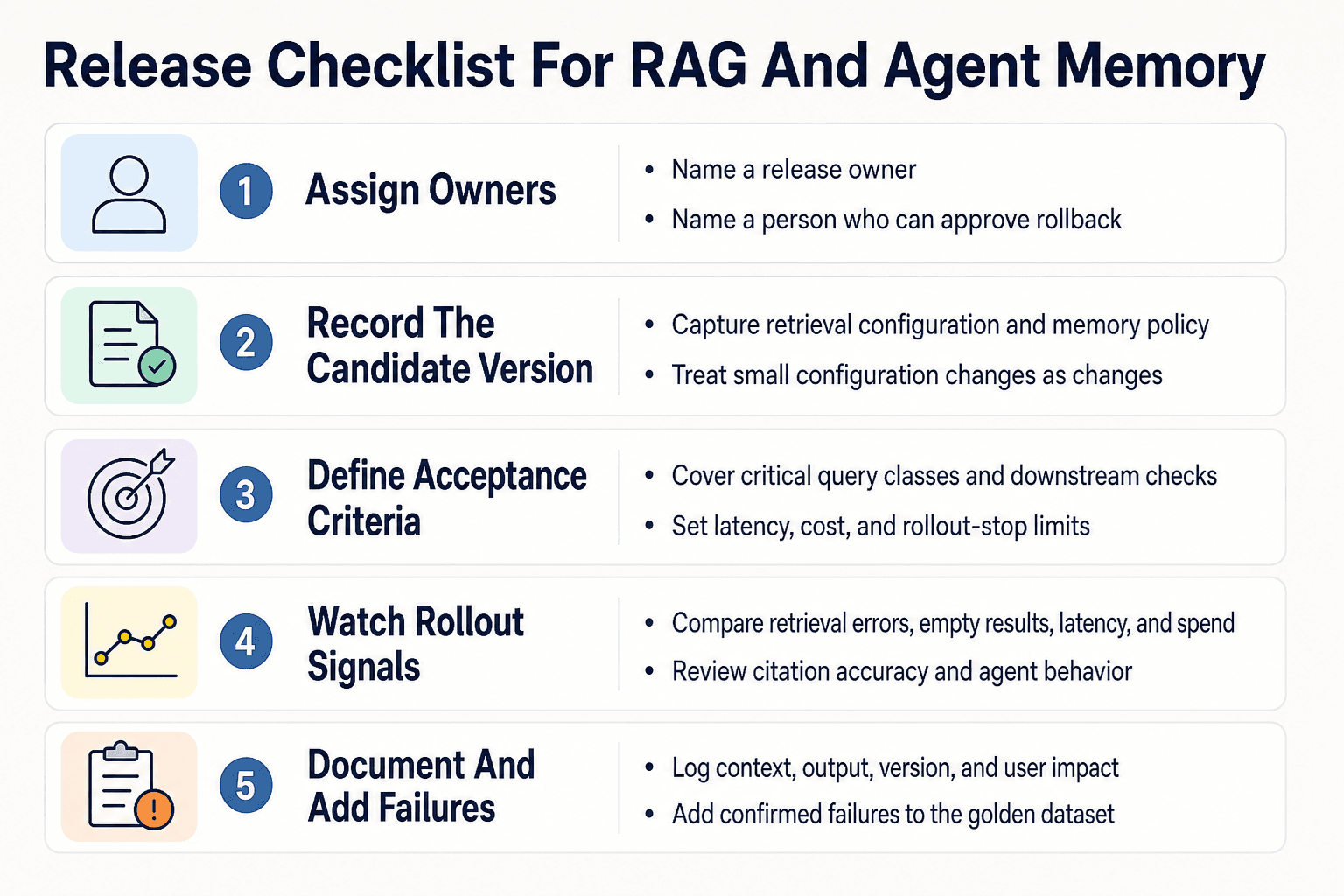
Before the change: define owners, versions, and acceptance criteria
Name one owner for the release and one person who can approve a rollback. Record the candidate's embedding model, index, chunking rules, filters, reranker, prompts, and memory policy. Small config changes count.
Write acceptance criteria before results can sway them. Include critical query classes, downstream answer checks, latency and cost limits, plus the conditions that stop the rollout.
During the rollout: watch quality, latency, cost, and abstention signals
Start with shadow traffic, then expose a small canary behind a feature flag. Compare the candidate with the baseline for retrieval errors, empty results, retrieval latency, model calls, and spend.
Watch what retrieval metrics miss. Track citation accuracy, unsupported answers, wrong agent actions, failed tool calls, and abstentions. An abstention rise isn't always bad, but it needs review if users lose answers they previously received.
Pause the rollout when a critical case fails, access rules break, errors rise, or a preset serving limit is breached. Don't wait for an aggregate dashboard to confirm a clear incident.
After the rollout: document failures and improve the evaluation set
Log the query, retrieved context, final output, pipeline version, and user impact for each failure. Then decide whether the cause was retrieval, generation, stale content, or a gap in the test set.
Add confirmed failure cases to the golden dataset with a clear relevance judgment. That is how shipping retrieval changes without regressions becomes a repeatable process, not a promise no team can keep.
Frequently asked questions
What does shipping retrieval changes without regressions mean in RAG?
It means using a release process designed to detect and limit regressions, not proving that none can occur. Compare a candidate with a recorded baseline on representative queries, then monitor retrieval and downstream behavior during rollout.
Can you guarantee that a retrieval change will have no regressions?
- Tests cover the queries, criteria, and conditions included in them. Unknown production queries may behave differently. Treat evaluation as evidence for a release decision, not a guarantee.
What should be included in a retrieval regression test set?
Use queries representative of the system's actual use, with relevance criteria that let you compare retrieved results. For RAG or agent memory, include checks on downstream answers or behavior as well as retrieval.
How do you compare two retrieval pipeline versions?
Run the baseline and candidate on the same query set under the same relevance criteria. Compare retrieval results and downstream answer quality, and review individual failures rather than relying only on an aggregate result.
When should a RAG team use shadow traffic versus a canary release?
Use shadow testing to observe candidate behavior without making it the live response path. Use a canary when you are ready to expose the candidate to a limited portion of live use. It depends on the evidence needed and the risk your team is prepared to manage.
What metrics should trigger a retrieval rollback?
Set triggers before rollout for the signals that matter to your system, including retrieval relevance, downstream answer quality, latency, and operational reliability. Define acceptable limits for your own baseline and use case.
How is agent-memory evaluation different from document retrieval evaluation?
Document retrieval checks whether relevant material is retrieved. Agent-memory evaluation should also check whether the retrieved memory supports the intended downstream behavior. A plausible retrieval result alone does not show that the agent's answer or action remained acceptable.
About GigaRAG
GigaRAG helps you share agent memory like you share Google Docs. It connects your AI agents to a central Hive Mind, with access controls for what each agent can use. Developers, vibe coders, and teams can keep project knowledge available across sessions and tools, so agents can pick up where work left off without rebuilding context or managing a full RAG stack.


