Queries That Are Too Short to Embed Usefully in RAG
Queries that are too short to embed usefully call for an explicit decision policy. Rather than silently filling gaps, decide whether the available request and trusted context are sufficient for retrieval—or whether the system should clarify, apply a known filter, or abstain.
Use this framework to preserve uncertainty when a request does not state the target, task, scope, or timeframe needed for your application.
Quick answer
For a short request, choose the least assumptive next step:
- Retrieve when the request is already specific enough for the task.
- Add only trusted context that resolves a known missing detail.
- Apply a filter only when its scope is already known.
- Ask a focused clarifying question when different interpretations would lead to different responses.
- Abstain when the available information does not support a responsible selection.
When are queries too short to embed usefully?
Treat brevity as a prompt to inspect the request, not as a rule by itself. A short request may be actionable when it includes a known identifier, while a longer request may still leave the target or task unresolved.
Separate input handling from decision policy
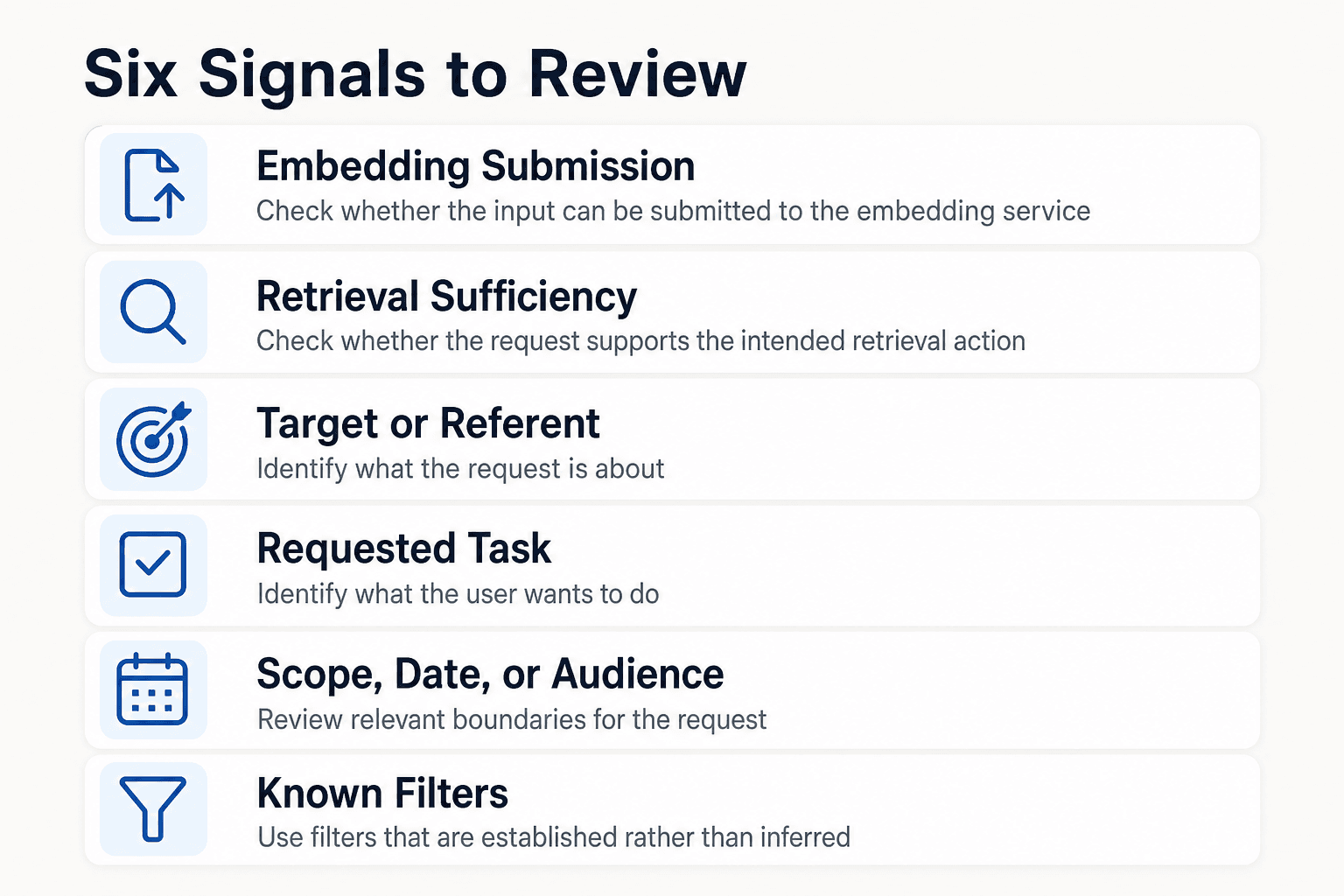
Define two checks in your implementation:
- Whether the input can be submitted to the selected embedding service.
- Whether the request contains enough information for the retrieval action your application is about to take.
These checks serve different operational purposes. The first concerns input handling; the second concerns how your application responds to uncertainty.
Signals to review
Review whether the request names:
- a target or referent;
- a requested task;
- a relevant scope, date, or audience; and
- any filters that are already known rather than inferred.
If these details are absent, define a clarification or abstention path instead of adding them silently.
A source note on over-length inputs
Retrieve, enrich, or clarify a short query?
| Situation | Preferred policy action | Avoid |
|---|---|---|
| The request identifies the needed target and task | Retrieve using the request | Adding speculative details |
| Trusted conversation context resolves one missing detail | Add that relevant context | Adding unrelated history |
| More than one interpretation would change the response | Ask a focused question | Selecting an interpretation silently |
| A known scope is available | Apply the known filter | Inferring a new scope |
| The available information remains insufficient | Abstain or request detail | Presenting an unsupported selection as settled |
How to handle short requests in a RAG workflow
Use a policy that makes each choice reviewable. The point is not to force every request into retrieval; it is to record whether the system retrieved as written, used trusted context, applied a known constraint, requested clarification, or abstained.
Keep the request and added context distinct
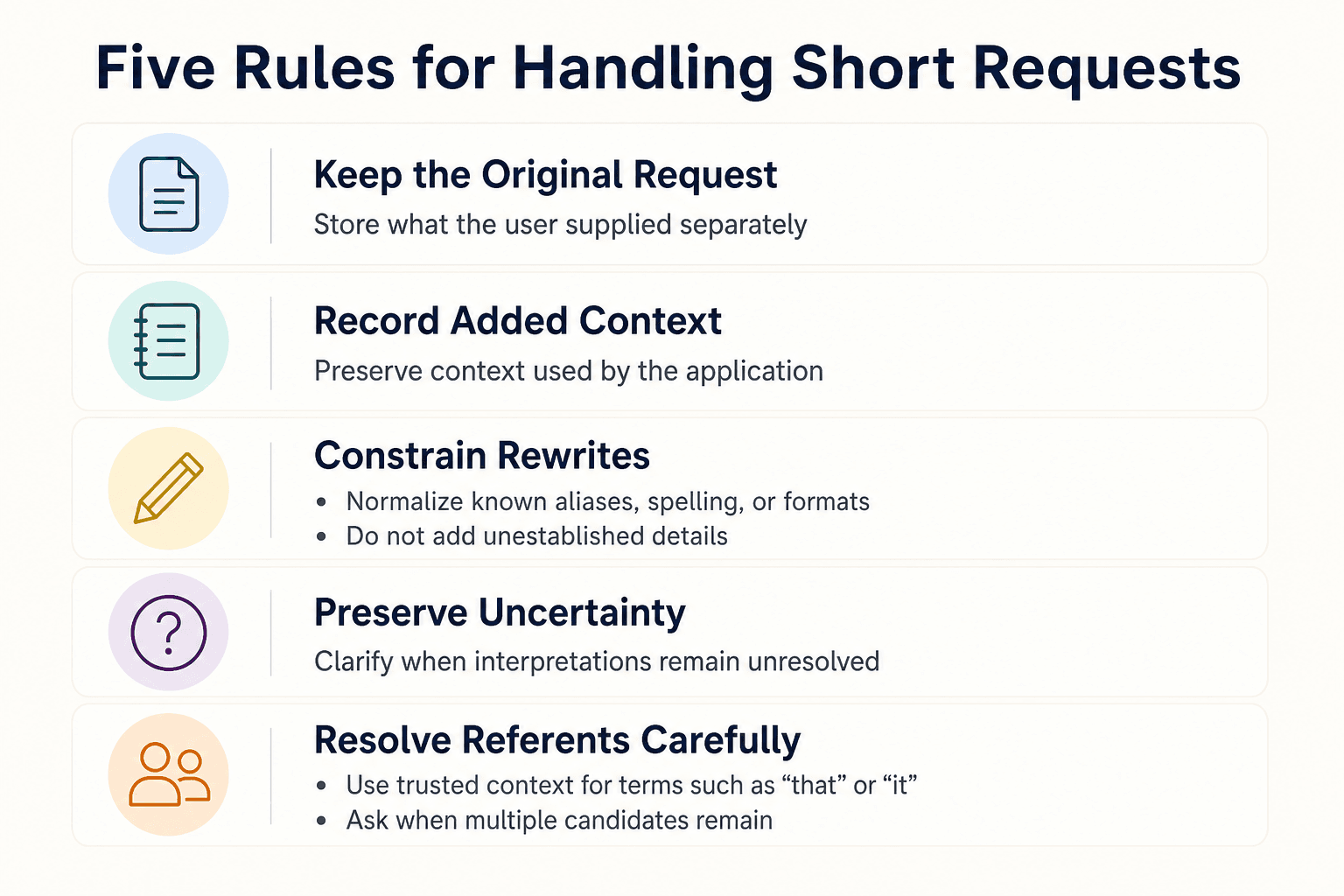
Store the original request separately from any context added by the application. This preserves a clear record of what the user supplied and what the application used to interpret it.
Treat rewriting as constrained transformation
A rewrite may normalize a known alias, spelling variant, or format used by your corpus. Do not let the rewrite add a target, preference, date, region, or task that has not been established.
Keep uncertainty visible at answer time
When a request has unresolved interpretations, preserve that state in the workflow. A clarification can be more appropriate than choosing one interpretation merely because it produces a convenient retrieval path.
Queries that are too short to embed usefully: a step-by-step guide
- Inspect the request for a target, task, scope, and constraints relevant to your application.
- Identify any trusted context that resolves a specific missing detail.
- Retrieve using the request as written when it already meets your policy.
- Apply only filters whose scope is known.
- Ask a focused clarifying question when multiple interpretations would materially change the response.
- Abstain or request more detail when the policy cannot identify a supported next action.
[!tip] For follow-up requests containing pronouns such as “that” or “it,” define a rule for resolving the referent from trusted context. If the rule leaves multiple candidates, ask the user which candidate they mean.
Diagnose short-request handling before changing your index
Before changing retrieval settings, run controlled checks that distinguish an unclear request from a retrieval configuration issue.
Use controlled request variants
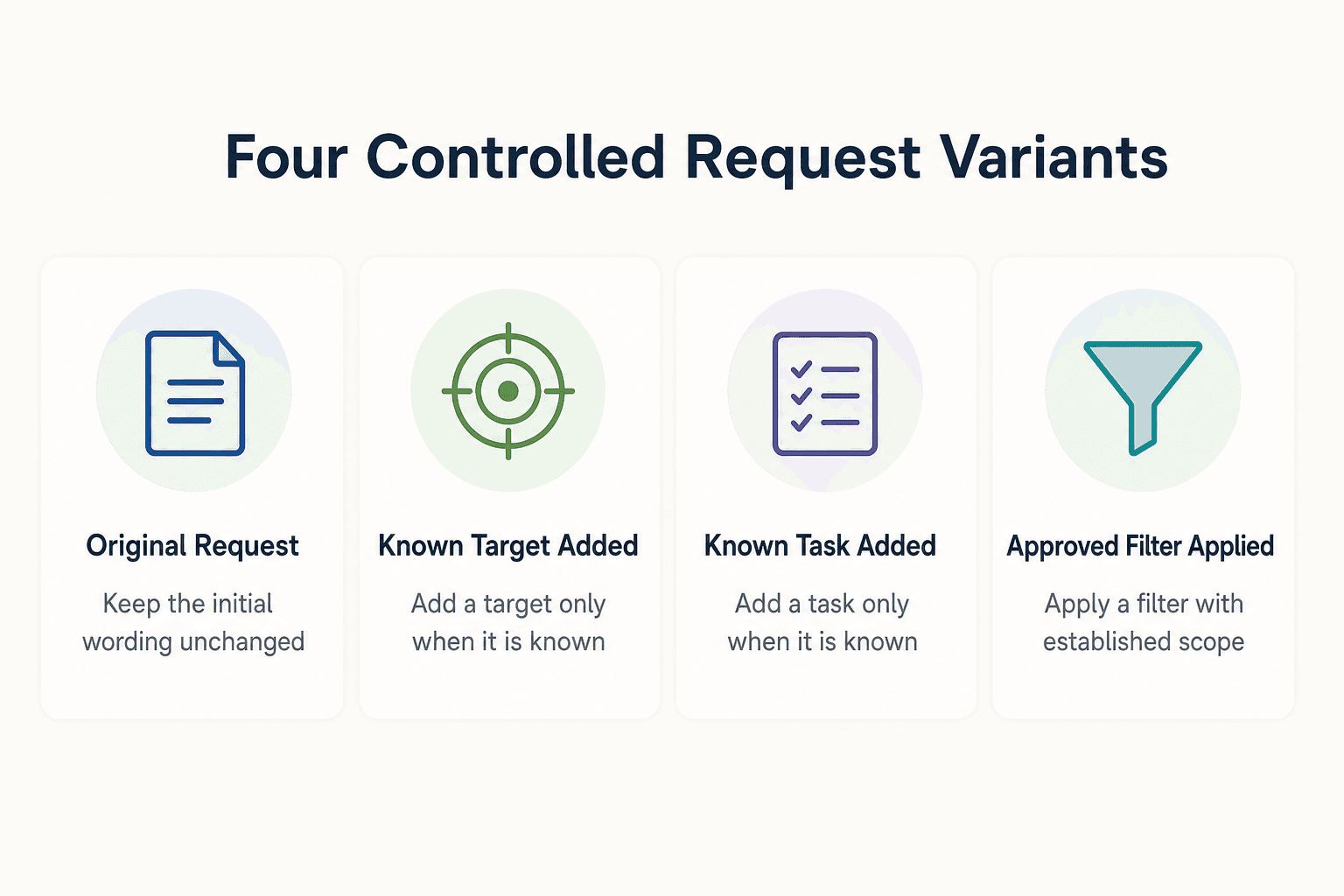
Hold your test setup constant and compare:
- the original request;
- a version with a known target added;
- a version with a known task added; and
- a version with an approved filter applied.
Document which version your policy permits and why. The goal is to understand how the workflow responds to information that is known, not to manufacture information that is missing.
Example: a broad commercial request
For a request such as “pricing,” define the clarification your application needs before choosing among products, plans, regions, contract terms, or user goals. If one of those details is already established in trusted context, record that source of context.
Example: an unspecified change request
For a request such as “what changed?”, define the entity and comparison point required by your use case. If neither is available from trusted context, ask for one rather than selecting an entity or period on the user’s behalf.
Log the decision path
For each request, log the original wording, context used, rewrite if any, filters applied, selected documents if any, and the final action. This record supports later review of whether the policy preserved or obscured uncertainty.
A decision framework for short RAG queries
Start from the information actually available to the application. The following rules can be adapted to your domain and risk tolerance.
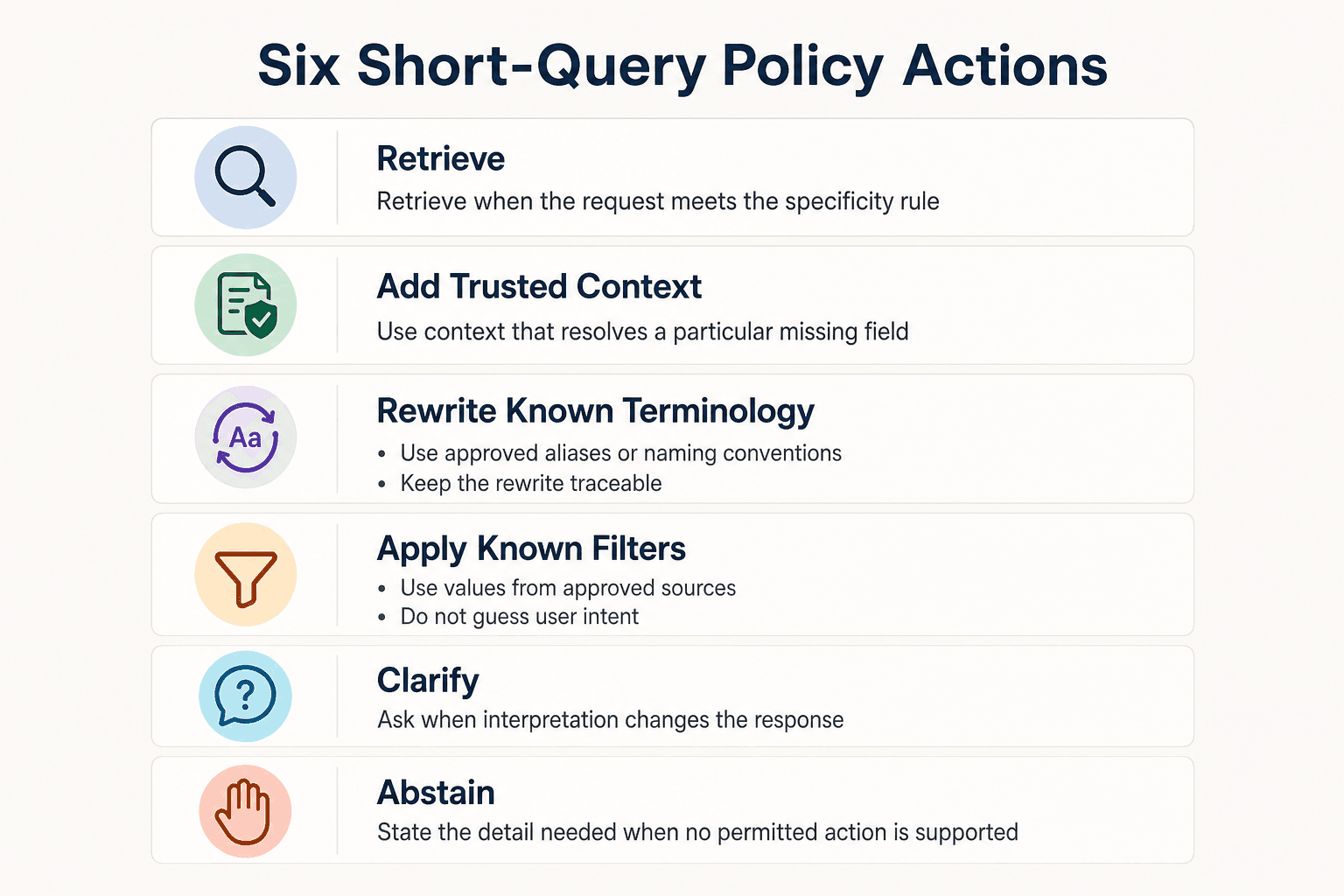
1. Retrieve when the request meets your specificity rule
Define the identifiers, targets, or tasks that count as sufficiently specific in your corpus. Keep that rule explicit so it can be reviewed and tested.
2. Add only relevant, trusted context
Use prior context only when it resolves a particular missing field. Do not add context simply because it exists.
3. Rewrite for known terminology
Use rewriting for terminology that your application already recognizes, such as approved aliases or established naming conventions. Keep the rewritten form traceable to the original request and known context.
4. Apply filters only when their values are known
Filters can narrow a search when their values come from the request, authenticated user state, or another approved source. Do not use filters to guess what the user intended.
5. Clarify when interpretation changes the response
Ask a short question that identifies the decision the user must make. For example: “Which product do you mean?” or “What period should I compare?”
6. Abstain when the policy cannot support a choice
If the workflow still lacks the information required by its rules, state what detail is needed next. This is preferable to presenting an unverified interpretation as the user’s intended request.
Build for useful retrieval, not just accepted inputs
Design the workflow so it can preserve missing information rather than conceal it. A useful implementation records the request, the context it used, the transformation it applied, and the action it chose.
[!note] The supplied GitHub issue concerns an input above a stated maximum context length: “This model's maximum context length is 8192 tokens, however you requested 17143 tokens”. That is an input-length issue, which should be handled separately from an application policy for underspecified requests.
For queries that are too short to embed usefully, the goal is a transparent decision: retrieve with known context, ask for clarification, apply a known filter, or abstain.
Frequently asked questions
Can a one-word query be part of a RAG workflow?
Yes—if your application’s policy identifies enough known context to act on it. Define that policy around the requirements of your corpus and task rather than word count alone.
What should make a request too ambiguous to act on?
Use ambiguity as a decision rule when the available information permits multiple materially different interpretations and your application has no approved way to distinguish them.
Should an agent ask a clarifying question before searching?
Ask when clarification is necessary for the next action under your policy. When trusted context resolves the required detail, use that context and keep a record of it.
Can conversation history be used with a short request?
It can be used when your application treats that history as trusted and relevant to the current request. Keep the context selected for the request distinct from unrelated conversation history.
Does rewriting replace clarification?
- Use rewriting for known terminology and formatting. Use clarification when the missing information requires a user choice.
When should a system abstain?
Abstain when the workflow cannot identify a permitted action from the request and approved context. State the detail required to continue.
About
GigaRAG is for agent memory and RAG pipeline builders. get this right. Whether you are working through ragie alternatives or something adjacent, we publish what we have actually tested, including where it falls short.