What Is the State of RAG and Vector Search in 2026?
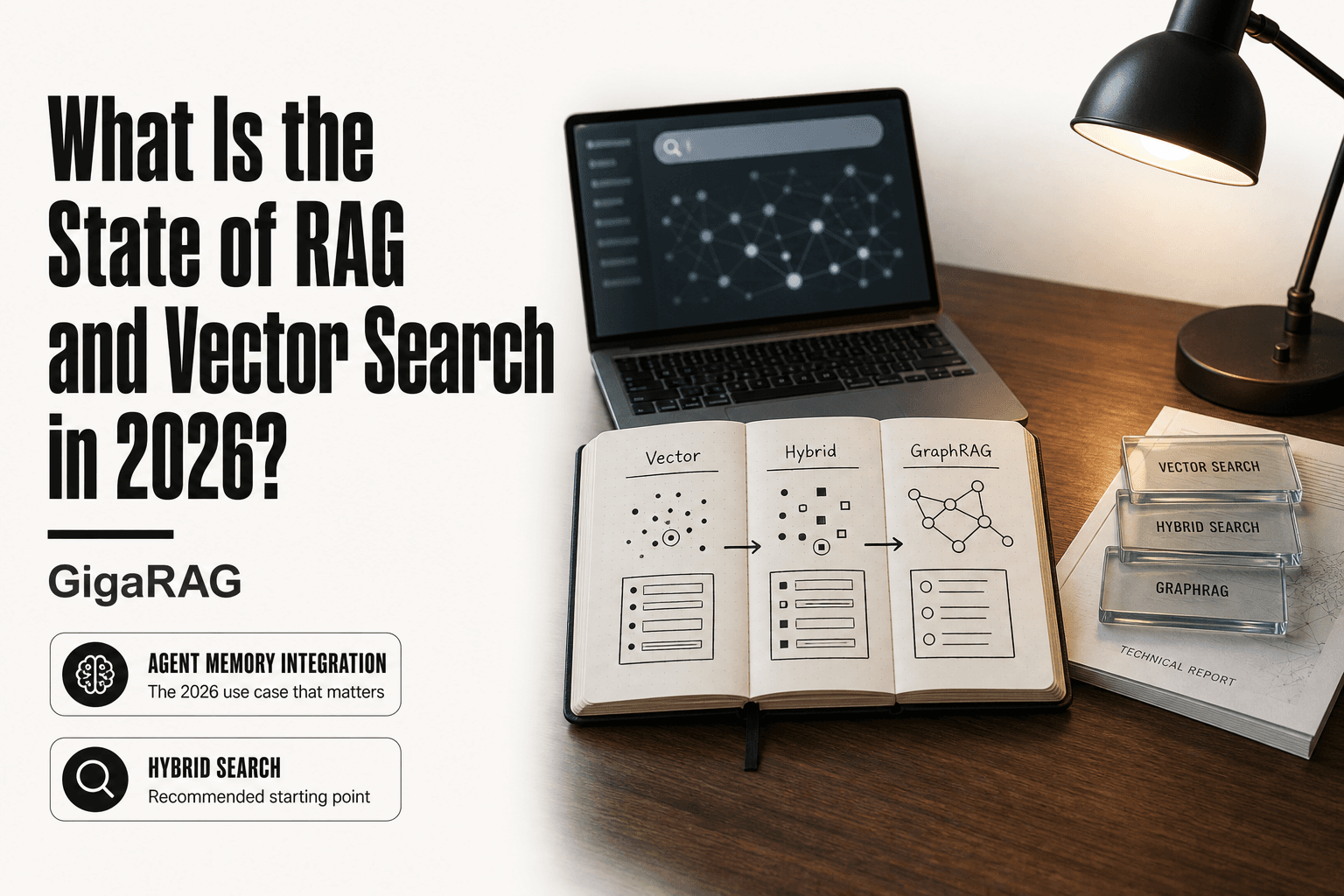
The state of RAG and vector search in 2026 is a mess of contradictions if you're a pipeline builder trying to sort signal from noise. One camp says RAG is dead, replaced by long context windows. Another pushes it as the backbone of enterprise AI. You're caught in the middle, trying to ship agent memory that actually works. The honest answer is that RAG isn't dead, but its role has shifted in ways most vendor content won't tell you. Tools like GigaRAG exist to simplify agent memory pipelines, but this isn't a product pitch. It's a field report on what RAG still does well, what it fundamentally cannot do, and how to choose between pure vector search, hybrid search, and GraphRAG for your specific use case.
| At a glance | Details |
|---|---|
| RAG status | Alive but evolving |
| Core shift | From chatbots to agents |
| Key trend | Agent memory integration |
| Search types | Vector, hybrid, GraphRAG |
| Main limitation | Hallucination and context gaps |
| Best practice | Hybrid search for accuracy |
In This Guide
- Is RAG Still Relevant in 2026?
- Pure Vector vs Hybrid vs GraphRAG for Agent Memory
- What Is Retrieval Augmented Generation (RAG)?
- State Of RAG And Vector Search: A Step-by-Step Guide
- What RAG Cannot Do in 2026
- RAG for Agent Memory: The 2026 Use Case That Matters
- Choosing Your Retrieval Approach: Vector, Hybrid, or GraphRAG
- What Is the Best Vector Database for RAG in 2026?
- Key Trends in RAG and Vector Search for 2026
Is RAG Still Relevant in 2026?
Yes. RAG is still relevant in 2026, but its role has shifted from a workaround for small context windows to the backbone of persistent agent memory. The "RAG is dead" takes you'll see on Reddit and Medium miss what changed: long context windows solved one problem, but they created three new ones that retrieval still solves better.
The "RAG is dead" argument, and why it's wrong
The argument goes like this: models now handle 1M tokens or more, so why retrieve anything? Just dump everything into the prompt and let the model sort it out.
Here's why that breaks down in practice. Cost scales with context length, and it scales fast. A 1M-token prompt costs roughly 100x more than a 10K-token prompt on most providers. Latency scales too. And attention quality degrades as context grows: models lose track of details buried in the middle of long prompts, a problem researchers have documented since 2023 and that hasn't gone away.
The honest answer is that long context is a tool, not a replacement. It's great for reading one long document. It's terrible for searching across 10,000 documents.
What long context LLMs actually changed
Long context windows did change one thing: they made naive RAG less necessary for small-scale use cases. If you have 50 pages of documentation, you can often skip retrieval entirely and just paste it all in.
What they didn't change is the fundamental problem of scale. Enterprise knowledge bases, code repositories, and agent conversation histories grow without bound. You can't paste a terabyte of context into a prompt, and you wouldn't want to pay for it if you could.
So long context didn't kill RAG. It moved the line. Retrieval now matters for scale, for cost control, and for precision, not just for fitting things into a small window.
Why agent memory makes RAG more critical in 2026
Agent memory is where RAG becomes non-negotiable. An agent that works across hours or days accumulates conversation history, task state, user preferences, and learned corrections. That context grows continuously.
You can't reload the entire history into every prompt. You need to retrieve the relevant slice: what did the user say about this project last week, what constraint did they add yesterday, what error did we hit last time we tried this.
Vector search is the mechanism that makes that retrieval possible. Without it, agents either forget everything between sessions or drown in irrelevant context. Neither works.
So RAG isn't just relevant in 2026. For agent memory specifically, it's the difference between an agent that remembers and one that starts over every time.
[!note] RAG is not dead; it is being integrated into agentic systems. The core retrieval-augmented generation concept remains essential, but the focus has shifted from simple Q&A to multi-step reasoning and memory.
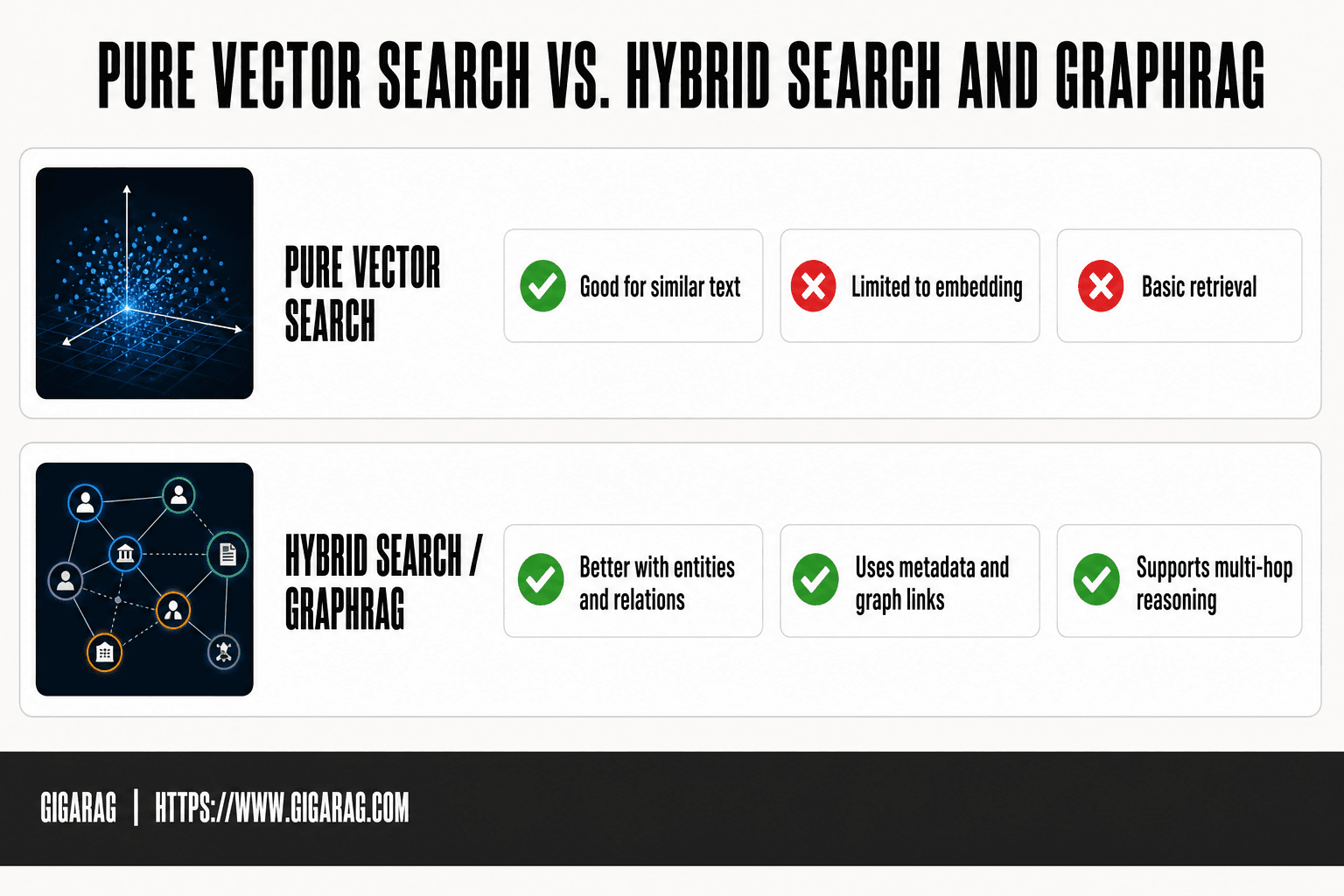
Pure Vector vs Hybrid vs GraphRAG for Agent Memory
| Factor | Pure Vector Search | Hybrid Search / GraphRAG |
|---|---|---|
| Semantic understanding | Good for similar text | Better with entities and relations |
| Context handling | Limited to embedding | Uses metadata and graph links |
| Scalability | High, but can miss nuance | Moderate, but richer results |
| Agent memory fit | Basic retrieval | Supports multi-hop reasoning |
| Implementation cost | Low | Higher (setup and tuning) |
What Is Retrieval Augmented Generation (RAG)?
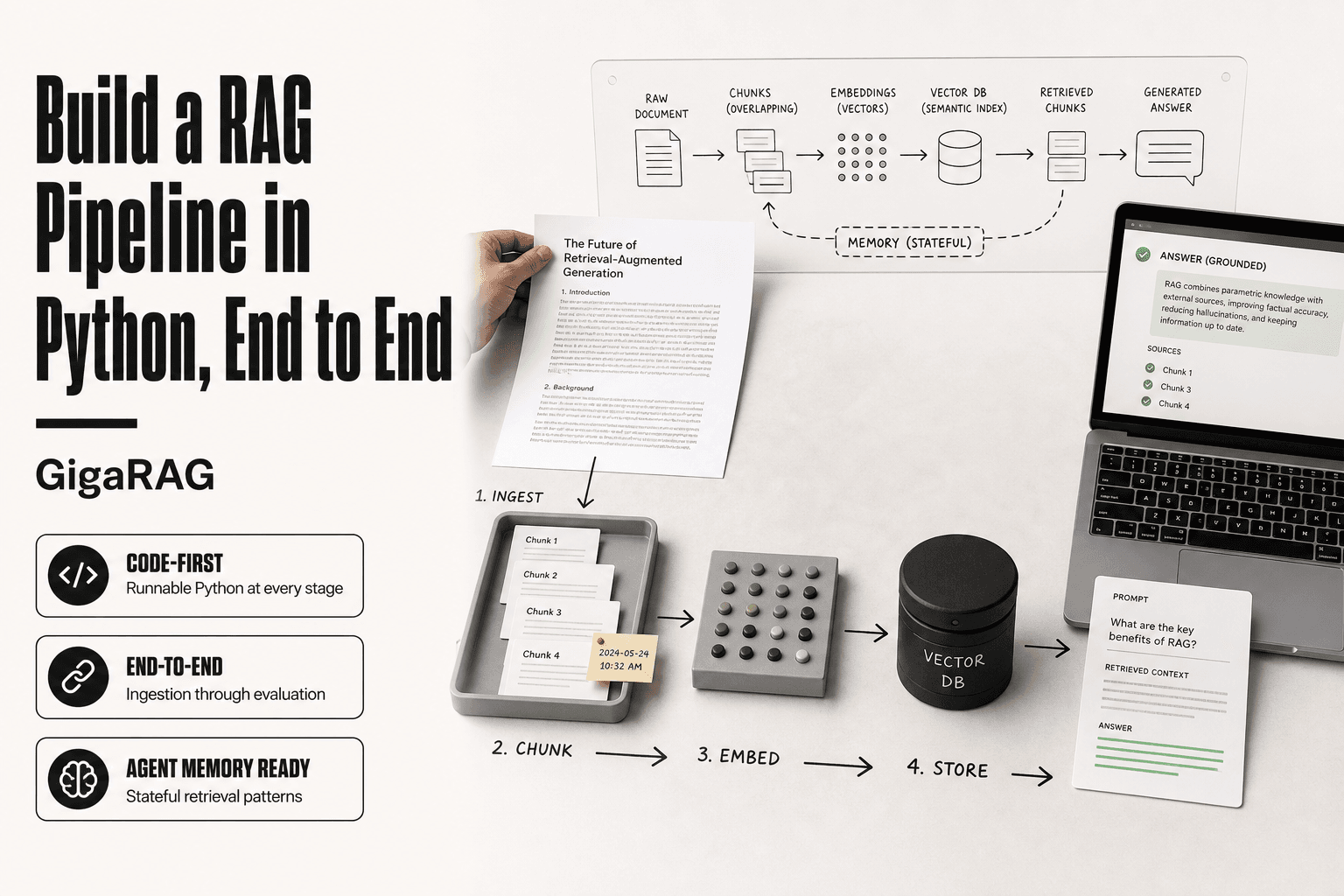
RAG is a pattern that gives a language model access to external knowledge at inference time. Instead of relying only on what the model learned during training, RAG fetches relevant documents from a datastore and feeds them into the prompt. The model then generates its answer grounded in that retrieved context.
The RAG pipeline: retrieve, augment, generate
The pipeline has three steps. First, you take the user's query and convert it into a vector embedding. You search a vector database for the nearest matching chunks. Second, you take those retrieved chunks and insert them into the prompt alongside the original query. That's the augmentation step. Third, the model generates a response using both the query and the retrieved context.
The key insight: the model never sees your entire knowledge base. It only sees the few chunks that match the query. That keeps prompts small, costs low, and answers grounded in sources you control.
Does RAG use vector search? Yes, here's how
RAG uses vector search as its retrieval mechanism, but they're not the same thing. Vector search is the lookup step. RAG is the full pattern: retrieve, then generate.
You can build RAG with other retrieval methods too. BM25 keyword search works. Hybrid search combining both works better for many use cases. But vector search is the default because embeddings capture semantic similarity, not just exact word matches. A query about "car repair costs" can retrieve a chunk about "auto maintenance expenses" without sharing a single keyword.
[!tip] For agent memory, start with hybrid search (BM25 + dense vectors) rather than pure vector search. It handles exact matches and semantic queries better, reducing hallucination in critical agent responses.
State Of RAG And Vector Search: A Step-by-Step Guide
- Define your agent's memory needs: what queries will it answer?
- Assess your data: is it text-heavy, structured, or relational?
- Prototype with pure vector search first to establish a baseline.
- Add hybrid search (keyword + vector) to improve precision.
- If relationships matter, integrate a knowledge graph for GraphRAG.
- Evaluate with realistic queries, measuring accuracy and latency.
- Iterate based on failure cases, not just average scores.
What RAG Cannot Do in 2026
RAG is a retrieval pattern, not a reasoning engine. It finds relevant text and hands it to a model. What happens after that depends entirely on the model's own capabilities. That distinction matters more in 2026 than it did two years ago, because the failure modes have become clearer.
RAG cannot reason, it can only retrieve and synthesize
RAG retrieves chunks. The model synthesizes them into an answer. But synthesis is not reasoning. If the answer requires connecting facts across three documents in a way no single chunk states explicitly, RAG won't magically produce that connection. The model might infer it, or it might miss it entirely. Retrieval gives the model ingredients. It doesn't give it a recipe.
RAG cannot fix bad embeddings or poor chunking
The retrieval step is only as good as what you indexed. If your chunks split a key concept across two documents, or your embedding model doesn't capture the semantic relationship you care about, the right context never reaches the model. Better generation can't compensate. The model will answer confidently from whatever it received, even when that context is incomplete or irrelevant.
RAG cannot guarantee factual accuracy
Retrieved documents can be wrong. Outdated. Contradictory. RAG grounds the model in your sources, but it doesn't verify those sources. If your knowledge base contains an error, RAG will happily reproduce it with the model's usual confidence. The retrieval step adds provenance, not truth.
When RAG fails: real failure modes
The failures are predictable. Retrieval misses the right chunk, so the model answers from nothing relevant. Retrieval returns the right chunk but the model ignores it. The chunk is correct but the model misreads it. Or the chunk is wrong, and the model amplifies the error. Each failure looks identical from the outside: a confident, plausible, incorrect answer.
RAG for Agent Memory: The 2026 Use Case That Matters
Agent memory is where RAG stops being a document lookup tool and starts being infrastructure. An agent that forgets everything between sessions isn't an agent. It's a script with extra steps. Persistent memory changes that, and vector search is the mechanism that makes it work.
What agent memory actually requires from RAG
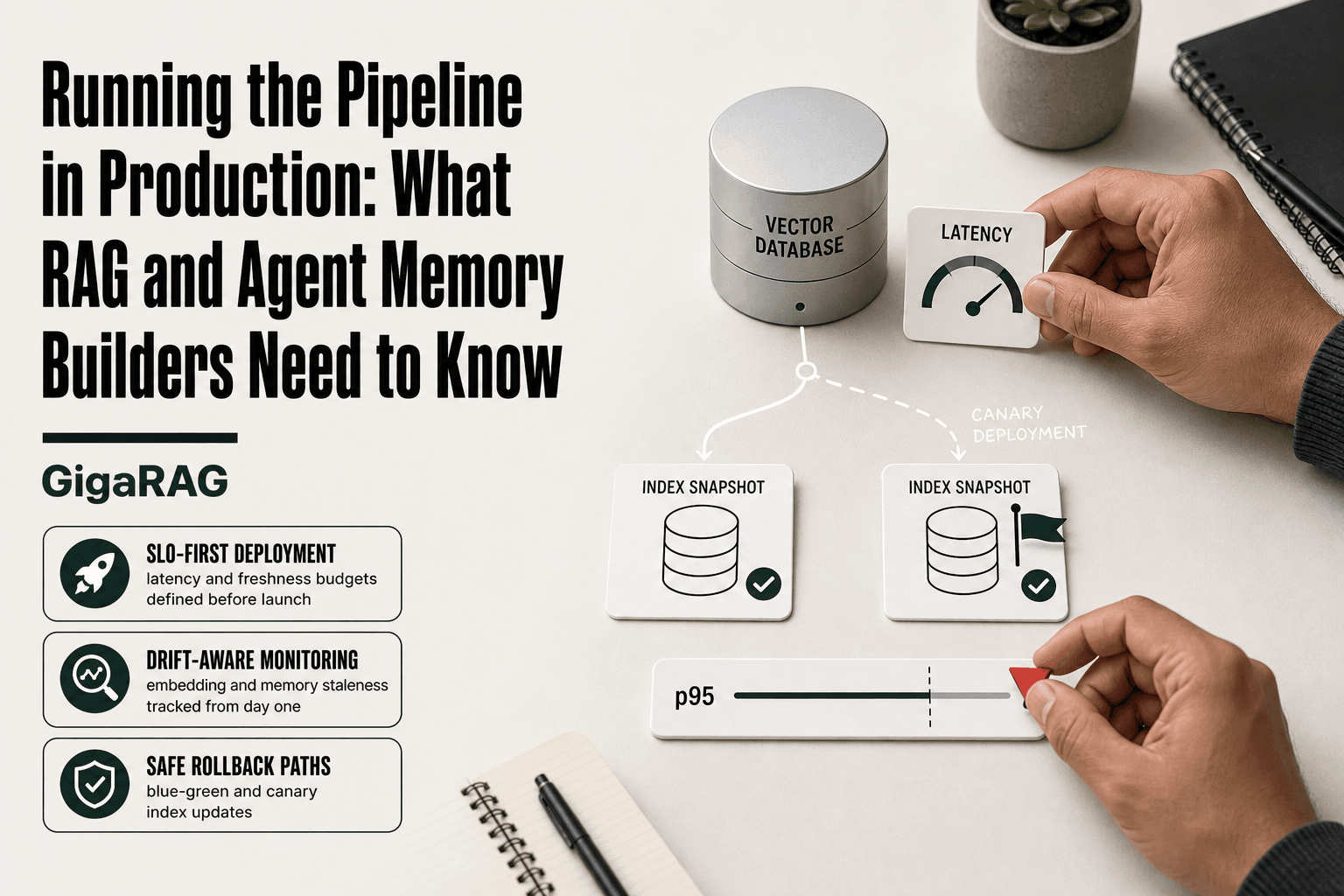
Agent memory imposes three requirements that document Q&A never did. First, latency. A retrieval step that takes 800 milliseconds is fine for a chatbot. It's a disaster for an agent making ten tool calls in sequence. Second, incremental updates. Agents learn continuously. You can't re-index the whole memory store every time the agent picks up a new preference. Third, context windowing. You can't stuff the agent's entire history into the prompt. You need to retrieve the relevant slice and leave the rest in storage.
Vector search as the backbone of persistent agent context
Conversation history, task state, learned preferences. All of it becomes embeddings in a vector store. When the agent needs to recall something, it runs a similarity search against its own memory. The retrieved chunks become context for the next step. That's the whole pattern. The honest catch: similarity search retrieves what's semantically close, not what's causally relevant. An agent remembering "the user prefers short answers" is easy. An agent remembering "the user was annoyed three turns ago because I asked for clarification twice" is much harder. That requires storing emotional state and interaction quality alongside content, which most memory architectures skip.
Practical architecture: memory store + retrieval layer
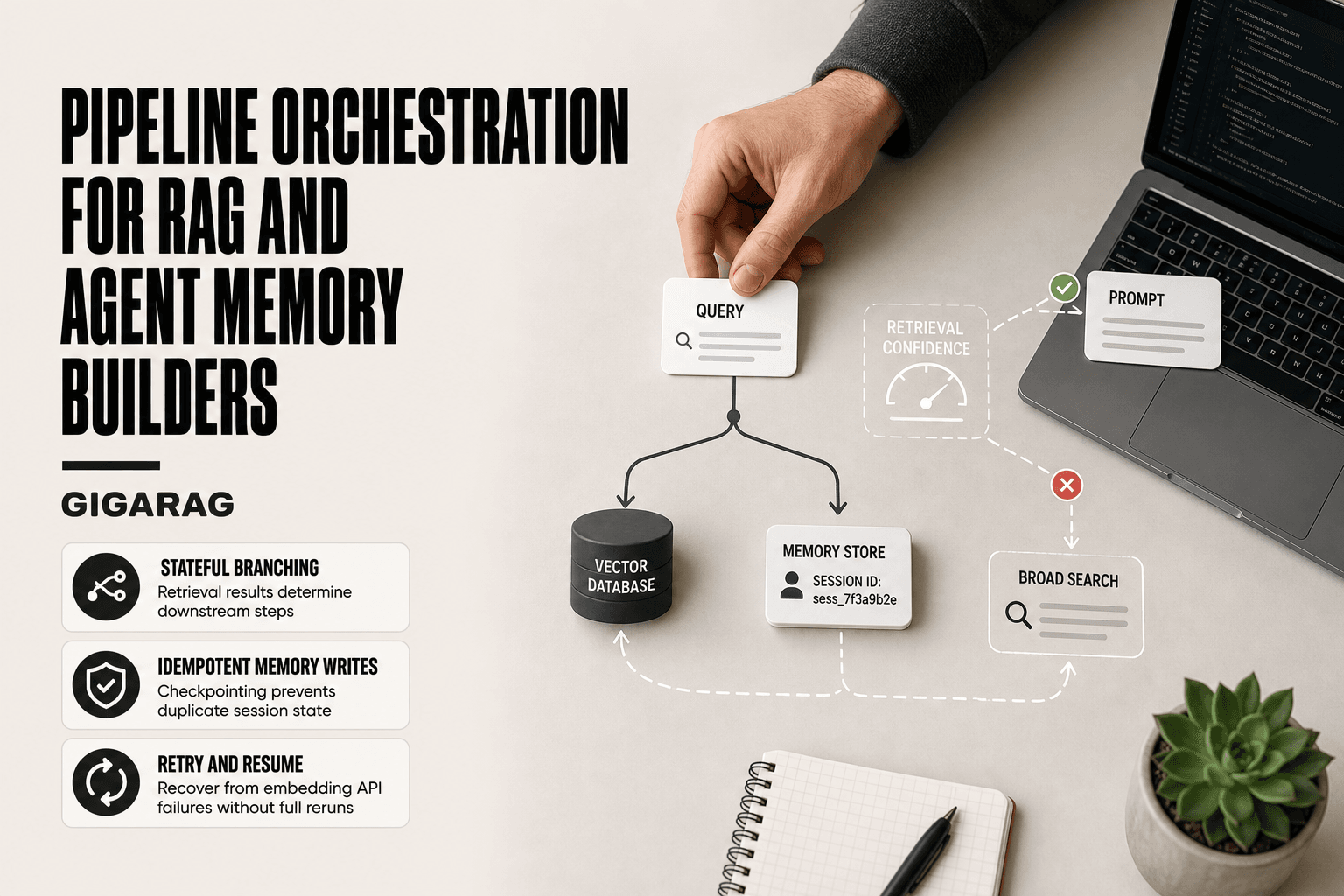
The workable pattern is two components. A memory store holds embeddings for everything the agent has seen and done. A retrieval layer decides what to pull into context at each step. Keep them separate. The memory store optimizes for write throughput and storage cost. The retrieval layer optimizes for latency and relevance. Don't try to make one system do both.
In practice, you'll store three kinds of memory: episodic (what happened), semantic (what the agent knows), and procedural (how the agent does things). Each needs different retrieval strategies. Episodic memory wants recency weighting. Semantic memory wants pure similarity. Procedural memory wants exact match. One vector index with one similarity metric won't serve all three well.
Choosing Your Retrieval Approach: Vector, Hybrid, or GraphRAG
The retrieval approach you pick determines what your pipeline can find, how fast it finds it, and how much you'll pay to maintain it. There's no single right answer. There are three wrong answers for your specific use case, and the job is figuring out which two to avoid.
Pure vector search: when it's enough
Pure vector search works when your queries are semantic and your corpus is homogeneous. If users ask "how do I reset my password" and your docs say "password recovery steps," embeddings bridge that gap. No keyword match needed.
It's enough when recall on paraphrased queries matters more than exact phrase matching. Support tickets, FAQ retrieval, semantic search over meeting notes. All fine with dense embeddings alone.
The catch: vector search misses exact identifiers. Product codes, error numbers, API endpoint names. "Error 503" and "error 503" are identical to BM25 but may embed differently. If your corpus is full of precise tokens users will type verbatim, pure vector search will frustrate them.
Hybrid search: combining dense and sparse retrieval
Hybrid search runs dense embeddings and BM25 in parallel, then merges results. You get semantic matching from the vector side and exact token matching from the sparse side. Most production RAG systems land here by default.
It's necessary when your queries mix natural language with precise terms. Legal documents, medical records, technical documentation. Users ask "what are the side effects of lisinopril" (semantic) and "section 4.2.1 compliance requirements" (exact).
The trade-off is operational. You're running two indexes, two retrieval passes, and a fusion step. Latency goes up. Maintenance doubles. For a pipeline serving 50 queries a second, that's real infrastructure cost. For 5 queries a minute, it's negligible.
GraphRAG: when relationships matter more than similarity
GraphRAG builds a knowledge graph from your corpus and retrieves by traversing relationships, not measuring vector distance. It answers questions like "which suppliers provide components for products that failed QA last quarter" by walking edges between entities.
Use it when your questions are multi-hop. When the answer requires connecting facts across documents rather than finding one relevant passage. Fraud investigation, supply chain analysis, regulatory compliance across interconnected entities.
The honest cost: building and maintaining a knowledge graph is significantly more work than indexing embeddings. Entity extraction, relationship classification, graph updates when source data changes. Most teams don't need it. The ones that do usually know already.
Decision criteria for agent memory pipelines
For agent memory specifically, start with hybrid search. Agent queries mix semantic recall ("what does this user care about") with exact lookups ("what was the ticket number from Tuesday"). Pure vector search will miss the latter. GraphRAG is overkill unless your agent reasons over structured relationships between entities.
It depends on three things: query type, corpus size, and update frequency. Semantic queries over homogeneous text: pure vector. Mixed queries with precise terms: hybrid. Multi-hop reasoning over connected entities: GraphRAG. If you're unsure, hybrid is the safe default. You can drop the sparse index later if you find you don't need it. Adding it after the fact is more painful.
What Is the Best Vector Database for RAG in 2026?
There isn't one. Any vendor claiming otherwise is selling you their database, not answering your question.
Evaluation criteria: latency, scale, hybrid support, cost
What matters is your pipeline's shape. Latency: if you're serving agent memory lookups at 50 queries a second, you need sub-50ms retrieval. If it's a nightly batch job, any database works. Scale: under 10 million vectors, most options perform fine. Past 100 million, you need something built for sharding and approximate nearest neighbor at that size. Hybrid support: if your queries mix semantic and exact terms, you need BM25 alongside dense search. Not every vector database does this well. Cost: managed services charge per query or per vector. Self-hosted costs engineering time. Pick the one you'll actually maintain.
The honest answer: it depends on your pipeline
It depends on three things: query volume, corpus size, and whether you need hybrid search. Small corpus, low traffic, semantic-only queries: almost anything works. Large corpus, high traffic, mixed queries: look at databases with native hybrid search and proven latency at your scale. The database is rarely the bottleneck. Your chunking strategy and embedding model matter more.
Key Trends in RAG and Vector Search for 2026
Four trends matter for pipeline builders. The rest is noise.
Agentic RAG: retrieval that plans and iterates
Agentic RAG means the agent decides what to retrieve, retrieves it, checks whether the result actually answers the question, and retrieves again if it doesn't. That loop replaces the old single-shot pattern: embed query, fetch top-k, generate. The old pattern fails when the first retrieval misses. The new one recovers.
In practice, you'll see agents issuing multiple queries per turn, refining them based on what comes back. That costs more tokens and adds latency. Worth it when accuracy matters more than speed.
Reasoning-aware retrieval
Retrieval is starting to understand the reasoning task, not just the query string. A question like "what changed between these two reports" needs different chunks than "summarize this report." Reasoning-aware retrieval scores chunks by whether they support the inference the model needs to make, not just by semantic similarity to the query.
This is early. Most implementations are research-stage. Don't rebuild your pipeline around it yet.
Semantic chunking replacing fixed-size chunking
Fixed-size chunking splits text every 500 tokens whether or not that's a natural boundary. Semantic chunking splits where meaning shifts: at paragraph breaks, section headers, or topic changes. The result is chunks that map to complete ideas, not fragments.
The catch: semantic chunking needs a model to find those boundaries. That's slower and costs more per document. For most pipelines, the retrieval quality gain justifies it. For high-volume ingestion, test both before committing.
Smaller, specialized embedding models
The trend is away from giant general-purpose embedding models toward smaller ones tuned for a domain: legal text, code, biomedical literature. These models are faster, cheaper to run, and often beat general models on domain-specific retrieval.
The trade-off: you need training data for your domain. If you don't have it, a general model is still the safer default.
The state of RAG and vector search in 2026 comes down to this: the pattern still works, but only when you match the retrieval approach to the job. Pure vector search for semantic queries over homogeneous text. Hybrid search when exact terms matter. GraphRAG when relationships drive the answer. For agent memory, hybrid is the safe starting point. The tools keep changing. The fundamentals don't.
Frequently Asked Questions
Is RAG relevant in 2026?
Yes, RAG is relevant but has evolved. It is no longer just about appending retrieved text to a prompt; it is now a component of agentic systems that use retrieval for memory, tool use, and multi-step reasoning. The core idea of grounding AI with external knowledge remains vital.
What is the best vector database for RAG in 2026?
There is no single best vector database; the choice depends on your scale, latency needs, and existing infrastructure. Popular options include Pinecone, Weaviate, and Milvus, but many teams also use PostgreSQL with pgvector for simplicity. Evaluate based on your specific workload and budget.
Does RAG use vector search?
RAG often uses vector search to retrieve relevant documents, but it is not mandatory. Hybrid search, which combines vector and keyword methods, is increasingly common to improve accuracy. GraphRAG uses graph traversal instead of or alongside vector search for relational data.
What are the key trends in AI research for 2026?
Key trends include agentic AI, where models take actions, and the integration of memory systems. Research is focusing on improving reasoning, reducing hallucinations, and making retrieval more efficient. There is also a push toward smaller, specialized models that can run on edge devices.
What are the main limitations of RAG in 2026?
RAG still struggles with incomplete or contradictory retrieved information, leading to hallucinations. It also has difficulty with multi-hop reasoning where answers require combining information from multiple sources. Context windows are expanding, but retrieval quality remains a bottleneck.
How does agent memory differ from traditional RAG?
Agent memory is more dynamic and persistent, storing interactions and learned facts over time, whereas traditional RAG typically retrieves from a static corpus. Agent memory systems use RAG to fetch relevant past experiences or knowledge, but they also update memory based on new interactions.
What is GraphRAG and when should I use it?
GraphRAG combines knowledge graphs with retrieval-augmented generation, allowing the model to traverse relationships between entities. Use it when your data has complex interconnections, such as in fraud detection or recommendation systems, where understanding relationships is key to accurate answers.
About GigaRAG
GigaRAG helps GigaRAG is for agent memory and RAG pipeline builders. get this right. Whether you are working through What Is the State of RAG and Vector Search in 2026? or something adjacent, we publish what we have actually tested, including where it falls short.