When to Stop Building Your Own Pipeline: A Practical Guide for RAG and Agent Memory Builders
You've spent months on your RAG pipeline, and the question you're afraid to ask isn't how to keep going. It's when to stop building your own pipeline. You've wired together chunking logic, swapped embedding models, tuned your vector store, and written evaluation scripts that mostly tell you things are fine. But the honest answer is that "fine" isn't a threshold. It's a feeling, and feelings don't hold up in production.
The good news is you're not stuck. The sunk cost is real, but so is the exit. GigaRAG handles agent memory pipelines without the maintenance tail, and it's one of several honest alternatives worth considering before you sink another quarter into custom infrastructure.
This guide gives you a concrete stop-building scorecard with weighted criteria: retrieval quality thresholds, maintenance hours per week, latency limits, and evaluation rigor. It's not a how-to-build guide. It's a when-to-stop guide, and it starts by being honest about what a DIY pipeline cannot deliver.
| At a glance | Details |
|---|---|
| Core question | When does DIY stop paying off? |
| Key signal | Maintenance hours exceed feature hours |
| Retrieval threshold | Recall below target after tuning |
| Evaluation gap | No rigorous offline/online metrics |
| Scaling ceiling | Latency or cost grows nonlinearly |
| Still build if | Unique data or strict control needed |
In This Guide
- What a RAG Pipeline Actually Costs You
- Build vs Buy: DIY RAG Pipeline vs Managed Agent Memory
- The 5 Stages of a RAG Pipeline (and Where They Break)
- When To Stop Building Your Own Pipeline: A Step-by-Step Guide
- How Long Pipelines Take to Build (and Why That Number Lies)
- Stop Signal #1: Your Retrieval Quality Has Plateaued
- Stop Signal #2: Maintenance Is Eating Your Roadmap
- Stop Signal #3: Agent Memory Makes DIY Exponentially Harder
- When to Stop Building Your Own Pipeline: The Scorecard
- When Building Is Still the Right Call
- What You Cannot Do with a DIY Pipeline
- Making the Call: A Practical Decision Framework
What a RAG Pipeline Actually Costs You
Most builders think of a RAG pipeline as a one-time build: wire up ingestion, chunk the documents, embed them, stuff a vector store, and call it done. That's the demo. The real cost is what happens after the demo, and it's a monthly bill you pay in engineering hours, not dollars.
The visible costs: chunking, embeddings, vector store
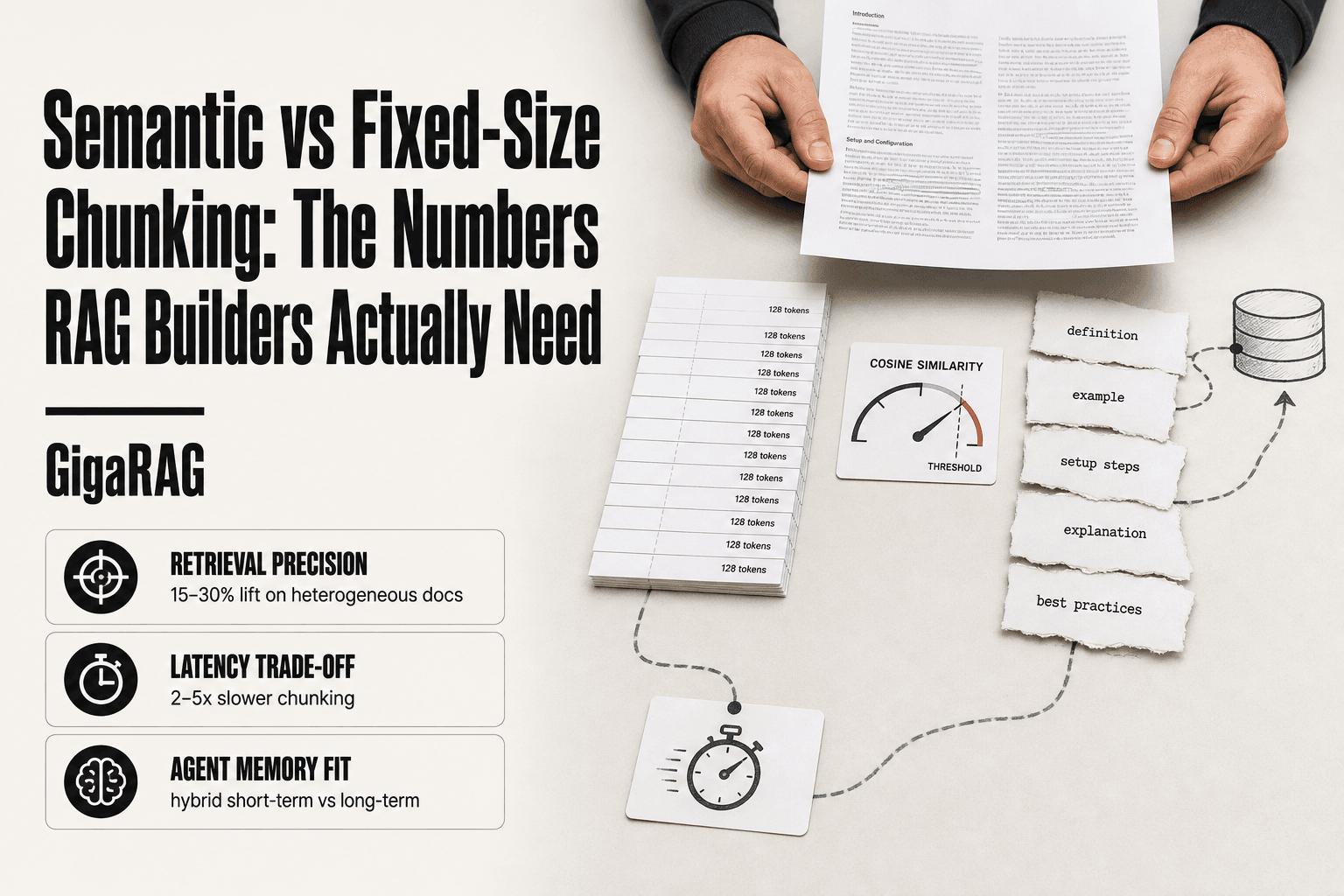
Chunking strategy is the first cost you'll feel. Pick the wrong chunk size or overlap, and retrieval quality drops. Change your document types, and you'll re-chunk everything. Embedding models update every few months. When a new model ships with better recall, you either re-embed your entire corpus or accept stale vectors. Re-embedding a million documents isn't free: it's compute time, API spend, and a migration window where your pipeline serves mixed-quality results.
The vector store looks cheap until it isn't. Index rebuilds, schema changes, and scaling past a single node all take real work. You'll also need to decide between managed vector databases and self-hosted ones, and that decision locks in maintenance either way.
The hidden costs: evaluation harness, observability, re-ranking
The costs nobody budgets for are the ones that kill DIY pipelines. An evaluation harness means building test sets, computing recall@k and precision@k, and running those evals every time you change a chunking parameter or swap an embedding model. Without it, you're tuning blind. With it, you're maintaining another codebase.
Observability is the same story. You need to see which queries fail, why they fail, and whether retrieval degraded after a data update. That's logging, tracing, and dashboards you build yourself. Re-ranking adds another layer: a cross-encoder or rule-based reranker that needs its own tuning and evaluation cycle.
Why agent memory pipelines multiply the maintenance burden
Agent memory makes all of this harder because retrieval is no longer stateless. A standard RAG query is independent: same query, same results. An agent memory pipeline has to track conversation state, consolidate memories over time, and decide what to forget. Every one of those mechanics adds a new failure mode and a new evaluation surface.
You're not maintaining one pipeline anymore. You're maintaining a retrieval system, a memory system, and the glue between them. That's the cost most teams discover three months in.
[!note] A DIY RAG pipeline can still be the right choice when you have highly unique data, strict data residency requirements, or need full control over every component. The scorecard is a decision aid, not a mandate.
Build vs Buy: DIY RAG Pipeline vs Managed Agent Memory
| Factor | DIY Pipeline | Managed Platform (e.g., GigaRAG) |
|---|---|---|
| Time to first working version | Weeks to months | Hours to days |
| Maintenance overhead | High: infra, tuning, upgrades | Low: vendor handles ops |
| Evaluation rigor | Often ad-hoc or missing | Built-in metrics and observability |
| Scaling headroom | Manual sharding, caching, cost spikes | Elastic scaling with predictable cost |
| Customization control | Full control over every component | Configurable but bounded by platform |
The 5 Stages of a RAG Pipeline (and Where They Break)
A RAG pipeline has five stages: ingestion, chunking, embedding, retrieval, and generation. Each stage has a specific failure mode that signals your DIY approach is no longer viable. The break points are predictable, and they compound.
Ingestion: schema drift and data quality decay
Ingestion breaks when your data sources change shape. A new document type arrives, a field gets renamed, an API response adds a nested object. Your parser handles the old schema fine and silently drops the new fields. You won't notice until retrieval quality degrades and you can't trace why.
Data quality decay is slower but worse. Duplicate documents accumulate, stale records stay indexed, and nobody owns cleanup. The pipeline keeps working while the index gets worse.
Chunking: strategy churn and evaluation blind spots
Chunking breaks when you start changing strategy without measuring impact. You try smaller chunks, then larger, then semantic chunking, then sliding windows. Each change feels like progress. Without an evaluation harness, you're guessing.
The blind spot is real: chunking changes affect recall and precision differently per query type. You can't see that without running evals.
Embedding: model updates and re-embedding costs
Embedding breaks when a better model ships and you can't afford to switch. Re-embedding a large corpus costs compute and API spend. Sticking with the old model costs retrieval quality. Either way, you're paying.
Retrieval: recall plateaus and latency spikes
Retrieval breaks when tuning stops helping. You add hybrid search, re-ranking, query expansion, and recall@k barely moves. Meanwhile, latency climbs past what your users tolerate. The plateau is the signal.
Generation: context window mismatches and token waste
Generation breaks when retrieved chunks don't fit the context window cleanly. You truncate, you lose relevant context. You stuff everything, you waste tokens and slow responses. The mismatch compounds with every query.
[!tip] Before you commit to a managed platform, export a representative sample of your queries and expected answers. Use it to benchmark the vendor's retrieval quality and latency against your current pipeline — this turns a subjective decision into a measurable one.
When To Stop Building Your Own Pipeline: A Step-by-Step Guide
- Track your maintenance hours for two weeks; if they exceed feature development hours, flag it.
- Measure retrieval quality (e.g., recall@k, MRR) against a held-out set; if below your target after tuning, flag it.
- Assess evaluation complexity: do you have automated offline and online metrics? If not, flag it.
- Check scaling behavior: does latency or cost grow nonlinearly with data volume? If yes, flag it.
- Review opportunity cost: list features you could ship if you weren't maintaining the pipeline.
- Tally flags; if three or more are present, seriously evaluate a managed alternative.
- If you decide to switch, run a parallel pilot with a subset of traffic to compare quality and cost.
How Long Pipelines Take to Build (and Why That Number Lies)
A demo RAG pipeline takes two to three weeks. A production pipeline takes three to six months. The number you hear most often is the demo number, and it's the one that lies.
Initial build: weeks, not months, for a demo
You can wire together ingestion, chunking, embedding, and retrieval in about two weeks if you've done it before. Use a hosted vector store, grab an off-the-shelf embedding model, and you'll have something that answers questions by the end of the sprint. It won't handle edge cases. It won't have evaluation. It will demo fine.
That's the trap. The demo works, so you estimate the remaining work in days. You're wrong by an order of magnitude.
Production hardening: where the real time goes
Hardening is everything the demo skipped: retry logic, rate limiting, schema validation, monitoring, alerting, and an evaluation harness that actually runs. Each of those is a week or more. Add re-ranking, query routing, and caching, and you're at three to six months before you'd trust it with real users.
Most teams don't budget for this. They ship the demo and call it production, then spend the next year fixing what breaks.
The maintenance tail: 3-5x the initial build cost
The honest number is the maintenance tail. Embedding model updates, vector store upgrades, dependency churn, and evaluation upkeep run three to five times the initial build cost over the pipeline's life. A two-week demo becomes a two-year commitment.
That's the number that matters, and it's the one nobody puts in the project plan.
Stop Signal #1: Your Retrieval Quality Has Plateaued
You've tuned chunk sizes, swapped embedding models, added re-ranking, and your retrieval metrics haven't moved in weeks. That's not a tuning problem. That's a plateau.
The metrics that matter: recall@k, precision@k, MRR
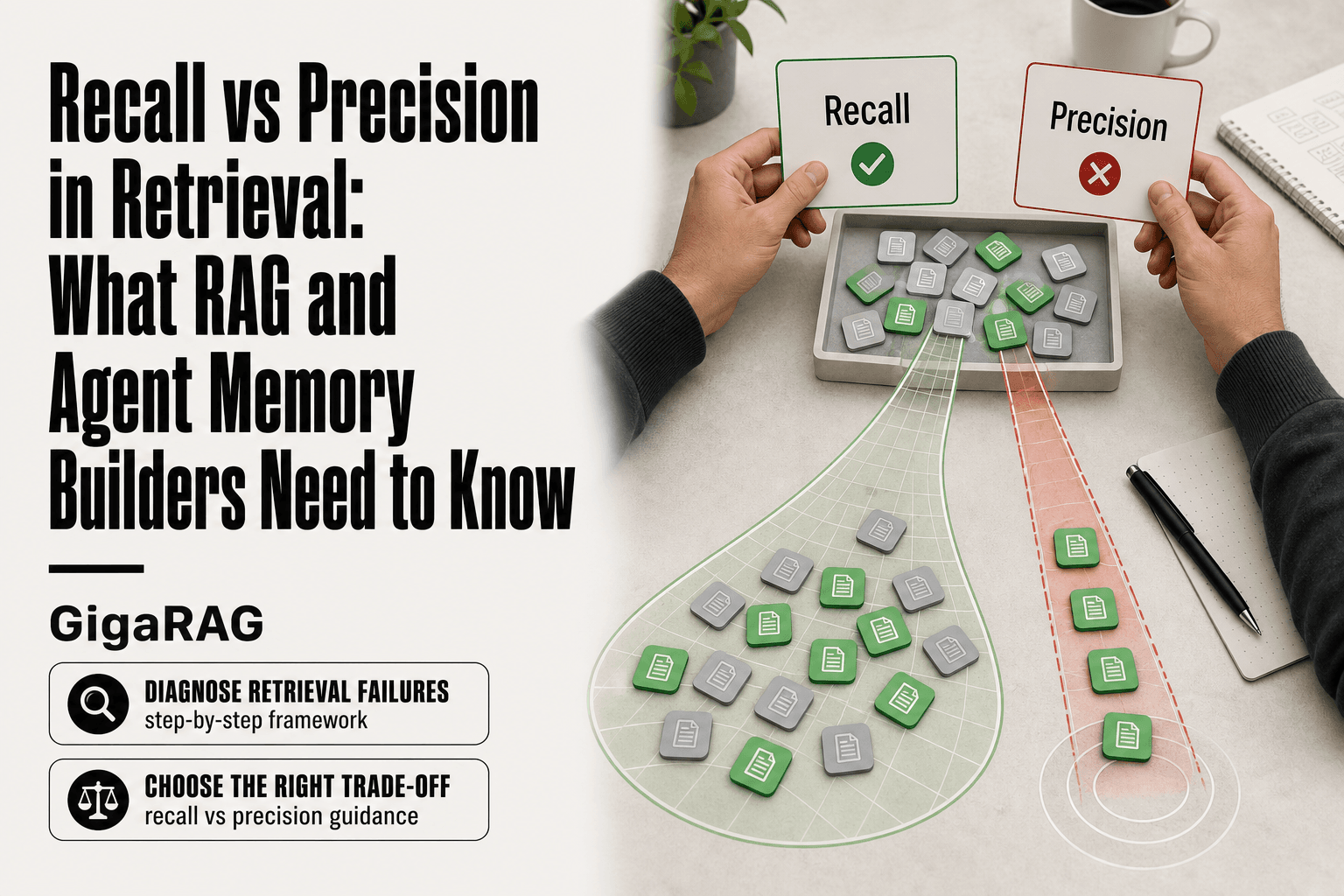
Three numbers tell you whether retrieval is working. Recall@k measures how often the right chunk appears in your top-k results. Precision@k measures how many of those top-k results are actually relevant. MRR measures how high the first relevant result ranks.
Track all three. Recall tells you if the answer is there at all. Precision tells you if you're drowning the model in noise. MRR tells you if the right answer shows up early enough to matter.
The plateau threshold: when tuning stops helping
Here's the honest threshold. If recall@10 is above 0.85 and precision@5 is above 0.7, you're in good shape. Additional tuning buys you fractions of a point. If you're below those numbers and stuck after two or three rounds of chunking and embedding changes, the problem isn't your tuning. It's your architecture.
The main catch is that most DIY pipelines never measure these at all. Teams tune by feel, swap models on a hunch, and wonder why nothing improves. Without a baseline, you can't see the plateau.
What a managed pipeline can and cannot fix
A managed pipeline fixes the baseline problem: it ships with evaluation built in, so you see recall and precision from day one. It cannot fix bad data. If your source documents are inconsistent or your queries are ambiguous, no pipeline saves you.
The honest answer is that retrieval quality plateaus are usually a signal about your data, not your code. Before you stop building, check whether the plateau is architectural or just messy inputs. If it's architectural, stop tuning and start evaluating alternatives.
Stop Signal #2: Maintenance Is Eating Your Roadmap
Retrieval plateaus are one thing. Maintenance is quieter and worse. It doesn't announce itself. It just shows up every week as a dependency bump, a schema change, or a re-embedding job that eats your afternoon.
Embedding model updates and re-embedding costs
When your embedding model ships a new version, you don't just swap the model. You re-embed every document in your corpus. For a million chunks, that's a batch job that runs for hours and costs real money in compute. Skip it and your new queries embed into a different vector space than your old documents. Retrieval silently degrades.
Vector store upgrades and schema migrations
Vector stores change their index formats, their filtering syntax, and their distance metrics. Upgrading means migrating data, re-testing recall, and often re-tuning your chunking because the new index behaves differently. Each upgrade is a small project. They arrive every few months.
The hours-per-week threshold: when to stop
Track your maintenance hours for two weeks. If you're spending more than 5 hours per week on pipeline upkeep, not feature work, you're not building a product. You're operating a service you didn't plan to run.
That's the threshold. Under 5 hours, keep going. Over 5 hours for two consecutive weeks, the pipeline owns you.
Stop Signal #3: Agent Memory Makes DIY Exponentially Harder
Standard RAG is stateless. Every query hits the same retrieval path, gets the same treatment, and returns. Agent memory breaks that assumption. The agent remembers what it did three turns ago, and that memory changes what it should retrieve next. You're no longer building a pipeline. You're building a state machine.
Stateful retrieval vs. stateless RAG
In stateless RAG, the query is the only input. In agent memory pipelines, the query arrives wrapped in context: previous turns, user preferences, task history, and half-finished plans. Retrieval has to account for all of it. That means your retrieval logic now branches. Sometimes you search the conversation history. Sometimes you search the knowledge base. Sometimes you search both and merge. Each branch needs its own evaluation, its own latency budget, and its own failure mode.
Memory consolidation and forgetting curves
Agents accumulate memory faster than they can use it. After a few hundred turns, the raw transcript is too big for any context window. So you consolidate: summarize old turns, extract entities, compress decisions into structured records. That consolidation step is a second pipeline running alongside your retrieval pipeline. And it has its own tuning problem: consolidate too aggressively and the agent forgets critical context. Too little and your token costs climb and latency spikes. There's no default that works. You tune it per use case.
Why multi-agent coordination breaks DIY pipelines
One agent with memory is hard. Three agents sharing memory is a different problem entirely. Each agent has its own context window, its own retrieval needs, and its own view of what's relevant. Coordinating them means deciding who writes to shared memory, who reads it, and how conflicts get resolved. That's distributed systems work. Most DIY pipelines were never architected for it, and retrofitting shared memory into a single-agent design usually means a rewrite.
If you're here, the stop decision isn't theoretical. It's already made.
When to Stop Building Your Own Pipeline: The Scorecard
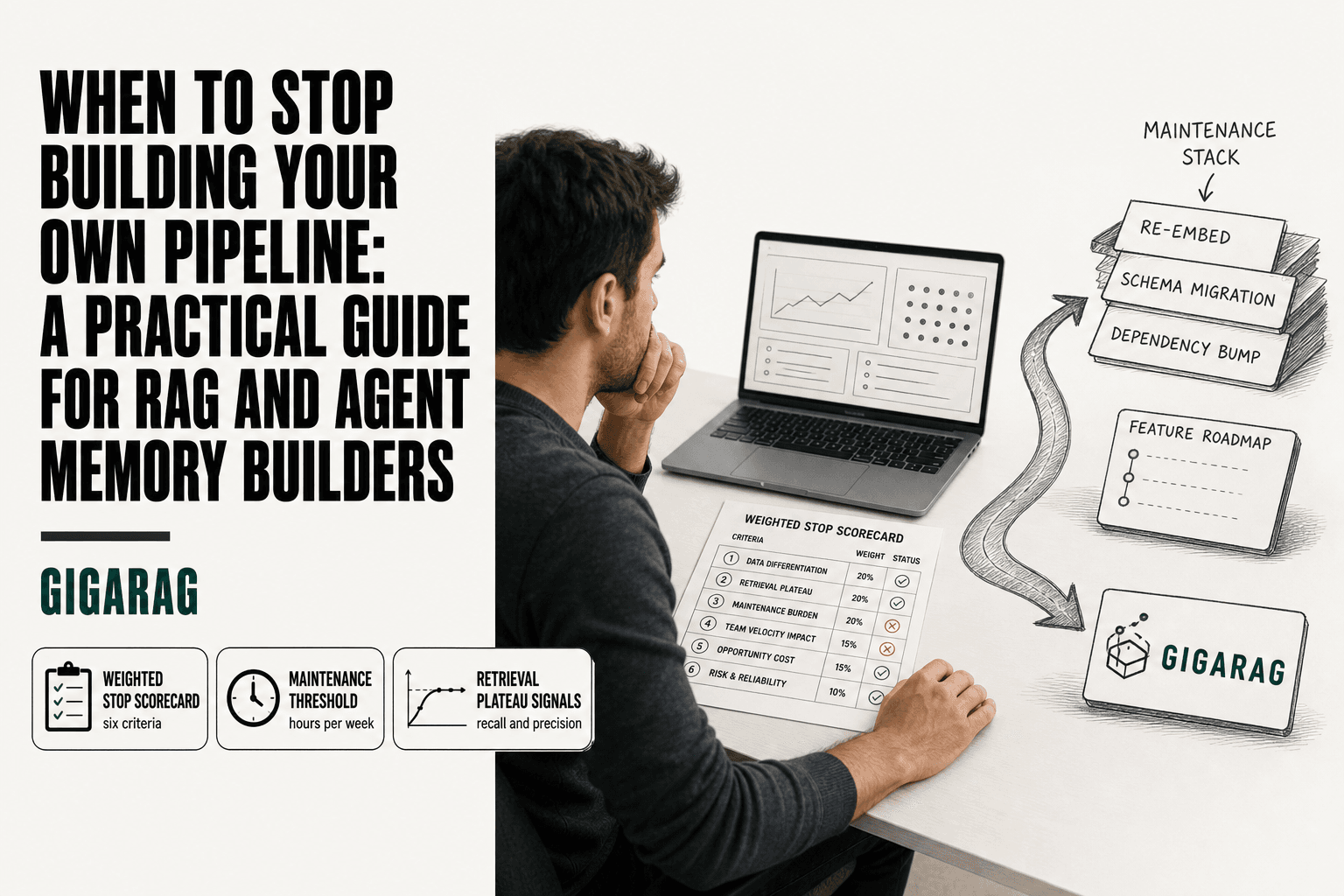
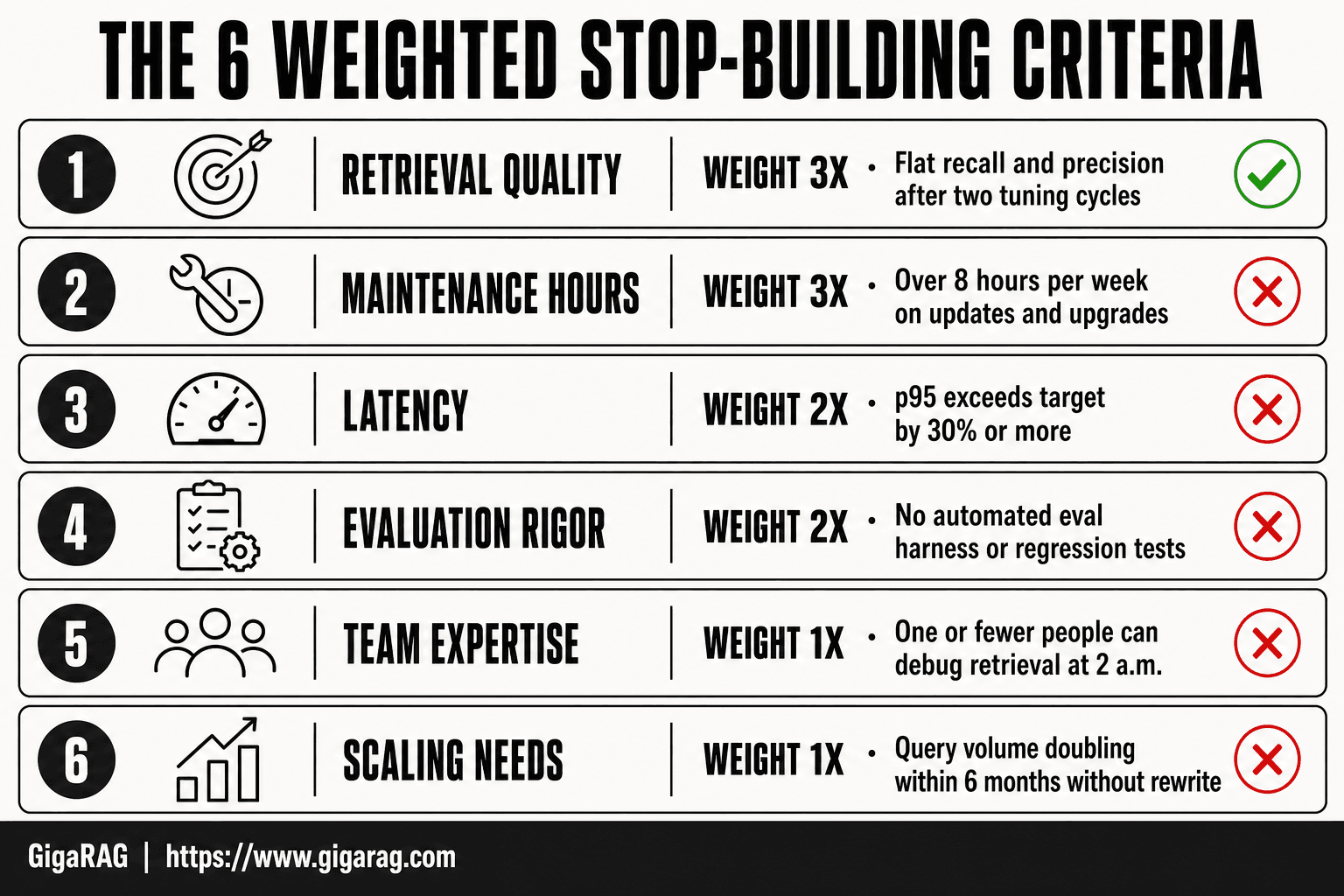
You've read the stop signals. Now you need a way to turn them into a decision. This scorecard does that. Six criteria, each weighted by how much it actually drives your day-to-day pain. Tally your score and you get a clear answer: stop, pause, or keep building.
The 6 criteria that matter
Score each from 0 to 5, where 0 means "this is fine" and 5 means "this is actively hurting us."
Retrieval quality (weight 3x). Are your recall@k and precision@k numbers flat for two consecutive tuning cycles? Score high.
Maintenance hours (weight 3x). Track actual hours spent on embedding updates, vector store upgrades, and dependency churn. Over 8 hours per week is a 5.
Latency (weight 2x). If your p95 retrieval latency exceeds your target by 30% or more, score high.
Evaluation rigor (weight 2x). Do you have an automated eval harness with regression tests? No harness at all is a 5.
Team expertise (weight 1x). How many people on your team can debug a retrieval failure at 2 a.m.? One or fewer is a 5.
Scaling needs (weight 1x). Will your query volume double in the next 6 months? If yes and your current architecture can't handle it without a rewrite, score high.
Scoring thresholds: stop, pause, or keep building
Multiply each score by its weight, then add them up. Max possible score is 60.
0-20: Keep building. Your pipeline is serving you. The maintenance burden is manageable and retrieval quality is still improving.
21-40: Pause. Stop adding features. Run a 30-day evaluation sprint. If retrieval quality doesn't improve measurably in that window, move to stop.
41-60: Stop. The pipeline is costing more than it returns. Start planning a migration to a managed service or a simpler architecture.
How to use the scorecard with your team
Don't score this alone. Get the person who owns retrieval, the person who owns infrastructure, and the person who owns the product in one room. Each scores independently, then you compare. Where scores diverge by more than 2 points, talk through the gap. That conversation usually surfaces the real problem faster than the score itself.
Run the scorecard once a quarter. The numbers will drift. Your job is to notice when they cross a threshold before the pipeline takes your roadmap down with it.
When Building Is Still the Right Call
The scorecard says stop. But sometimes the scorecard is wrong. Three scenarios justify keeping your DIY pipeline, and you should know them before you tear anything down.
When data constraints force DIY
Your data can't leave your infrastructure. A hospital with PHI, a bank with transaction records, a defense contractor with classified documents. Managed RAG services run in someone else's cloud. If your compliance officer says the data stays on-prem, you build. No managed service fixes that.
When the pipeline is your product
You're not building a retrieval layer for your app. The retrieval layer is the app. You sell it, you version it, you tune it per customer. In that case the maintenance hours aren't overhead. They're the product roadmap. The scorecard's maintenance threshold doesn't apply, because every hour spent tuning is an hour spent improving what you sell.
When managed services are the wrong fit
Managed services optimize for the common case. If you need a custom chunking strategy tied to a domain-specific schema, or a hybrid retrieval path with a re-ranker you trained yourself, most managed offerings won't bend that far. You'll spend more time fighting the abstraction than you'd spend maintaining your own code.
The honest answer is this: build when the constraint is external, the pipeline is the revenue, or the customization is the point. Otherwise, the scorecard stands.
What You Cannot Do with a DIY Pipeline
You can build a RAG pipeline that works. You cannot build one that matches what a dedicated team ships after two years of hardening. The gap isn't skill. It's surface area.
Production-grade observability
A DIY pipeline logs what you remembered to log. Retrieval latency, embedding failures, chunk count. What you miss is the connective tissue: trace IDs across ingestion and query paths, per-stage latency breakdowns, drift detection on your embedding model's output distribution. Managed platforms ship this because their entire business depends on debugging other people's pipelines at scale. You'll get the basics in a weekend. You won't get the dashboard that tells you why recall dropped 4 points last Tuesday without three days of forensic work.
Automated evaluation and regression testing
You can write a script that runs recall@k on a golden set. You can even wire it into CI. What you can't easily build is the evaluation harness that catches silent regressions: a chunking change that improves one query pattern while degrading twenty others, an embedding model update that shifts nearest-neighbor results in ways your golden set doesn't cover. Teams that build this properly spend months on it. That's months not spent on your actual product.
Scaling headroom without re-architecture
Your pipeline handles 10,000 documents fine. At 10 million, the vector store needs sharding. At 100 million, your re-ranking step becomes the bottleneck and your cache hit rate collapses. Each of those jumps is a re-architecture project, not a config change. Managed services absorb those transitions because they've already built for the next order of magnitude. You'll discover the wall when you hit it.
None of this means DIY is wrong. It means DIY has a ceiling, and the ceiling is lower than most builders admit.
Making the Call: A Practical Decision Framework
You have the scorecard. You have the stop signals. Now you need a process for applying them without another three months of deliberation.
Run the scorecard with your team
Print the six criteria. Have each person score them independently, then compare. The disagreements matter more than the averages. When one engineer scores retrieval quality a 2 and another scores it a 7, you've found either a measurement gap or a definition gap. Fix that before you total anything.
Don't let the person who built the pipeline score it alone. Their sunk cost is real, and it will nudge every number upward.
Set a 30-day re-evaluation checkpoint
Score it once, write down the date, and commit to re-scoring in 30 days. If the numbers haven't moved, that's your answer. A pipeline that isn't improving under active tuning is a pipeline telling you it's done.
If the scorecard says stop, the honest question isn't whether to keep building. It's when to stop building your own pipeline and move the effort somewhere it pays. GigaRAG is one option for agent memory specifically. It isn't the only one.
Frequently Asked Questions
How long do pipelines take to build?
A basic RAG pipeline can be prototyped in days, but a production-grade system with robust evaluation, observability, and scaling typically takes weeks to months. The ongoing maintenance never really ends, which is why many teams reassess after the initial build.
What are the 5 stages of a pipeline?
In RAG, the typical stages are: ingestion, chunking, embedding, retrieval, and generation. Agent memory pipelines add stages like memory writing, consolidation, and forgetting. Each stage adds maintenance and tuning overhead.
How do I know if my retrieval quality is good enough?
Define a target metric (e.g., recall@10 above a certain threshold) based on your use case, and measure it on a held-out set. If you've tuned for weeks and still miss the target, that's a strong stop signal.
When should I stop building my own pipeline?
Consider stopping when maintenance hours consistently exceed feature development, retrieval quality plateaus below target, evaluation is ad-hoc, or scaling costs grow nonlinearly. If three or more of these apply, a managed alternative is worth evaluating.
Is building your own RAG pipeline ever the right choice?
Yes. If you have highly unique data, strict compliance needs, or require full control over every component, building may still be justified. The key is to make that choice deliberately, not by default.
What does a managed agent memory platform offer over DIY?
Managed platforms typically provide built-in evaluation, observability, and elastic scaling, reducing maintenance overhead. They may also offer features like automatic memory consolidation and retrieval optimization that are hard to replicate in-house.
About GigaRAG
GigaRAG is for agent memory and RAG pipeline builders. get this right. Whether you are working through when to stop building your own pipeline or something adjacent, we publish what we have actually tested, including where it falls short.