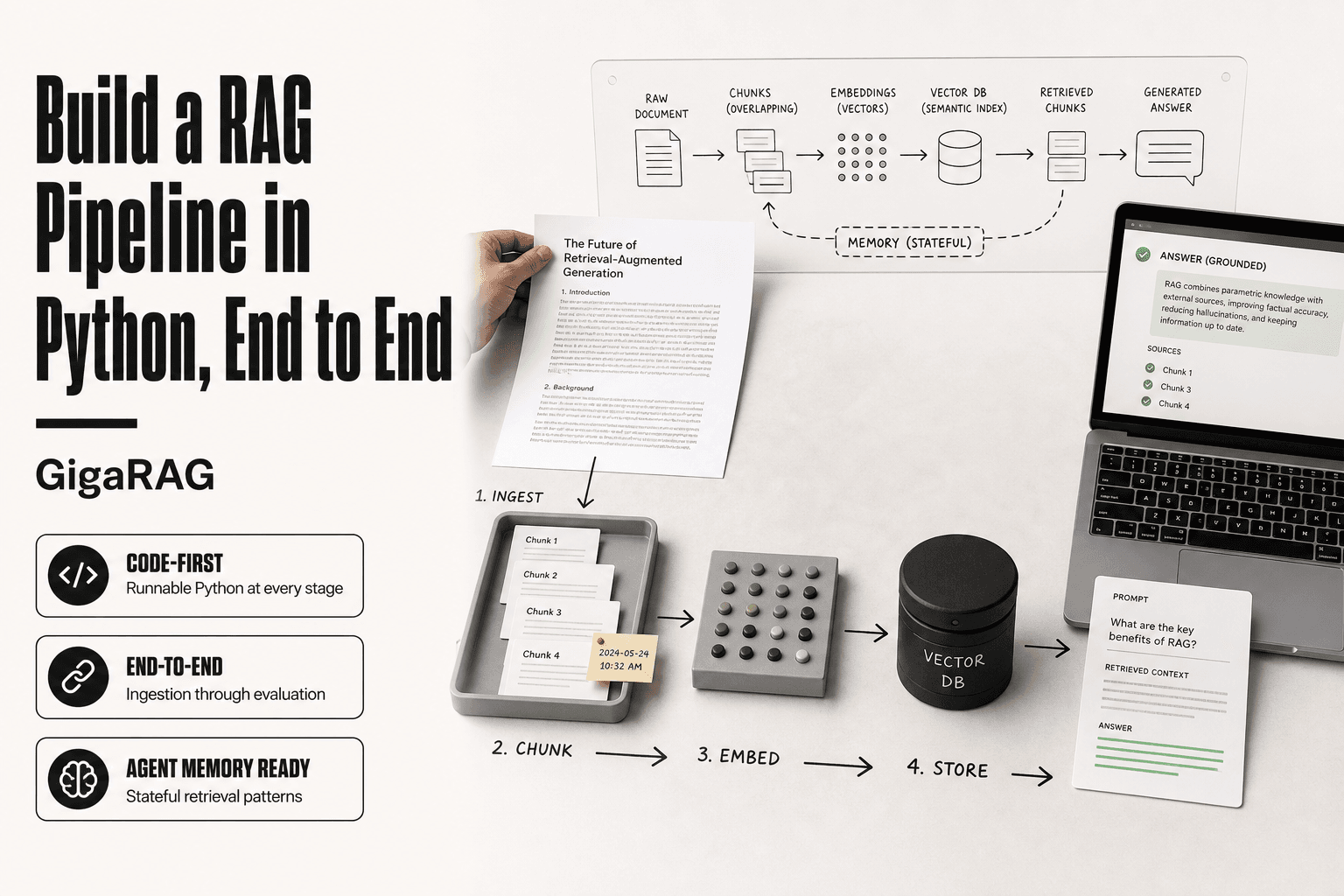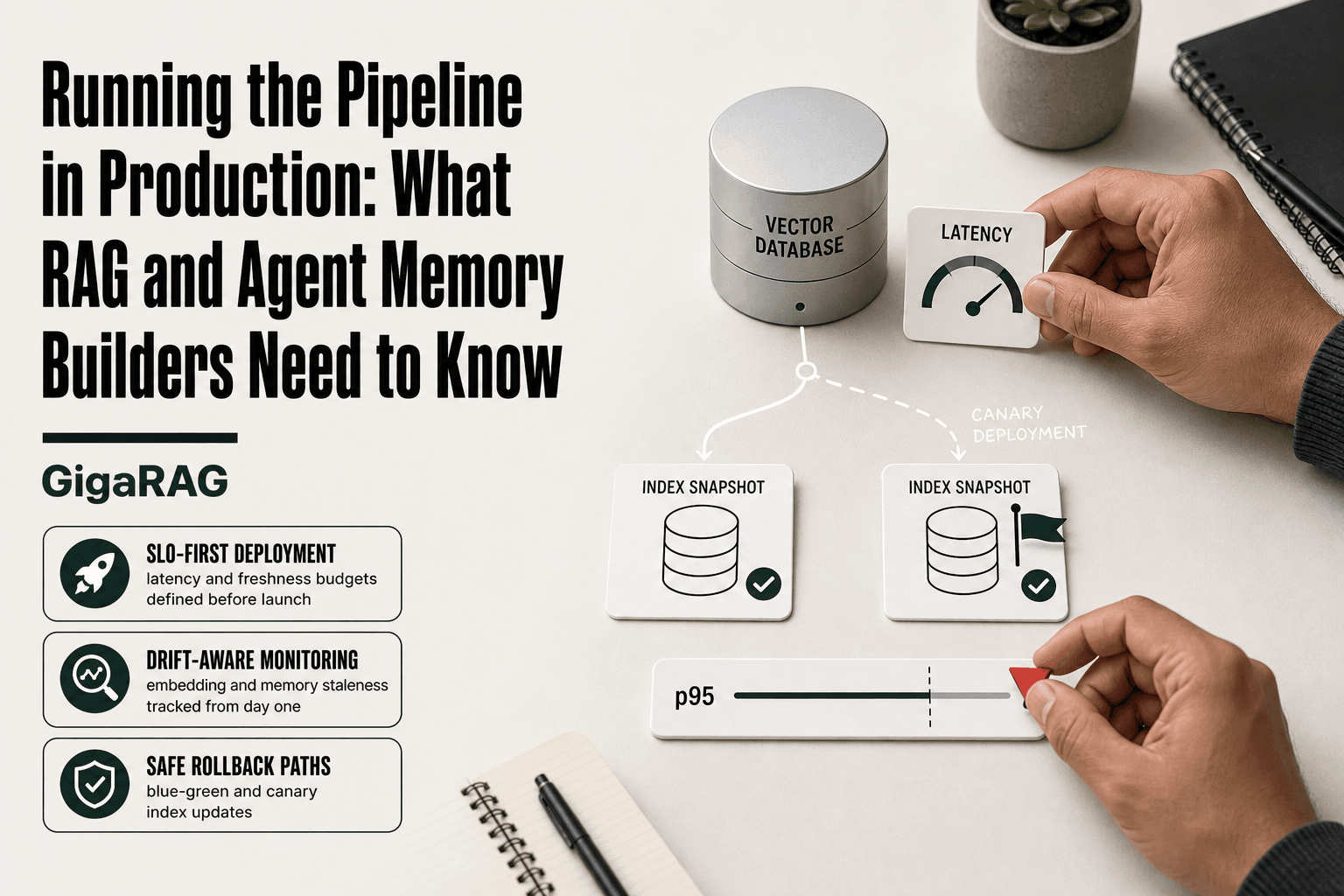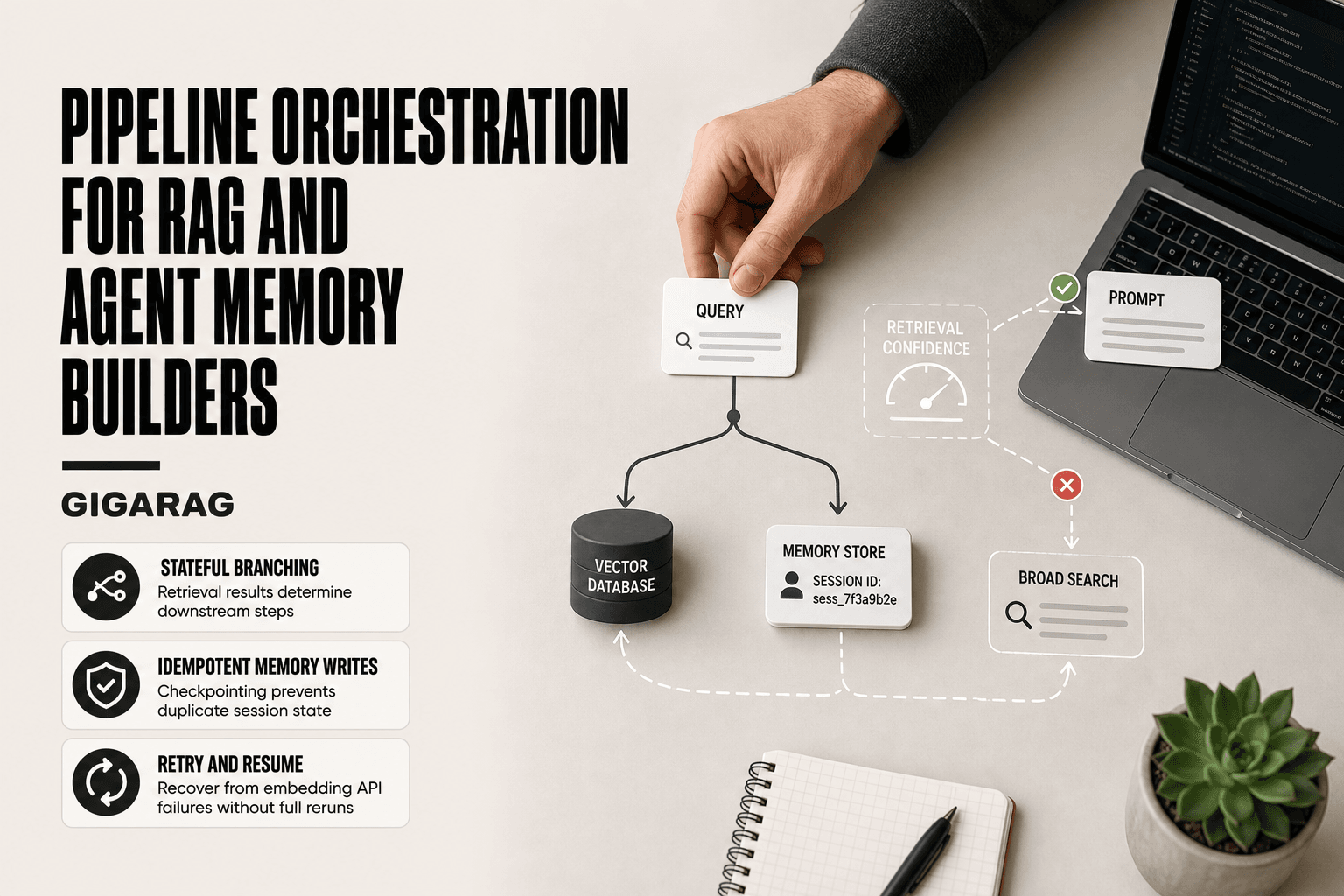
Sync vs Async Ingestion Architecture: What RAG and Agent Memory Builders Need to Know
Sync vs async ingestion architecture is a decision you'll make early when building a RAG pipeline or agent memory system, and it shapes everything downstream: retrieval quality, user-facing latency, and how much infrastructure you end up maintaining. The core question is simple. Should data flow through the pipeline synchronously, blocking until embedding and indexing complete, or asynchronously, queued and processed later? The honest answer is it depends on your latency requirements, data volume, and consistency needs. Most top results push async hard, and for good reason, but sync is not a legacy mistake. There are real scenarios where blocking is the right call for agent memory updates and small document sets. GigaRAG handles both patterns, and seeing where each one breaks helped me write this guide.
| At a glance | Details |
|---|---|
| Core decision | Sync for immediate consistency; async for scale and decoupling |
| Latency impact | Sync adds write latency; async adds eventual consistency delay |
| Best for RAG | Async for bulk embedding; sync for real-time updates |
| Complexity | Sync simpler; async needs queues and monitoring |
| Failure handling | Sync fails fast; async requires retries and DLQs |
| When to choose sync | Low volume, strong consistency, simple pipelines |
In This Guide
- What Is Sync vs Async Ingestion Architecture?
- Sync vs Async Ingestion: Which Fits Your RAG Pipeline?
- Why Async Ingestion Dominates Modern RAG Pipelines
- Sync Vs Async Ingestion Architecture: A Step-by-Step Guide
- When Sync Ingestion Is Actually the Right Call
- A Practical Decision Framework for Sync vs Async Ingestion Architecture
- Architecture Patterns for RAG and Agent Memory Ingestion
- Common Challenges and How to Handle Them
- Sync vs Async Ingestion Architecture: Final Recommendations
What Is Sync vs Async Ingestion Architecture?
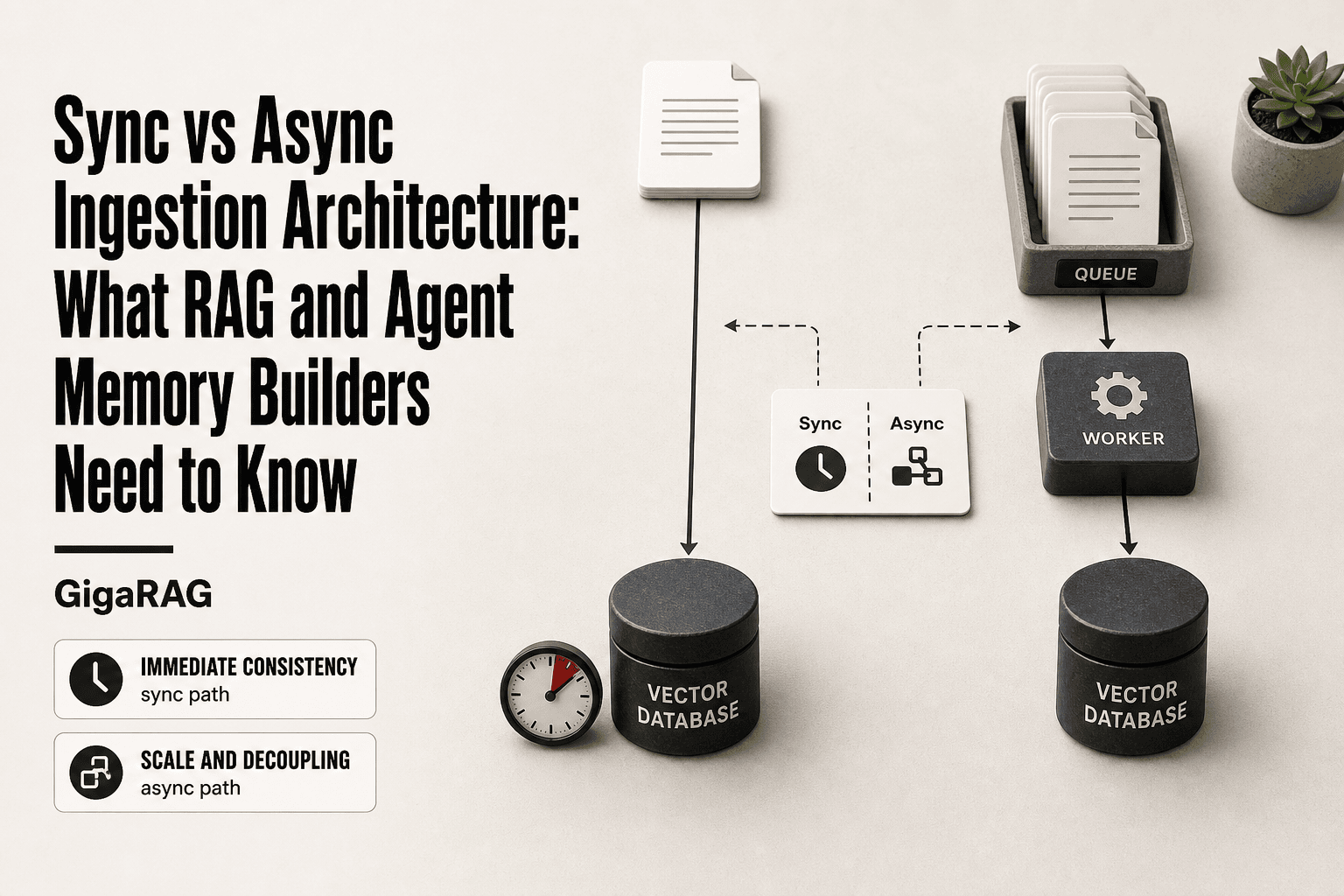
Sync ingestion blocks the caller until the document is fully parsed, embedded, and written to the vector store. Async ingestion queues the document and returns immediately, processing it later.
Synchronous ingestion: blocking, immediate, consistent
When you POST a document to a sync endpoint, the request stays open through parsing, chunking, embedding, and the vector store write. You get a 200 only when the document is retrievable. That's the trade: every call costs you the full pipeline latency, but you never have to check whether the data landed.
Asynchronous ingestion: queued, decoupled, eventual
Async hands the document to a queue and returns a 202. A worker picks it up, runs the same pipeline, and writes to the vector store on its own schedule. Your API stays fast. The catch: the document isn't searchable yet, and you need a way to tell the client when it is.
[!note] Synchronous ingestion doesn't automatically mean slow; for low-volume or real-time use cases, it can be simpler and sufficient. Asynchronous ingestion introduces eventual consistency, so retrieval may return stale data until processing completes.
Sync vs Async Ingestion: Which Fits Your RAG Pipeline?
| Factor | Synchronous Ingestion | Asynchronous Ingestion |
|---|---|---|
| Latency | Higher per-request latency due to blocking | Lower request latency; processing happens in background |
| Consistency | Immediate consistency: data is queryable after write | Eventual consistency: data appears after processing delay |
| Scalability | Limited by request throughput and resource contention | Scales horizontally with queues and workers |
| Complexity | Simpler to implement and debug | Requires queue, worker, and monitoring infrastructure |
| Error handling | Errors surface immediately to caller | Errors require retries, dead-letter queues, and alerting |
| Use case fit | Real-time updates, small batches, strong consistency needs | Bulk ingestion, high volume, decoupled services |
Why Async Ingestion Dominates Modern RAG Pipelines
It isn't fashion. It's three structural problems that sync handles poorly.
Decoupling document parsing from embedding generation
Parsing a PDF is slow. Embedding 500 chunks is slower. In a sync pipeline, those two costs stack inside one request, and the caller pays for both. Async splits them. The API accepts the raw document, returns immediately, and a worker handles parsing and embedding on its own clock. You can scale the parser pool separately from the embedder pool. When one backs up, the other keeps moving.
Handling large volumes without blocking the API
A bulk upload of 10,000 documents will not finish in a single request. Sync forces you to either time out or hold the connection open for minutes. Async lets the API accept all 10,000 in seconds and drain the queue over hours. The client gets a job ID, not a hang. That's the difference between an ingestion endpoint that survives a spike and one that falls over.
Retry and fault tolerance without user-facing latency
Embedding providers rate-limit. Vector stores have transient outages. In sync, a failure means the user resubmits and waits again. In async, the worker retries with backoff, and the user never sees it. You can also park poisoned documents in a dead letter queue instead of failing the whole batch.
The honest catch: async adds a queue, a worker pool, and a status-checking mechanism. You don't get that complexity for free. But for any pipeline handling more than a handful of documents per minute, the alternative is worse.
[!tip] For RAG pipelines, consider a hybrid approach: use synchronous ingestion for small, real-time updates (e.g., user feedback) and asynchronous for bulk document loads. This balances consistency and scalability without over-engineering.
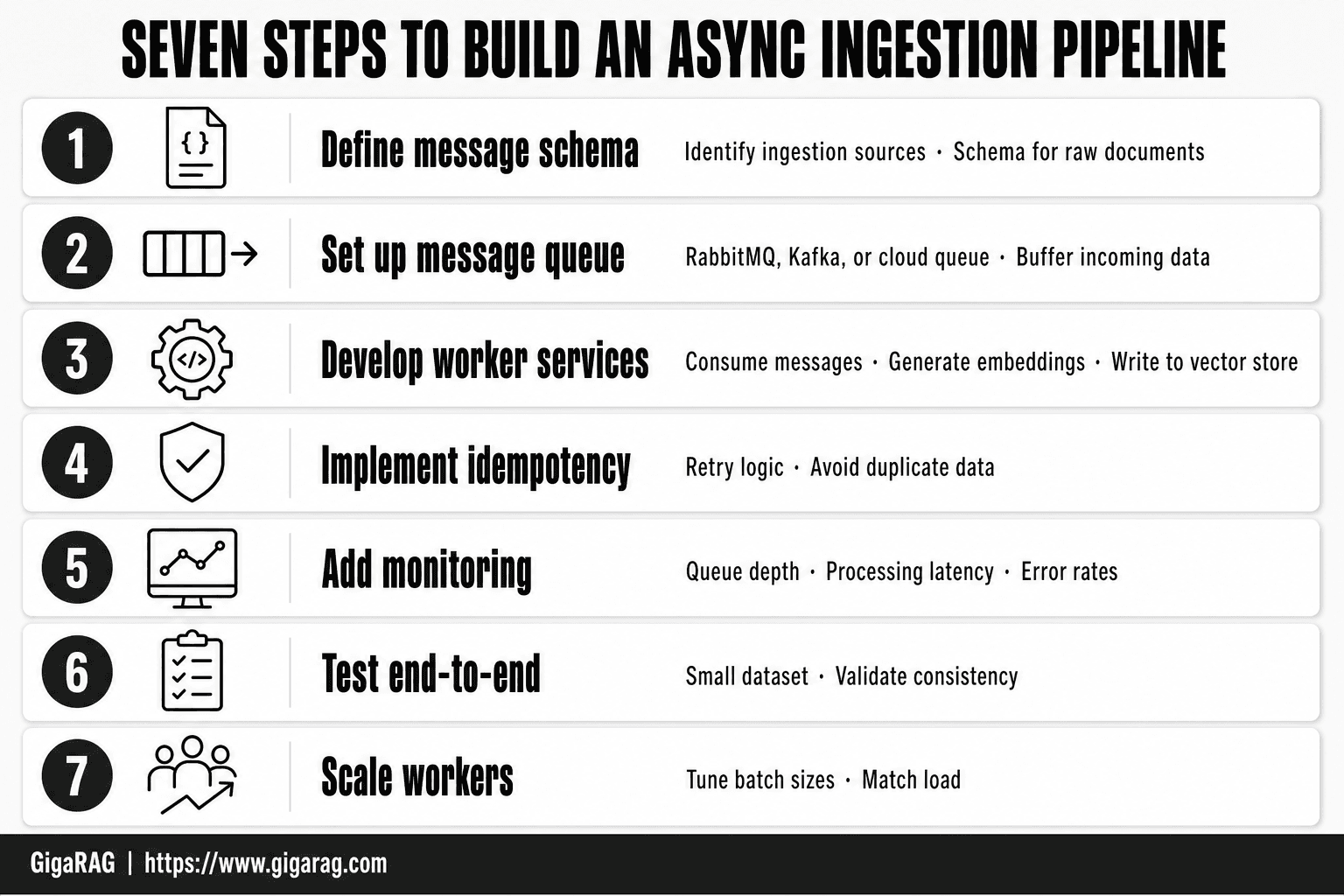
Sync Vs Async Ingestion Architecture: A Step-by-Step Guide
- Identify ingestion sources and define a message schema for raw documents.
- Set up a message queue (e.g., RabbitMQ, Kafka, or cloud queue) to buffer incoming data.
- Develop worker services that consume messages, generate embeddings, and write to the vector store.
- Implement idempotency and retry logic to handle failures without duplicating data.
- Add monitoring and alerting for queue depth, processing latency, and error rates.
- Test with a small dataset to validate end-to-end flow and consistency guarantees.
- Gradually scale workers based on load and tune batch sizes for optimal throughput.
When Sync Ingestion Is Actually the Right Call
Async isn't always better. It's the default for volume, but sync wins when the caller needs the result before moving on.
Low-latency agent memory updates
An agent that writes a fact to memory and then immediately reasons over it can't wait for a queue to drain. Sync ingestion means the write completes before the next turn starts. The agent reads back what it just stored. No stale state, no race condition between write and read.
Transactional consistency for RAG indexing
When a document and its chunks must land in the vector store together, sync gives you a transaction boundary. Either the whole document indexes or nothing does. Async can leave you with half a document indexed while the other half sits in a queue, and a retrieval query in between returns partial results.
Small document sets and debugging simplicity
Under a few hundred documents, sync is simpler. No queue, no worker pool, no status polling. You call the API, it returns, you're done. Debugging is a stack trace, not a queue inspection. The overhead of async infrastructure costs more than the latency you'd save.
The honest answer: sync is the right call when consistency and immediacy beat throughput. Most RAG systems need both, which is why the next section gives you a framework for choosing.
A Practical Decision Framework for Sync vs Async Ingestion Architecture
You've seen both sides. Now you need a way to choose. The framework below works through four questions in order. Each answer pushes you toward sync or async.
Step 1: Assess your latency requirements
Does the caller need the result before it can proceed? If an agent writes a fact to memory and then reasons over it in the same turn, that's a hard latency requirement. Sync is the only option. If the caller can fire off a document and check back later, async opens up.
Step 2: Evaluate data volume and throughput
Under a few hundred documents total, sync handles the load without breaking a sweat. You don't need a queue for that. Past a few thousand documents, or when ingestion spikes arrive in bursts, async absorbs the load without blocking your API. The volume threshold is the pivot.
Step 3: Determine consistency needs
Do you need transactional guarantees? If a document and all its chunks must land in the vector store together, or nothing at all, sync gives you that boundary. Async means eventual consistency: chunks appear over time, and a query in between returns partial results. For most RAG use cases, eventual consistency is fine. For agent memory, it usually isn't.
Step 4: Identify downstream consumers
What reads the data after ingestion? A vector database serving retrieval queries tolerates eventual consistency well. An operational database feeding an agent's immediate reasoning does not. If your downstream consumer is a vector store queried by users, async is safe. If it's an agent's working memory, sync is safer.
The decision matrix
| Factor | Sync | Async |
|---|---|---|
| Latency requirement | Caller blocks until done | Caller proceeds immediately |
| Data volume | Under a few hundred docs | Thousands of docs or bursty loads |
| Consistency | Transactional, all-or-nothing | Eventual, chunks appear over time |
| Downstream consumer | Agent memory, operational DB | Vector store, retrieval queries |
Score it: if you answered sync on latency or consistency, start sync. If you answered async on volume and your downstream consumer tolerates eventual consistency, go async. Most RAG systems end up hybrid: sync for agent memory writes, async for bulk document ingestion.
Architecture Patterns for RAG and Agent Memory Ingestion
The framework points somewhere. Now you need the actual wiring. Three patterns cover most RAG and agent memory systems. Each one maps to a specific answer from the previous section.
Sync pattern: direct API call to embedding and vector store
This is the simplest thing that works. The caller invokes an endpoint, the endpoint embeds the text, writes the vector to the store, and returns. Nothing is queued.
import openai
from qdrant_client import QdrantClient

def ingest_document_sync(text: str, doc_id: str):
    # Embed the text
    embedding = openai.embeddings.create(
        model="text-embedding-3-small",
        input=text
    ).data[0].embedding

    # Write to vector store
    client = QdrantClient("localhost", port=6333)
    client.upsert(
        collection_name="agent_memory",
        points=[{
            "id": doc_id,
            "vector": embedding,
            "payload": {"text": text}
        }]
    )
    return {"status": "indexed", "doc_id": doc_id}
The caller blocks until the upsert returns. That's the point. If the agent needs the memory available before its next reasoning step, this is the pattern. No queue, no worker, no retry logic. The tradeoff: one slow embedding call stalls the entire request. Under a few hundred documents, you won't notice.
Async pattern: message queue with worker pool
For bulk ingestion, decouple the API from the pipeline. The caller drops a message on a queue and returns immediately. A pool of workers consumes messages, embeds text, and writes to the vector store.
import pika
import json

def publish_document(text: str, doc_id: str):
    connection = pika.BlockingConnection(
        pika.ConnectionParameters("localhost")
    )
    channel = connection.channel()
    channel.queue_declare(queue="ingestion_queue", durable=True)
    channel.basic_publish(
        exchange="",
        routing_key="ingestion_queue",
        body=json.dumps({"doc_id": doc_id, "text": text}),
        properties=pika.BasicProperties(delivery_mode=2)  # persistent
    )
    connection.close()
    return {"status": "queued", "doc_id": doc_id}
The worker side pulls messages, embeds, and upserts. If a worker crashes mid-embed, the message stays in the queue and another worker retries. That's the fault tolerance you paid for with added complexity. You now run a broker, a worker pool, and a dead letter queue for messages that fail repeatedly.
Hybrid pattern: sync for agent memory, async for bulk document ingestion
Most production systems end up here. Agent memory writes go through the sync path because the agent needs them immediately. Bulk document ingestion goes through the async path because volume matters more than latency.
The two paths share the same embedding function and the same vector store. What differs is the transport. A single codebase can expose both endpoints: POST /memory for sync writes, POST /ingest for queued writes. The sync path handles low volume and strict consistency. The async path handles high volume and eventual consistency. You don't have to choose one architecture for everything. You choose per data flow.
Common Challenges and How to Handle Them
Async ingestion solves throughput but introduces four problems you'll hit within the first week. None are fatal. All require explicit handling.
Idempotency and duplicate ingestion
Queues retry. A worker crashes after embedding but before the vector store confirms the write. The message goes back on the queue, and you get two vectors for the same document. Fix it by making the doc_id deterministic: hash the content, not a random UUID. Then the upsert overwrites instead of duplicating. If your vector store doesn't support upsert semantics, you need a deduplication check before each write.
Backpressure and queue overflow
A spike in document uploads fills the queue faster than workers drain it. Memory balloons, the broker slows, and latency climbs for everything downstream. Set a max queue length and reject new messages with a 429 when you hit it. That's better than accepting work you can't process.
Debugging async pipelines
When a document fails to index, you can't just check the API response. You trace it through the broker, the worker logs, and the dead letter queue. Add correlation IDs to every message. Without them, a failed ingestion is a needle in a haystack of worker logs.
What you cannot expect from async
You cannot expect the document to be queryable immediately after the API returns. You cannot expect ordering guarantees unless your broker provides them. And you cannot expect exactly-once delivery from most message queues. At-least-once is the default. Design for duplicates.
Sync vs Async Ingestion Architecture: Final Recommendations
The decision comes down to one question: can the user wait? If the answer is yes, async wins on throughput, fault tolerance, and cost. If the answer is no, sync is the only honest choice.
For agent memory updates that must be queryable on the next turn, use sync. For bulk document ingestion, use async. For everything in between, start with async and add a sync path only where a specific consumer blocks on freshness.
What you cannot expect from either approach: sync will not scale past a few hundred documents per minute without degrading your API. Async will not give you transactional consistency, no matter how carefully you tune the broker.
GigaRAG handles this split internally: sync writes for agent memory, async queues for bulk ingestion, with the same embedding pipeline behind both. You configure the path per data source rather than rebuilding the architecture. That's the pattern worth copying, whether you build it yourself or use a platform that already made the call.
Frequently Asked Questions
What is the difference between sync and async ingestion?
Synchronous ingestion processes data immediately and blocks until complete, ensuring the data is available for querying right after the write. Asynchronous ingestion queues data for background processing, allowing the request to return quickly but introducing a delay before data is queryable.
When should I use synchronous ingestion for RAG?
Use synchronous ingestion when you need immediate consistency, such as real-time updates to agent memory or low-volume document additions where latency is acceptable. It simplifies architecture and debugging.
How does async ingestion affect retrieval quality in RAG?
Async ingestion can lead to temporary staleness: queries might not see the latest data until processing completes. However, with proper monitoring and SLAs, you can minimize the window and ensure eventual consistency.
Can I mix sync and async ingestion in one system?
Yes, a hybrid approach is common. For example, use sync for critical real-time updates and async for bulk loads. This requires careful design to avoid race conditions and ensure data integrity.
What are the key challenges of async ingestion?
Challenges include managing eventual consistency, handling failures with retries and dead-letter queues, and monitoring queue health. These add operational complexity compared to sync ingestion.
How do I choose between sync and async for my RAG pipeline?
Evaluate your latency requirements, data volume, consistency needs, and team capacity. If you need immediate consistency and have low volume, go sync. If you need scalability and can tolerate eventual consistency, go async.
Does async ingestion require additional infrastructure?
Yes, async ingestion typically requires a message queue, worker services, and monitoring tools. This increases setup and maintenance effort but enables better scalability and decoupling.
About GigaRAG
GigaRAG is for agent memory and RAG pipeline builders. get this right. Whether you are working through sync vs async ingestion architecture or something adjacent, we publish what we have actually tested, including where it falls short.