What Is Agentic Memory and When Should You Use It?
What is agentic memory and when should you use it? If you build RAG pipelines, you've hit the wall already: your agent answers a question, the user asks a follow-up, and the agent asks them to repeat everything. That's statelessness. Context windows run out, sessions end, and your carefully tuned retrieval pipeline has no idea what happened three turns ago. Agentic memory is the fix, but it's not free. It adds state, storage, staleness, and cost. You don't need it for every pipeline. You need it when the conversation itself is the source of truth. GigaRAG handles agent memory and RAG pipelines in one place, but this guide stays vendor-neutral. You'll learn what agentic memory actually is, how it differs from plain retrieval, the memory types that matter, and a decision checklist you can run against your own use case before you add a single line of state code.
| At a glance | Details |
|---|---|
| Core idea | Agents store and reuse context across turns and sessions |
| Main benefit | Continuity and personalization without re-prompting |
| Main cost | Added complexity, storage, and retrieval failure modes |
| Best fit | Multi-session, personalized, stateful agent workflows |
| Poor fit | Stateless one-shot tasks and simple Q&A |
| Relationship to RAG | Complements retrieval; does not replace it |
In This Guide
- What Is Agentic Memory?
- Agentic Memory vs Pure RAG: Which Do You Need?
- Why AI Agents Need Memory
- What Is Agentic Memory And When Should You Use It: A Step-by-Step Guide
- Types of Agentic Memory
- Memory Management Approaches
- When Should You Use Agentic Memory?
- Agentic Memory vs RAG: How They Fit Together
- What Agentic Memory Cannot Do
- Memory Hygiene: Why Forgetting Matters
- Agentic Memory Frameworks Compared
- Best Practices for Agentic Memory Implementation
- Final Thoughts
What Is Agentic Memory?
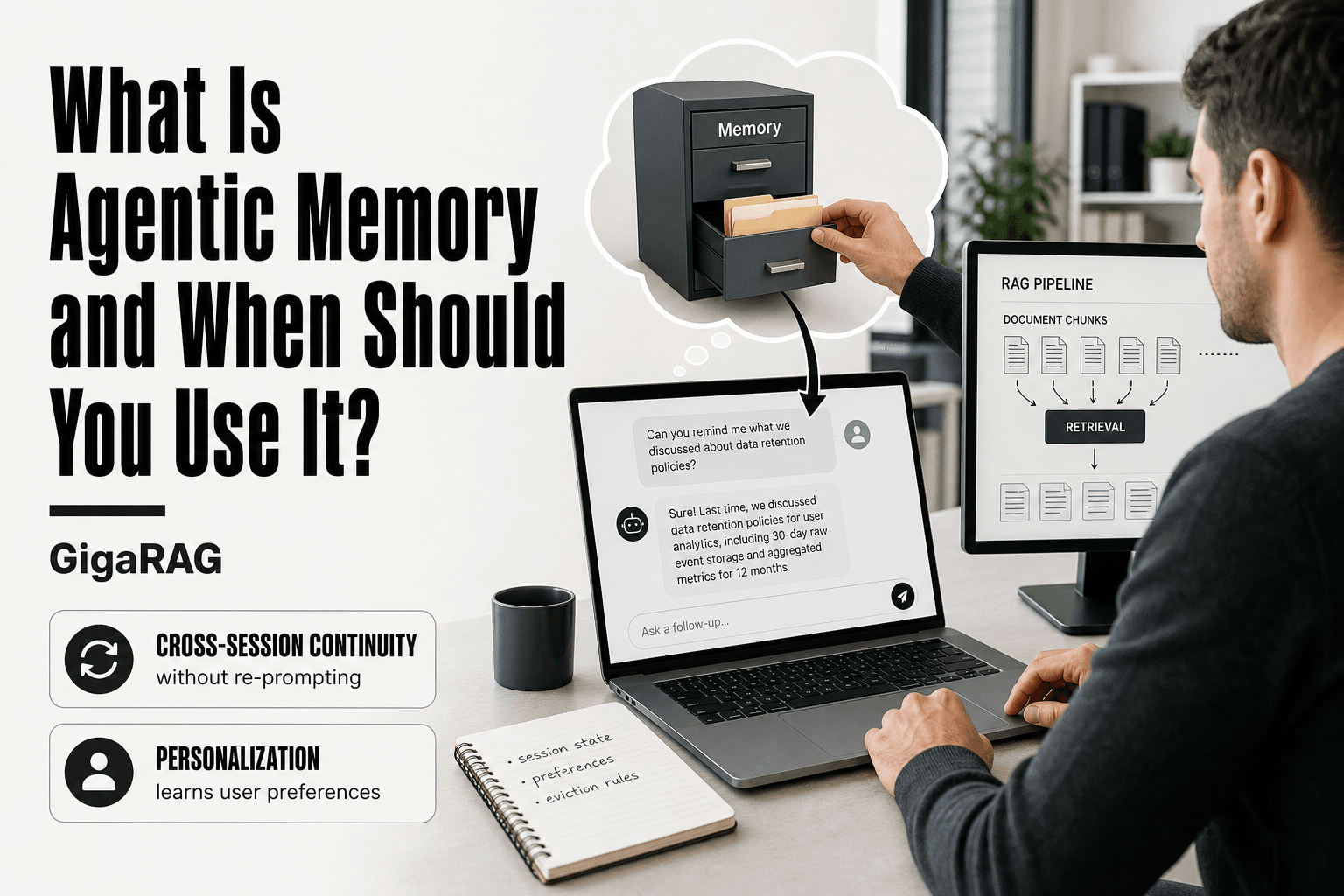
Agentic memory is a persistent store that lets an AI agent remember facts, decisions, and context across turns and sessions, instead of starting from zero every time. It's what turns a stateless model into something that can hold a conversation, track a task, or learn your preferences.
Agentic memory vs context window
The context window is short-term. It holds whatever you stuff into the prompt, and it empties when the request ends. Agentic memory sits outside that window. The agent writes to it, reads from it, and decides what's worth keeping. Context is a whiteboard wiped clean after each meeting. Memory is the filing cabinet.
Agentic memory vs traditional RAG retrieval
RAG pulls from a fixed corpus of documents. The agent queries it, gets chunks back, and moves on. Agentic memory is different: the agent writes to it as it works. It stores conversation history, task state, and learned facts. RAG answers "what does the knowledge base say?" Memory answers "what have we already established?"
What makes memory "agentic"
The agent controls it. It chooses what to store, when to retrieve, and what to discard. That's the key difference from a static vector database or a hardcoded prompt template. The memory isn't passive storage. It's part of the agent's decision loop.
[!note] Agentic memory stores and recalls context over time, while RAG retrieves from an external knowledge base at query time. They solve different problems and are often used together rather than as substitutes.
Agentic Memory vs Pure RAG: Which Do You Need?
| Factor | Agentic Memory | Pure RAG |
|---|---|---|
| Primary purpose | Persist and reuse interaction context | Retrieve facts from a knowledge base |
| State across sessions | Yes, by design | No, stateless per query |
| Personalization | High, learns user preferences | Low, same answer for all users |
| Typical complexity | Higher: storage, writes, retrieval policies | Moderate: index, embed, retrieve |
| Failure modes | Stale or wrong memories, privacy leaks | Missing or irrelevant retrieved chunks |
Why AI Agents Need Memory
The statelessness problem
Every request to an LLM starts from zero. The model doesn't know who you are, what you asked before, or what it already told you. That's statelessness. Each turn is a fresh conversation with a stranger.
You can work around it by stuffing history into the prompt. But the context window is finite. Long conversations hit the ceiling, and you start trimming. What gets cut? Usually the oldest context, which is often the most important for continuity.
What breaks when agents forget
Without memory, an agent re-asks questions you already answered. It loses track of a task halfway through. It contradicts itself across sessions. A support agent that forgets your account issue on turn three isn't helpful. It's broken.
The cost is concrete: more tokens spent re-establishing context, more user frustration, and inconsistent behavior that erodes trust. Memory is what lets an agent behave like the same agent from one turn to the next.
[!tip] For RAG pipeline builders: start by logging which context your agent actually reuses across sessions. If nothing is reused, memory adds cost without benefit — fix retrieval first.
What Is Agentic Memory And When Should You Use It: A Step-by-Step Guide
- List the concrete tasks where your agent loses context today.
- Check whether the task spans multiple turns or sessions.
- Confirm the context is user-specific and reusable, not just retrievable.
- Estimate storage, latency, and privacy costs of persisting that context.
- Prototype with a simple memory store before adopting a framework.
- Define eviction, update, and correction rules for stored memories.
- Measure whether memory improves task success versus pure RAG.
Types of Agentic Memory
Memory isn't one thing. It's a stack of different stores, each with its own job and its own failure mode. Builders who treat memory as a single bucket end up with bloated context and stale recall.
Short-term (working) memory
Working memory holds what the agent needs right now: the current task, recent turns, intermediate steps. It lives inside the context window or a scratchpad. It's fast and cheap, but it evaporates when the session ends.
Use it for anything that fits in one conversation. A coding agent tracking the file it's editing doesn't need long-term storage. It needs the last five turns and the current diff.
Long-term memory
Long-term memory persists across sessions. It stores facts, preferences, and past interactions in a vector database or knowledge graph. Retrieval pulls relevant items back into context when needed.
You reach for long-term memory when an agent must remember something from last week. A support agent that recalls a customer's previous issue, or a research assistant that remembers which sources you already rejected. The trade-off: retrieval adds latency and a new failure mode.
Episodic vs semantic vs procedural memory
Long-term memory splits into three types.
Episodic memory stores specific events: what happened, when, with whom. "The user asked about invoice #4421 on Tuesday." Semantic memory stores general facts: "The user prefers concise answers." Procedural memory stores how to do things: the steps of a workflow the agent learned.
Most RAG pipelines only need semantic memory. Episodic memory matters for personalization. Procedural memory matters for agents that learn new tasks. Don't build all three until the use case demands it.
Memory Management Approaches
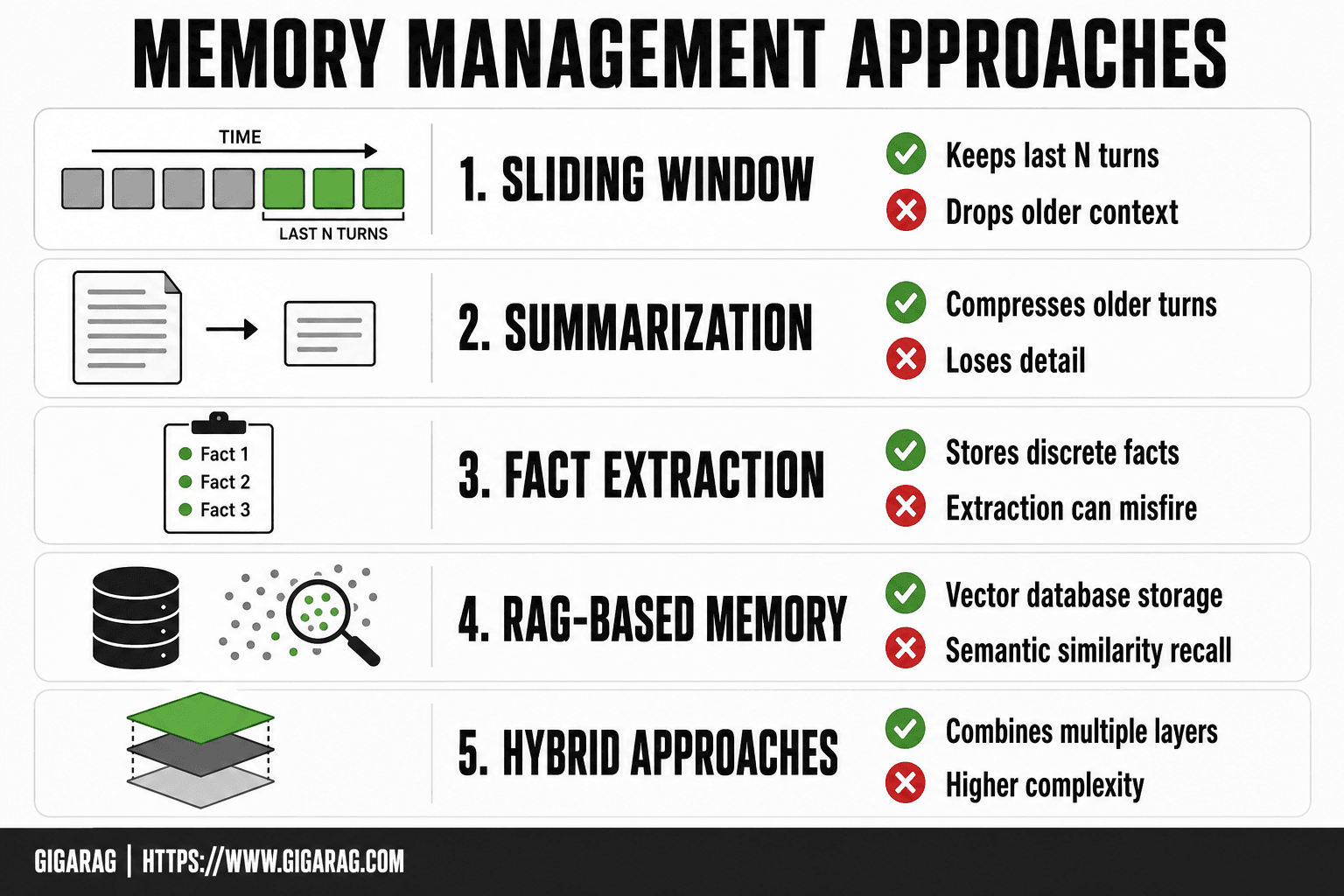
You can't just dump everything into context and hope. Context windows fill up, costs climb, and irrelevant history degrades retrieval quality. Memory management is the set of techniques for deciding what to keep, what to compress, and what to throw away.
Sliding window
Keep the last N turns or tokens, drop everything older. Simple, predictable, cheap. The trade-off: anything outside the window is gone. A 10-turn window means turn 11 can't see turn 1. Fine for short tasks, useless for cross-session recall.
Summarization
Compress older turns into a running summary, then feed the summary plus recent turns into context. You keep the gist without the token cost. The catch: summaries lose detail. The agent remembers that you discussed pricing, but not the exact number you quoted.
Fact extraction
Pull discrete facts out of the conversation and store them separately: "user's budget is $5,000", "prefers Python over JavaScript". Retrieval pulls relevant facts back when needed. This gives you precise recall, but extraction itself can misfire. A bad extraction writes a wrong fact into memory.
RAG-based memory
Store raw interactions in a vector database, embed them, and retrieve by semantic similarity at query time. This scales to large histories and supports fuzzy recall. The trade-off: retrieval accuracy varies, and you're now running a second retrieval pipeline alongside your main RAG system.
Hybrid approaches
Most production systems combine these. Sliding window for immediate context, summarization for medium-term history, fact extraction for stable preferences, vector retrieval for long-tail recall. Each layer covers a different time horizon. The cost is complexity: more moving parts, more failure modes, more to debug. Start with one technique. Add layers only when a specific gap shows up.
When Should You Use Agentic Memory?
Not every agent needs memory. A single-turn Q&A bot that answers from a fixed knowledge base is fine stateless. Memory earns its complexity when the agent has to remember something across turns or sessions that it can't re-derive from the current input.
Signals you need agentic memory
You need memory when any of these are true:
- Conversations run past 5 turns. Below that, a sliding window or full context usually suffices. Past 5 turns, the agent starts losing earlier context and repeating itself.
- The user expects personalization. Preferences, past choices, named entities. If the agent should know "you" without being re-told, that's memory.
- Tasks span sessions. A research agent working across days needs to recall what it found yesterday. Stateless agents restart from zero.
- State is expensive to reconstruct. If re-deriving context costs more than storing it, store it.
A decision checklist for RAG pipeline builders
Run your use case against these four questions:
- Does the agent need to recall anything not present in the current query?
- Does that recall span more than one session?
- Is the recalled information stable enough to store (preferences, facts) rather than volatile (one-off details)?
- Can you afford the retrieval latency and storage cost?
Two or more "yes" answers means memory is worth building. One "yes" means try a simpler approach first.
When stateless approaches are enough
Stateless is the right default when queries are independent, context fits in the window, and personalization doesn't matter. A documentation search bot doesn't need memory. A code review assistant that sees the full diff in one turn doesn't either. Don't add memory because it sounds sophisticated. Add it when a concrete failure shows up: the agent repeats a question you already answered, or forgets a preference you told it twice.
Agentic Memory vs RAG: How They Fit Together
Memory and RAG solve different problems. Memory stores what the agent has learned or experienced: user preferences, task state, facts extracted from past turns. RAG retrieves external knowledge at query time from a corpus the agent doesn't own. Confusing the two leads to bloated memory stores and stale retrieval.
Memory stores state; RAG retrieves knowledge
Memory is the agent's own record. RAG is a lookup against someone else's documents. A support agent remembers that a user prefers email over chat (memory) and pulls the current refund policy from your docs (RAG). Both feed the same context window, but they answer different questions: "what do I know about this user?" versus "what does the corpus say about this topic?"
Integration patterns for RAG pipelines
Three patterns work in practice:
- Memory as a retrieval filter. Stored preferences narrow the search space. If the agent knows the user works in Python, it filters RAG results to Python examples before ranking.
- Memory as a cache. Frequently retrieved chunks get stored in memory with a timestamp. Repeated queries skip the vector search entirely.
- Memory as query rewriting context. Past turns inform how to reformulate the current query. The agent rewrites "how do I fix that?" using what "that" referred to three turns ago.
When memory replaces retrieval — and when it doesn't
Memory replaces RAG when the fact is stable, personal, and small: a user's name, their plan tier, their preferred language. Don't retrieve what you already know.
It doesn't replace RAG when the knowledge is large, changing, or shared across users. Product docs, policies, codebases. Memory is not a knowledge base. Trying to make it one gives you stale facts and a vector store you didn't need.
What Agentic Memory Cannot Do
Memory makes agents feel smarter. It doesn't make them right. The honest answer is that agentic memory adds state, and state brings failure modes you don't get with stateless calls.
Staleness: memory decays
Stored facts go bad. A user changes their plan tier, moves teams, or updates a preference. The memory store doesn't know. Next session, the agent confidently recalls the old tier and acts on it. You need expiration policies and refresh triggers, and even then, staleness is a when, not an if.
Retrieval accuracy: memory is not a database
Vector search returns similar items, not exact matches. Ask for a specific fact and you might get a related one. Memory retrieval is probabilistic. If your use case needs precise recall, a database is the right tool. Memory is for context, not truth.
Privacy and cost constraints
Stored memory is stored data. It sits in a vector store, gets logged, and may surface in responses to other users if scoping is sloppy. Cost scales with memory size: more stored context means more tokens per call. Every remembered fact is a liability and a line item.
Memory Hygiene: Why Forgetting Matters
The previous section covered what memory can't do. This one covers what you should stop it from doing. Forgetting is a feature. An agent that remembers everything remembers nothing well.
Why agents should forget
Every stored fact competes for retrieval attention. As memory grows, retrieval accuracy drops. The vector index gets crowded, similar items blur together, and the agent starts pulling stale or irrelevant context. You're paying token costs for memories that hurt performance.
There's also a legal angle. Data retention rules apply to agent memory the same way they apply to logs. If you can't justify keeping a fact, you shouldn't be storing it.
Practical memory hygiene practices
Start with expiration. Set a time-to-live on every memory type: session state dies at session end, preferences persist until changed, episodic details expire after 30 days unless re-accessed. Re-access resets the clock.
Score relevance. Track how often a memory gets retrieved and whether it influenced a good outcome. Prune anything below a threshold. Consolidation helps too: merge repeated facts into one entry instead of storing five near-duplicates.
Run pruning on a schedule, not as an afterthought. Weekly works for most pipelines. The goal is a memory store that stays small enough to retrieve from accurately, not a complete record of everything the agent ever saw.
Agentic Memory Frameworks Compared
Four frameworks dominate the conversation. They solve different problems, so the choice depends on what you're building.
LangChain memory
LangChain's memory modules wrap conversation history and expose it to the chain. It's the fastest way to add short-term recall to a prototype. You get buffer memory, summary memory, and entity memory out of the box. The main catch: it's tied to LangChain's abstraction layer. If you're not already using LangChain, pulling in its memory alone drags the whole framework with it. Memory also lives in the chain, not in a persistent store, so cross-session recall takes extra wiring.
LangGraph persistence
LangGraph handles memory differently. It checkpoints agent state at every step, which gives you durable, resumable conversations. That's real persistence, not just a buffer. The trade-off: checkpoints store raw state, not distilled facts. You get continuity, but retrieval still means replaying state. For long-running agents that need to pause and resume, it's the strongest option. For semantic recall across sessions, it's not enough on its own.
Mem0
Mem0 extracts facts from interactions and stores them in a vector database. It's built for cross-session personalization: preferences, user details, learned context. The good news is it handles consolidation and deduplication automatically. The catch: it's a memory layer, not an agent framework. You still need to wire it into whatever orchestrates your agent. And fact extraction quality depends heavily on the underlying LLM.
Other notable frameworks
Zep and Letta (formerly MemGPT) both offer managed memory stores with retrieval and expiration policies. Zep focuses on production deployments with temporal knowledge graphs. Letta treats memory as a first-class part of the agent loop, with self-editing memory. Both are heavier than LangChain's modules but lighter than building your own store.
Best Practices for Agentic Memory Implementation
Memory fails quietly. You won't notice the bad recall until a user asks a question the agent should have answered from context and gets a generic response instead. These practices catch that before it ships.
Start with the smallest memory that works
Don't build a full episodic store on day one. Start with a single buffer of recent turns, or a fact list capped at 50 entries. Ship that. Watch what breaks. Add consolidation only when you see repeated facts cluttering the buffer. Most agents need far less memory than the framework docs suggest.
Test retrieval quality like you test search
Write 20 questions your agent should answer from memory. Run them against your store. Measure how many come back with the right fact in the top result. If it's under 80 percent, fix retrieval before adding more memory. More stored facts make retrieval worse, not better.
Design for forgetting from day one
Every memory needs an expiry rule. Time-based: drop facts older than 30 days. Relevance-based: drop facts never retrieved in 50 turns. Write the deletion logic before you write the storage logic. Retrofitting forgetting into a live memory store is painful, and bloated memory degrades every downstream response.
Final Thoughts
Agentic memory is a tool with clear triggers, not a default. Use it when agents need cross-turn continuity, personalization, or long-running task state. Skip it when a stateless call or plain RAG does the job.
The decision framework is simple: if the agent must remember something the user didn't just say, memory earns its complexity. Otherwise it's overhead.
For RAG pipeline builders, GigaRAG offers a platform that handles agent memory and retrieval in one place. What is agentic memory and when should you use it? The answer depends on whether your agent needs to remember what the user didn't just say. Memory is heading toward consolidation and forgetting as first-class features, not afterthoughts.
Frequently Asked Questions
When should you use agentic memory?
Use agentic memory when your agent must remember user-specific context across multiple turns or sessions, such as preferences, prior decisions, or ongoing tasks. If each query is independent and answerable from a knowledge base, pure RAG is usually simpler and cheaper.
How does agentic memory work?
The agent writes relevant context to a memory store, then retrieves it later based on the current task. Implementations vary: some use vector stores, some use structured databases, and some combine both with summarization or ranking steps.
What are the main types of agent memory?
Common categories include short-term (within a session), long-term (across sessions), episodic (specific past events), semantic (facts and preferences), and procedural (how to perform tasks). Different frameworks name and split these categories differently.
What is the main problem with AI memory?
The main problem is that stored memories can become stale, incorrect, or irrelevant, and retrieving the wrong memory can degrade answers more than having no memory at all. Privacy and cost are also real concerns when persisting user context.
Does agentic memory replace RAG?
No. RAG retrieves from an external knowledge base, while memory persists interaction context. Most production systems use both: RAG for facts and memory for continuity and personalization.
What are popular agent memory frameworks?
Builders commonly evaluate options like Mem0, LangChain memory modules, and custom vector-store implementations. The right choice depends on your stack, latency budget, and how much control you need over memory writes and eviction.
About GigaRAG
GigaRAG is for agent memory and RAG pipeline builders. get this right. Whether you are working through what is agentic memory and when should you use it or something adjacent, we publish what we have actually tested, including where it falls short.