When Agentic Retrieval Is Overkill
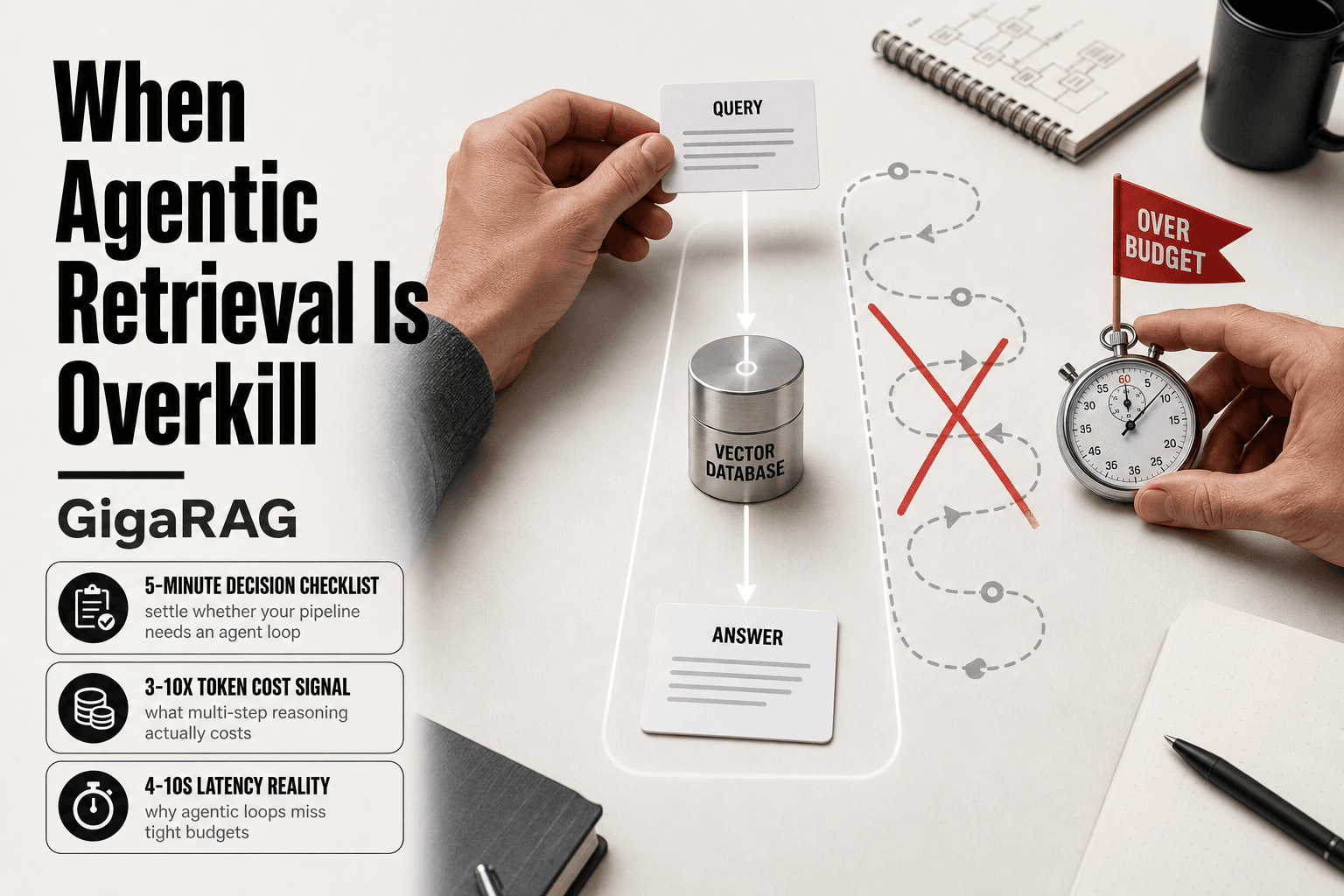
When agentic retrieval is overkill is a question most pipeline builders ask only after they've already shipped the agent loop and watched their latency budget evaporate. The pressure is real: every conference talk, every vendor demo, every benchmark pushes agentic RAG as the obvious next step. The honest answer is that for most production pipelines, it's a step you shouldn't take. The cost of adopting it blindly isn't hypothetical. It's extra seconds on every query, token spend that multiplies by 3 to 10 times, and failure modes you didn't have before. GigaRAG exists for RAG pipeline builders who need to get retrieval right without unnecessary complexity, and part of getting it right is knowing what you don't need. This guide gives you a concrete decision framework: five scenarios where agentic retrieval is overkill, the latency and cost thresholds that should stop you, and the simpler fixes that get you most of the way there.
| At a glance | Details |
|---|---|
| Core verdict | Most production RAG pipelines do not need agentic retrieval |
| Latency signal | If p95 budget is under ~2s, agentic loops rarely fit |
| Cost signal | Multi-step retrieval can multiply token spend several-fold |
| Complexity signal | Single-hop queries dominate? Skip the agent loop |
| Best fit | Multi-hop, ambiguous, tool-using queries with loose latency budgets |
| Decision time | A 5-minute checklist can settle it for your pipeline |
In This Guide
- What Is Agentic Retrieval?
- Agentic Retrieval vs Standard Single-Pass RAG
- Agentic Retrieval vs. Standard RAG: The Real Differences
- When Agentic Retrieval Is Overkill: A Step-by-Step Guide
- The Hidden Costs: Latency, Tokens, and Complexity
- When Agentic Retrieval Is Overkill: 5 Scenarios
- A Decision Framework for Pipeline Builders
- What Agentic Retrieval Cannot Do
- How to Improve RAG Performance Without Going Agentic
- When Agentic Retrieval Is Actually Worth It
What Is Agentic Retrieval?
Agentic retrieval is a retrieval loop where an LLM evaluates what it found, decides whether the evidence is sufficient, and triggers another retrieval pass if it isn't. The agent isn't just fetching documents. It's judging them mid-pipeline.
The core loop: retrieve, evaluate, decide, retrieve again
A single-pass retriever runs once and hands results to the generator. An agentic retriever runs, checks the results against the query, and asks: is this enough? If not, it rewrites the query, switches sources, or drills into a specific document. Then it retrieves again. The loop continues until the LLM decides it has what it needs or hits a stop condition.
How agentic retrieval differs from a single-pass retriever
The difference is control flow. Standard RAG is linear: query in, documents out, generation done. Agentic retrieval branches. The LLM sits inside the loop, making calls about where to look next. That's the whole distinction, and it's the source of both the power and the cost.
The role of LLM reasoning in the retrieval loop
The LLM isn't just generating answers. It's acting as a router and a critic. It reads partial results, spots gaps, and decides the next retrieval action. That reasoning step costs tokens and time on every iteration. You're paying for judgment, not just lookup.
[!note] Agentic retrieval does not fix bad retrieval quality — if your embeddings, chunking, or reranking are weak, adding an agent loop will amplify the noise rather than resolve it.
Agentic Retrieval vs Standard Single-Pass RAG
| Factor | Standard RAG | Agentic Retrieval |
|---|---|---|
| Latency profile | One retrieval + one generation pass | Multiple sequential model and tool calls |
| Cost profile | Predictable per-query token spend | Variable, often several times higher per query |
| Query fit | Single-hop, well-scoped lookups | Multi-hop, ambiguous, or tool-dependent questions |
| Failure modes | Retrieval miss, context overflow | Loop stalls, tool errors, runaway steps |
| Operational load | Simple to monitor and cache | Needs step tracing, budgets, and guardrails |
Agentic Retrieval vs. Standard RAG: The Real Differences
Here's what the loop means in practice when you compare the two architectures side by side.
Single-pass retrieval: one query, one retrieval, one generation
Standard RAG is a straight line. You embed the query, search the vector store, pull the top-k chunks, and hand them to the generator. That's it. Latency is predictable: one embedding call, one vector search, one LLM call. If the retrieval is wrong, the answer is wrong, and nothing catches it.
Agentic retrieval: iterative querying with LLM-driven decisions
Agentic retrieval replaces that straight line with a loop. The LLM reads the first batch of results and decides whether they answer the question. If not, it rewrites the query, picks a different source, or drills into a specific document. Then it retrieves again. Each pass costs tokens and time. The loop runs until the LLM is satisfied or hits a stop condition.
What the agent loop actually buys you, and what it costs
The loop buys you recovery from bad first-pass retrieval. When the initial query is ambiguous or the answer spans multiple documents, the agent can course-correct. Standard RAG can't.
The cost is everything else. Every iteration adds an LLM call, which means more latency and more token spend. You're also adding a failure mode: the agent can loop too long, chase irrelevant documents, or decide it's done when it isn't. For a single knowledge base with clean queries, that's overhead with no payoff.
[!tip] Before adopting agentic retrieval, instrument your pipeline to log per-query step counts and token spend for two weeks; the data will usually show that a small minority of queries actually need multi-step reasoning, and you can route only those to an agent loop.
When Agentic Retrieval Is Overkill: A Step-by-Step Guide
- Sample 50-100 real production queries and tag each as single-hop or multi-hop.
- Measure your current p95 end-to-end latency and compare it to your product's tolerance.
- Estimate token cost per query today, then multiply by the number of extra model calls an agent loop would add.
- List the failure modes you already handle; note which new ones an agent loop would introduce.
- Check whether any current query genuinely needs a tool call or iterative reasoning to answer.
- If single-hop queries dominate and latency is tight, keep standard RAG and revisit later.
The Hidden Costs: Latency, Tokens, and Complexity
The loop sounds elegant until you pay for it. Here's what the overhead actually looks like in production.
Latency: every agent loop adds seconds, not milliseconds
A single-pass RAG call runs in 200-800ms depending on your embedding model and vector store. An agent loop runs that same retrieval two, three, or five times, with an LLM reasoning call between each pass. Each reasoning call adds 1-3 seconds on a fast model. A three-iteration loop lands at 4-10 seconds end to end.
That's not a tuning problem. It's structural. The agent has to think before it retrieves again, and thinking is the slow part. If your users expect sub-second answers, agentic retrieval fails the budget before the first token of the final answer is generated.
Token cost: multi-step reasoning multiplies spend by 3-10x
Every loop iteration sends the full conversation history, the previous retrieval results, and the agent's reasoning trace back to the LLM. That context grows with each pass. A single-pass RAG call might use 2,000 tokens. An agentic loop with three iterations can easily hit 6,000-20,000 tokens before generation even starts.
The multiplier isn't linear. It compounds, because each iteration carries the cost of all previous iterations in its context window. At current API pricing, that's the difference between a $0.002 query and a $0.02 query. For a pipeline serving a million queries a month, that's $2,000 versus $20,000.
Complexity: more moving parts means more failure modes
Standard RAG has three components: embedder, vector store, generator. Agentic RAG adds a reasoning layer, a tool-calling interface, a stop condition, and usually a memory buffer. Each one is a new place for things to break.
The agent can loop forever if the stop condition is too loose. It can call the wrong tool if the tool descriptions are ambiguous. It can retrieve the same document three times because it forgot it already saw it. Debugging these failures means tracing the reasoning trace, which is verbose and non-deterministic. Your on-call engineer now needs to understand LLM behaviour, not just pipeline logs.
None of this is fatal. But it's real overhead you carry on every query, whether the query needed the loop or not.
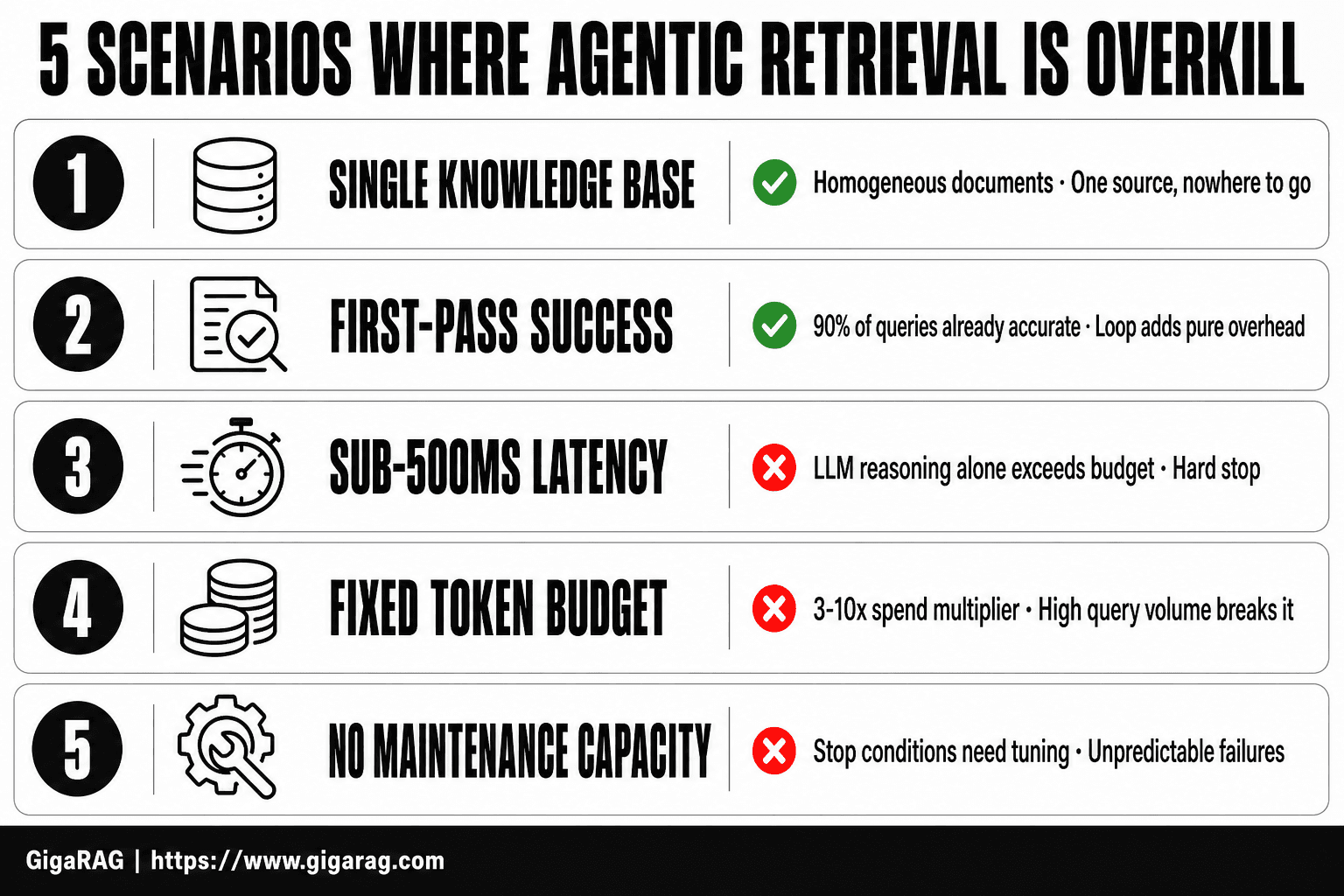
When Agentic Retrieval Is Overkill: 5 Scenarios
The honest answer is that most RAG pipelines don't need an agent loop. Here are the five scenarios where you should skip it.
Single knowledge base with homogeneous documents
If your corpus is one type of document, say 10,000 support tickets or a single product manual, a single-pass retriever handles it. The documents share structure, vocabulary, and intent. There's nothing to reason about across sources because there's only one source.
Agentic retrieval earns its keep when queries span heterogeneous collections: a wiki, a codebase, and a CRM. When everything lives in one bucket, the agent has nowhere to go. You're paying for a loop that runs once and stops.
Queries that a single retrieval pass answers accurately
Test this before you build anything. Run your actual query set through a standard RAG pipeline and measure retrieval accuracy. If 90% of queries return the right document in the top 5 results on the first pass, an agent loop adds nothing.
The agent only helps when the first pass fails and a second, differently-worded query would succeed. If your first pass already works, the loop is pure overhead. You're adding 4-10 seconds of latency to fix a problem you don't have.
Latency budgets under 500ms
This one is a hard stop. Agentic retrieval cannot hit sub-second response times. The LLM reasoning call alone takes longer than your entire budget.
If you're building a search box, an autocomplete, or any interface where users expect instant results, agentic retrieval is disqualified. No amount of prompt engineering or model choice gets a reasoning loop under 500ms. The architecture simply doesn't allow it.
Token cost constraints on production inference
The 3-10x token multiplier from the previous section isn't theoretical. If your pipeline serves high query volume on a fixed inference budget, agentic retrieval will blow through it.
A million queries a month at $0.002 each is $2,000. At $0.02 each, it's $20,000. If your budget is closer to the first number, you don't have a decision to make. Standard RAG is the only option that fits.
Teams without dedicated pipeline maintenance capacity
Agentic retrieval is not a set-and-forget system. The stop conditions need tuning. The tool descriptions need maintenance. The reasoning traces need debugging when queries go wrong.
If your team is one engineer who also owns three other services, you don't have the capacity to keep an agent loop healthy. A standard RAG pipeline breaks in predictable ways: bad embeddings, poor chunking, a misconfigured vector store. An agent loop breaks in unpredictable ways that require reading LLM reasoning traces. That's a different job.
The pattern across all five scenarios is the same: agentic retrieval solves problems you may not have. Before you add the loop, confirm the loop is doing something.
A Decision Framework for Pipeline Builders
You've seen the scenarios where agentic retrieval fails. Now here's the checklist to apply to your own system. Four questions. Answer them honestly and you'll know whether the agent loop is justified or overhead.
Question 1: Does your query set require multi-hop reasoning?
Pull 50 real queries from your logs. How many of them need information from two or more documents to answer? Not "could benefit from" two documents. Actually require it.
If the answer is under 20%, agentic retrieval is solving a problem your users don't have. Single-pass retrieval with good reranking handles the rest.
Question 2: Is your latency budget above 1 second?
This is a binary gate. Agentic retrieval needs at least 1-2 seconds for the reasoning loop, and often 4-10 seconds with multiple iterations.
If your users expect results in under a second, you're done. The architecture disqualifies itself. No need to read further.
Question 3: Can you absorb 3-10x token cost?
Take your current monthly inference spend. Multiply by 5 as a midpoint. Can your budget absorb that without a conversation with finance?
If the answer is no, or if you'd need to justify the increase with metrics you don't yet have, standard RAG is the defensible choice.
Question 4: Do you have the team to maintain an agent loop?
Not build it. Maintain it. That means someone owns the stop conditions, the tool descriptions, and the debugging when reasoning traces go wrong.
If your answer is "we'll figure it out after launch," that's a no. Agent loops degrade without active maintenance. A neglected agent loop is worse than no agent loop because it fails unpredictably.
Scoring: if you answered no to two or more, agentic retrieval is overkill
Two nos is the threshold. Not three, not four. Two.
Here's why: a single no might be workable. You can stretch a latency budget slightly, or hire one more engineer. But two nos means you're fighting the architecture on multiple fronts simultaneously. The latency problem makes the cost problem worse. The maintenance problem makes the accuracy problem unfixable.
If you scored two or more nos, build standard RAG with hybrid search and reranking. You'll get 90% of the benefit at 10% of the operational burden. Revisit the decision in six months when your query set has grown and your budgets have changed.
What Agentic Retrieval Cannot Do
The honest answer is that agentic retrieval fixes exactly one thing: when a single retrieval pass isn't enough. It doesn't fix the rest of your pipeline. If your retrieval quality is bad, an agent loop makes it worse, not better, because each iteration compounds the original error.
It cannot fix bad embeddings or poor chunking
If your chunks split paragraphs mid-sentence or your embedding model doesn't understand your domain, the agent retrieves garbage on the first pass. Then it reasons about that garbage and retrieves more garbage. The loop amplifies the problem. Fix embeddings and chunking first. That's a prerequisite, not an optimization.
It cannot compensate for a disorganized knowledge base
An agent can't find what isn't structured to be found. If documents are mislabeled, metadata is missing, or content is duplicated across sources, the agent spends iterations wandering. You'll pay for those iterations in tokens and latency. Clean the knowledge base before you add reasoning on top of it.
It cannot guarantee accuracy. It can still retrieve wrong documents
This is the one that surprises people. The agent looks confident. It retrieves, evaluates, decides, retrieves again. But every decision is an LLM call, and LLMs make mistakes. The agent can retrieve the wrong document, reason about it convincingly, and return a confident wrong answer. The loop adds steps, not certainty.
How to Improve RAG Performance Without Going Agentic
You don't need an agent loop to get better retrieval. Most performance gains come from fixing the boring parts of the pipeline: how you chunk, how you search, how you rewrite queries, and how well your embeddings match your domain. These changes cost nothing in latency and very little in engineering time.
Better chunking and metadata filtering
Chunk size is the first lever. If your chunks are too large, retrieval returns paragraphs that bury the answer in noise. If they're too small, you lose context. Start with 200 to 500 tokens per chunk, then test against your actual queries. Metadata filtering does the heavy lifting that agents pretend to do: tag documents by source, date, product, or customer, then filter before you search. A filtered search over a clean index beats an unfiltered agent loop every time.
Hybrid search with reranking
Vector search alone misses exact matches: product codes, error numbers, names. Add keyword search (BM25) alongside your vector index, merge the results, then run a reranker on the top candidates. A cross-encoder reranker scores relevance far better than cosine similarity. This is a two-step pipeline, not a loop. It adds maybe 50 to 100 milliseconds and fixes most of the retrieval failures that push people toward agentic RAG in the first place.
Query rewriting without an agent loop
You can rewrite queries before retrieval without any iterative reasoning. Use an LLM to expand a short query into a fuller search phrase, or to generate multiple query variants and retrieve against all of them. That's one LLM call, not a loop. It handles the "user asked something vague" problem without the token cost of an agent evaluating and re-querying.
Improving embedding quality for your domain
General-purpose embeddings underperform on specialized content: legal text, medical records, internal documentation. Fine-tune your embedding model on your own query-document pairs, or at minimum test domain-specific models before defaulting to the popular one. A better embedding model improves every retrieval you run, with zero added latency at query time. That's the cheapest performance win available.
When Agentic Retrieval Is Actually Worth It
The honest answer is that agentic retrieval does win in a narrow set of cases. You'll know them when you see them because the alternative, a single-pass pipeline, keeps failing in ways that more passes would fix.
Multi-hop queries across heterogeneous sources
If your answer requires pulling a customer ID from one system, using it to query a second, then comparing the result against a policy document in a third, a single retrieval pass can't do that. The agent loop earns its keep here: retrieve, evaluate what's missing, retrieve again with the new context. The cost is real, but the alternative is no answer at all.
Research-heavy use cases with iterative refinement
When the user's question is vague and the answer space is large, iterative refinement helps. An analyst asking "what do we know about churn in enterprise accounts" needs the system to explore, find a lead, then drill deeper. That's not a lookup. It's a search process, and the agent loop mirrors it.
When latency and cost are not constraints
Batch jobs, overnight reports, internal research tools where a 10-second response is fine. If nobody's waiting on the result and token spend isn't capped, the agent's overhead stops mattering. That's the threshold: agentic retrieval is worth it when the query genuinely needs multiple steps and nobody is watching the clock.
When agentic retrieval is overkill comes down to your query set, your latency budget, and your team's capacity to maintain the loop. If you answered no to two or more of the framework questions, skip the agent. Build standard RAG with hybrid search and reranking, fix your chunking and embeddings, and revisit the decision when your constraints change.
Frequently Asked Questions
What is agentic retrieval?
Agentic retrieval is a pattern where a language model decides, over multiple steps, what to search for, which tools to call, and when it has enough context to answer. Instead of a single retrieval pass, the model plans and iterates, which can improve answers on complex questions but adds latency, cost, and failure modes.
Is agentic RAG worth it?
It is worth it when your queries are genuinely multi-hop, ambiguous, or require external tools, and when your latency budget can absorb several sequential model calls. For single-hop lookups with tight latency or cost constraints, standard RAG is usually the better trade.
Is ChatGPT an agentic RAG?
ChatGPT is a general-purpose assistant that can use retrieval and tools, but it is not a drop-in agentic RAG architecture for your pipeline. Agentic RAG refers to a system design where retrieval and reasoning steps are orchestrated around your own data and tools, which you build and control separately.
How to improve RAG performance?
Start with the fundamentals: better chunking, stronger embeddings, a reranking stage, and query rewriting. Measure retrieval recall before adding reasoning loops. In many pipelines, these basics deliver more improvement than switching to an agentic architecture.
When is agentic retrieval overkill?
It is overkill when most of your queries are single-hop, your p95 latency budget is tight, your token cost per query is already constrained, or your team cannot yet monitor multi-step traces. In those cases, the added complexity rarely pays for itself.
What can agentic retrieval not do?
It cannot compensate for poor source data, weak embeddings, or missing documents. It also does not guarantee correctness, reduce hallucination on its own, or lower latency. Treat it as a reasoning layer, not a fix for retrieval quality.
About GigaRAG
GigaRAG is for agent memory and RAG pipeline builders. get this right. Whether you are working through when agentic retrieval is overkill or something adjacent, we publish what we have actually tested, including where it falls short.