When GraphRAG Is Not Worth the Cost for Your AI System
GraphRAG can help when your questions depend on relationships across code, tickets, services, and people. It won't inherently improve FAQ answers, single-document questions, or direct factual lookups, and it doesn't remove the need to tune chunking, metadata, retrieval, or source quality. For small corpora or weakly connected data, entity extraction, graph construction, and ongoing maintenance may add cost without improving the evidence your model retrieves.
The main catch is treating a graph layer as a default upgrade from vector RAG. Before you add one, prove that your workload has relationship-heavy, multi-hop questions that vector search or hybrid search cannot answer well enough. SQL and metadata filters are often the better fit for explicit fields, while hybrid retrieval can handle semantic queries alongside exact terms and identifiers.
Quick answer
GraphRAG is not automatically worth its added complexity: relationship-aware retrieval may help with multi-hop questions, but it does not inherently improve FAQs, single-document questions, or straightforward lookups.
- Start with a tuned vector or hybrid baseline.
- Compare retrieval evidence, answer quality, latency, and cost.
- Route only relationship-heavy questions to graph retrieval.
What GraphRAG adds over traditional RAG
GraphRAG doesn't inherently improve FAQ answers, single-document questions, or direct factual lookups. It also doesn't fix weak source material, bad chunking, or a vague query. Its added value is relationship-aware retrieval, and that only matters when the answer depends on how facts connect.
Vector RAG retrieves semantically similar chunks
Traditional vector RAG turns document chunks into embeddings, numerical representations of meaning. At query time, it finds chunks whose embeddings are close to the query's embedding, then sends those chunks to the model as context.
That works well when the answer lives in one or a few relevant passages. Ask for an API's authentication method, a policy detail, or a document summary, and semantic similarity may be enough.
The main catch is context shape. Vector search can retrieve several relevant chunks without showing how people, systems, events, or documents relate, so the model must infer those links from a flat set of passages.
GraphRAG retrieves entities, relationships, and paths
GraphRAG adds a graph layer on top of, or alongside, document retrieval. During indexing, the system identifies entities such as services, repositories, people, tickets, or policies, then records relationships between them.
Here's what happens behind the scenes: a question can map to known entities, traversal can follow selected links, and the system can assemble context around the resulting path. A question about why a deployment failed might pull a service, its recent code change, a linked incident, and the owning team's runbook.
That structure can help with multi-hop questions, where no single chunk contains the full answer. It also adds work: entity extraction, relationship rules, duplicate handling, provenance, graph updates, and query-time traversal all need care.
Why the two approaches can be complementary
It depends on what your questions require. If most requests ask for a relevant passage, vector retrieval is often the smaller system to run. If exact identifiers matter too, hybrid search can combine keyword matching with semantic retrieval.
A graph route makes more sense when the query asks about dependencies, ownership, causes, sequences, or connections across sources. Keep direct lookups on the simplest retrieval path that can return the needed evidence.
GraphRAG vs. vector RAG: when is each a better fit?
| Factor | GraphRAG | Vector or hybrid RAG |
|---|---|---|
| Relationship-heavy, multi-hop questions | Consider when answers depend on connected entities or relationships | Use as a baseline and test whether retrieval supplies enough evidence |
| FAQs and straightforward factual lookups | Not inherently an improvement | A simpler starting point to tune and evaluate |
| Evaluation | Measure evidence retrieval, answer quality, latency, and cost | Use the same queries and measures for a fair comparison |
| Query handling | Reserve for tasks that benefit from relationship-aware retrieval | Route simpler tasks here, or to SQL or metadata-filtered retrieval where appropriate |
When GraphRAG is not worth the cost
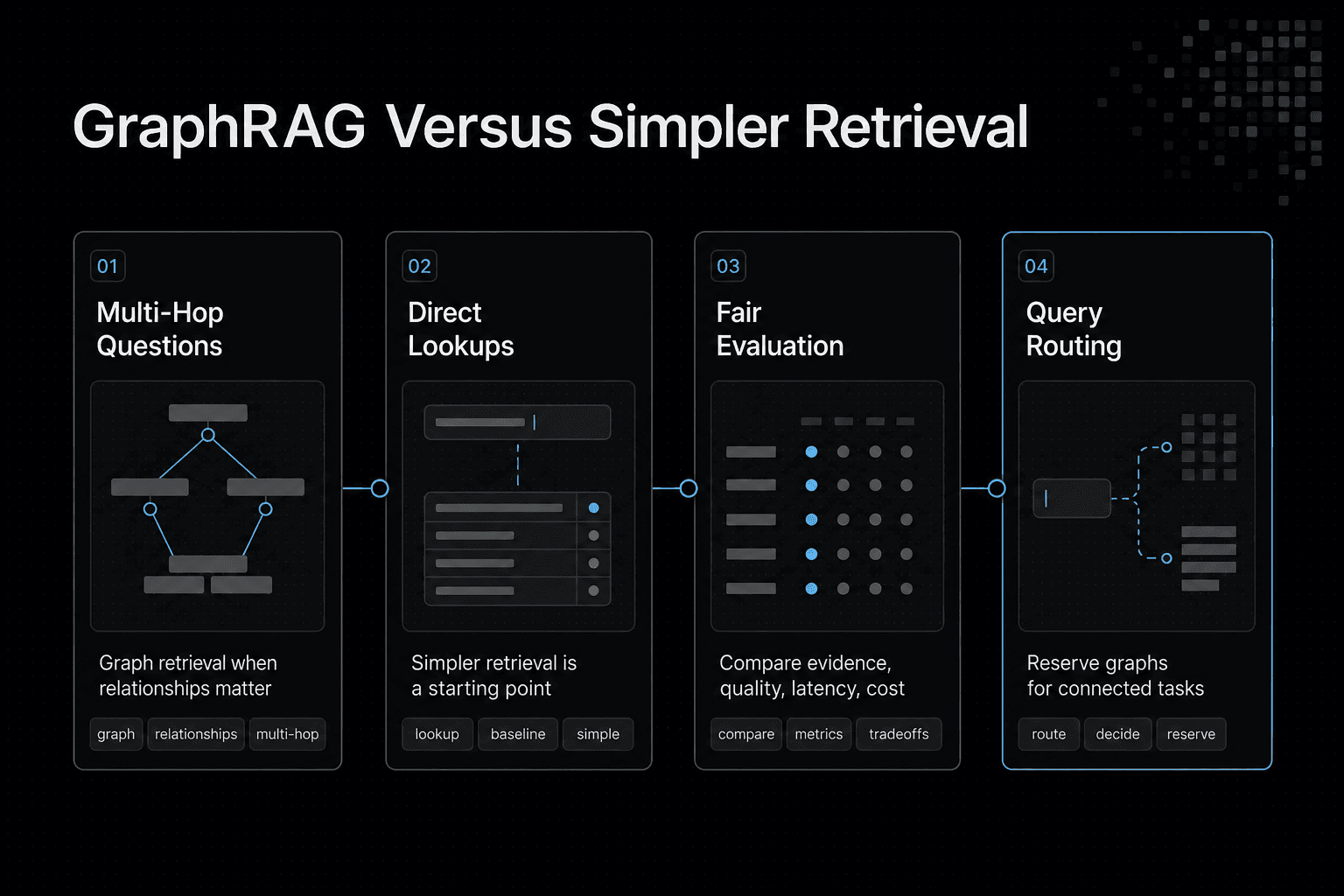
GraphRAG is not worth the cost when answers come from one known fact, one document, or a small set of weakly related records. It won't make poor sources trustworthy, clarify an unclear question, or fix retrieval when the basic index and filters need work.
FAQ systems and repeated fact retrieval
FAQ systems usually need a known answer returned with the right wording and current source. A well-chunked document store, metadata filter, or SQL query can do that without extracting entities and maintaining edges between them.
Repeated questions about pricing rules, setup steps, policy terms, or API parameters rarely need path traversal. Build a graph only if the answer consistently depends on relationships across several sources, not because the corpus contains nouns.
Small, weakly connected, or stable corpora
A graph needs useful connections. If your corpus is small, mostly separate documents, or changes so rarely that a simple index stays current, graph construction can add more machinery than retrieval value.
Stable data isn't automatically a graph use case. Entity cleanup, relationship definitions, and provenance still need attention, even when the underlying documents barely change.
Single-document questions and direct lookups
Questions such as "What does this contract allow?" or "Where is this function defined?" have a narrow evidence target. Retrieve the document, file, or record directly, then give the model the relevant passage.
The honest answer is that GraphRAG can't improve an answer when there is no meaningful second hop to make. It may add latency and more context for the model to sort through, which can make a direct task less predictable.
Cases where retrieval errors are really chunking, metadata, or source-quality problems
Before you start graph work, inspect failed queries. A missed answer may come from chunks that split a procedure in half, missing repository or date metadata, duplicate documents, stale content, or a query that doesn't name the thing the user wants.
Fix those problems first. Graph traversal cannot recover a fact that was never indexed, distinguish duplicate entities without rules, or decide which source is authoritative when your data does not say so.
Step-by-step: test whether GraphRAG earns its cost
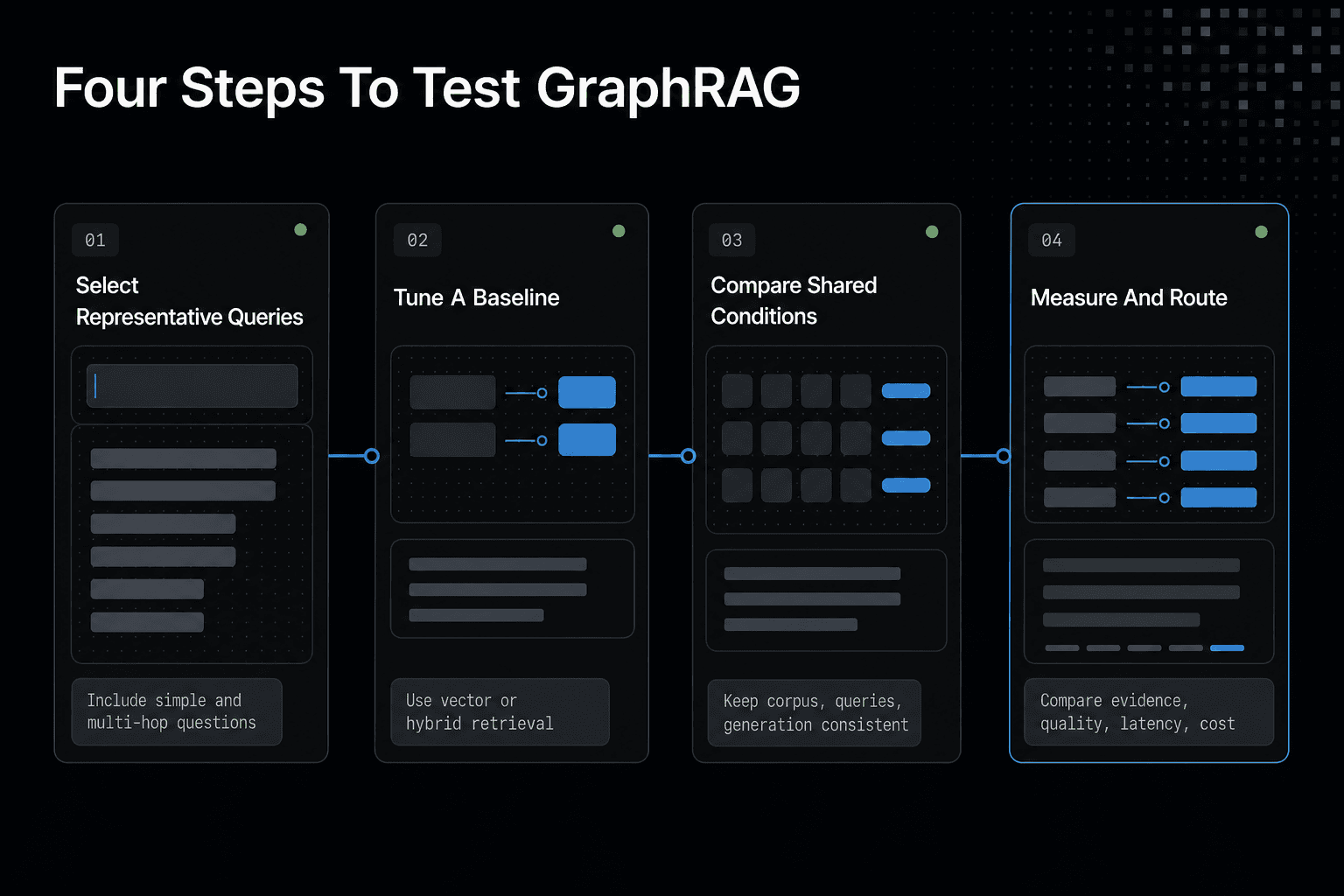
- Select representative queries, including simple lookups and relationship-heavy, multi-hop questions.
- Build a vector or hybrid baseline and tune its retrieval before comparing it with GraphRAG.
- Use the same corpus, queries, and answer-generation conditions for both approaches.
- Check whether each system retrieves the evidence needed to answer each query.
- Compare answer quality, latency, and cost across the same workload.
- Route only query types where GraphRAG shows a useful task-level payoff.
The hidden cost model behind GraphRAG
GraphRAG has three cost buckets: one-time build work, per-query serving work, and ongoing operations. Don't treat a graph database bill as the whole cost. Extraction prompts, review rules, update pipelines, and extra context sent to the model may matter just as much for your budget and latency target.
Build-time work: entity and relationship extraction, normalization, and graph creation
Start with the source corpus. You need to split documents or records, extract entities and relationships, normalize names that refer to the same thing, and attach source provenance before you can create nodes and edges.
This work can use models, rules, or both. A model may identify "Auth Service" and "authentication-service" as related names, but you still need a rule for when they become one canonical entity. Get that wrong, and later traversal can join unrelated records or miss a valid path.
Then comes graph creation and indexing. You may store raw extracted claims, approved entities, relationship types, source links, embeddings, and indexes for graph lookup. Keep build costs separate from ongoing reprocessing, because a first import and a daily update are different jobs.
Serving-time work: query interpretation, traversal, reranking, and context assembly
A graph query usually does more than retrieve similar chunks. Your system may identify entities in the question, choose relationship types or hop limits, traverse candidate paths, rerank the evidence, and assemble passages for the answer model.
Each step has a cost and a failure mode. A loose traversal can return too much connected material, while a strict one can miss the relationship that answers the question. More retrieved paths can also mean more prompt tokens, so query cost isn't just the graph lookup.
Keep the path small. Send only evidence that supports the answer, with its source and relationship context, rather than every node near a named entity.
Operations: schema changes, duplicate entities, provenance, monitoring, and incremental updates
The main catch is maintenance. Documents change, teams rename services, ownership moves, and the same entity appears under several names. Your pipeline needs a way to update affected nodes and edges without rebuilding everything blindly.
Schema changes need care too. If you add a relationship type such as "blocked_by" or change what counts as ownership, old graph records may no longer mean the same thing as new ones. Preserve provenance so you can trace a retrieved edge back to the source text, record, or event that created it.
Monitor extraction failures, duplicate rates, empty traversals, oversized result sets, stale sources, query latency, and answer evidence. Without those signals, you can't tell if a graph problem comes from data quality, routing, or traversal rules.
A cost-estimation worksheet based on your own inputs
Use your own inputs. Estimate build cost as:
documents or records processed x extraction work per item + normalization and review time + graph storage and indexing
Estimate monthly serving cost as:
queries per month x [query interpretation + traversal + reranking + prompt tokens + answer tokens]
Then add operations:
update frequency x incremental processing cost + monitoring + incident work + schema and entity-maintenance time
It depends on your corpus size, change rate, query volume, model pricing, graph store, and how often questions truly need multi-hop evidence. Write each assumption beside the variable, then compare that total with the tuned vector, hybrid, SQL, or metadata-filtered system you would otherwise run.
GraphRAG vs. vector RAG: cost, latency, accuracy, and maintenance
No retrieval method wins by default. GraphRAG can earn its extra work when answers depend on links between entities, but it won't inherently improve direct lookups, weak source material, or a poorly tuned baseline.
Comparison table: build cost, query cost, latency, accuracy potential, complexity, scalability, and maintenance
| Factor | GraphRAG | Tuned vector RAG | Hybrid search | SQL or metadata-filtered retrieval |
|---|---|---|---|---|
| Build cost | Higher when you extract, normalize, and link entities | Lower when chunking and embeddings are enough | Moderate, with lexical and semantic indexes | Low if fields already exist and are clean |
| Query cost | Can rise with query parsing, traversal, reranking, and larger context | Usually limited to retrieval, reranking, and answer context | Can rise when combining and reranking result sets | Often low for narrow, indexed filters |
| Latency | Can be higher when a query needs several retrieval steps | Often lower for simple semantic lookup | Depends on merge and reranking work | Often suitable for direct field queries |
| Accuracy potential | Best case is relationship-heavy, multi-hop evidence | Best case is semantically similar passages | Best case is mixed semantic and exact-term retrieval | Best case is explicit facts and constraints |
| Complexity | High: graph schema, entity resolution, traversal rules | Moderate: chunking, embeddings, ranking, and evaluation | Moderate to high: scoring and query design | Lower, unless the data model is poor |
| Scalability | Depends on graph shape, traversal limits, and update design | Depends on index size and retrieval settings | Depends on both search systems | Depends on schema, indexes, and query patterns |
| Maintenance | Ongoing entity, edge, provenance, and schema work | Ongoing source, chunk, and index updates | Ongoing tuning across two retrieval signals | Ongoing data-quality and schema work |
The table is a routing guide, not a scorecard. A tuned vector system may be the better choice when the answer lives in one or two passages, while SQL is often the cleaner answer when the question names a date, owner, status, tenant, or identifier.
How to interpret accuracy as task-specific evidence rather than a generic score
"Accuracy" needs a task attached to it. Measure direct lookups, exact identifier searches, semantic document questions, and multi-hop investigations separately, then check whether the retrieved evidence supports the answer.
A graph can return a plausible path that is irrelevant, stale, or built from wrongly merged entities. Vector retrieval can return a close-sounding chunk that misses a required relationship. Score both the answer and the evidence behind it.
Why a modest quality gain may or may not justify operational overhead
It depends on the consequence of a wrong answer, the size of the gain, and the full cost of keeping the graph correct. A small improvement may be worth it for high-stakes dependency tracing or incident investigation, where a missed connection costs real engineering time.
For ordinary help questions, it may not be worth it. If hybrid search or metadata filters meet the evidence, latency, and cost targets, graph maintenance adds work without a clear payoff.
When vector search, hybrid search, SQL, or metadata filters are enough
Don't add a graph because retrieval feels hard. Start with the data shape and the question shape: if the answer sits in a passage, a field, or a constrained subset of records, a simpler retrieval path is usually easier to build, inspect, and maintain.
Use vector RAG for semantic document retrieval
Use vector RAG when users ask for meaning rather than an exact string. Questions such as "How do I rotate credentials?" or "What does this policy allow?" can map well to relevant documentation chunks even when the wording differs.
Keep the corpus well chunked and attach source metadata. Vector search won't reliably enforce tenant boundaries, find an exact commit hash, or prove a chain of relationships, so don't make it carry those jobs.
Use hybrid search when exact terms, identifiers, APIs, or code symbols matter
Hybrid search combines semantic retrieval with lexical matching. That matters when a query contains an API name, error code, package version, class name, ticket ID, or other term where one character can change the result.
This is often the practical middle ground. A developer asking about getUserById may need documents that contain that exact symbol, while a semantic query may retrieve text about a related but different method. Tune the lexical and semantic balance against real queries, not assumptions.
Use SQL for explicit structured questions
Use SQL when the question maps to named fields and clear constraints. "Which open incidents belong to this service?" or "Who owns repositories with this status?" is a database query, not a graph problem.
SQL is also easier to audit when you need exact conditions, joins, ordering, and counts. The main catch is data quality: missing, stale, or loosely defined fields will still produce bad answers, even if the query itself is correct.
Use metadata filters for repository, tenant, date, ownership, and access boundaries
Apply metadata filters before retrieval when scope is known. Filter by repository, tenant, document date, owner, access role, or environment, then search only the records the user should see and the question can plausibly concern. For agent teams using GigaRAG, its access controls can manage what each agent can use; retrieval filters still help narrow each search to the relevant records.
This reduces noise. It also enforces a boundary that similarity scores cannot safely infer. Filters only work when ingestion assigns consistent metadata, so make sure you validate those fields as part of your indexing pipeline.
Real-world workloads: where GraphRAG helps and where it does not
A graph layer won't turn a direct lookup into a better answer. If the answer is in one file, one runbook, or one ticket with clear metadata, use the simpler path and spend your effort on source quality, access control, and retrieval tuning.
Graph retrieval earns its cost when the question needs connected evidence that no single record holds.
Codebase questions: symbol lookup versus cross-service dependency tracing
"Where is getUserById defined?" is a symbol lookup. Exact-term search, code search, or hybrid retrieval should find the definition and nearby use sites without building a graph of the whole repository.
"Which services will break if we change this authentication claim, and which open pull requests already touch them?" is different. You may need to connect a schema field to callers, services, owners, tickets, and pull requests across several systems. A graph can make those paths available as retrieval evidence, provided your ingestion process captures those links.
Agent memory: stable project facts versus relationship-rich work history
An agent remembering a project's language, deployment target, or current owner doesn't need graph traversal. Store stable facts in structured memory or metadata, where you can update and inspect them directly. GigaRAG can help teams keep that project knowledge available to AI agents across sessions and tools, with access controls for what each agent can use.
Work history can be messier. "Why did we reject this design, who approved the replacement, and what incident led to that choice?" spans decisions, people, dates, incidents, and documents. A graph only helps if those relationships are captured with provenance.
Support and internal knowledge: known-answer requests versus connected incident investigations
"How do I reset a customer's integration token?" should retrieve the current support procedure. A graph adds moving parts without changing the basic job.
An investigation such as "Why did this customer's webhook fail after last week's release, and who owns each affected component?" may require a trail through account settings, release notes, service dependencies, incident records, and team ownership. That is a relationship question, not just a search question.
What teams should not expect from a graph layer
Don't expect it to fix vague questions, stale tickets, duplicate entities, or missing ownership records. It also won't make an agent's answer trustworthy when it cannot show the records and paths behind its claim.
Keep the graph narrow. Build it around recurring investigations with clear multi-hop failures, not every document your team happens to have.
How to benchmark GraphRAG against a tuned vector RAG baseline
Don't compare a graph system with default vector search and call the result architectural proof. GraphRAG won't earn its added cost unless it improves the tasks that matter after both systems have been tuned against the same corpus, access rules, models, and answer format.
[!note] GraphRAG does not eliminate the need to tune retrieval. Compare it with a properly tuned vector or hybrid baseline.
Keep the test fixed. Change the retrieval architecture, then measure what changes for your users and operators.
Define a representative test set by query type and business consequence
Start with real questions, not prompts chosen to favor graph traversal. Group them by retrieval need: direct lookup, semantic document search, exact identifier search, structured field lookup, and multi-hop relationship investigation.
Label the expected evidence for each question, not only a preferred answer. Weight errors by consequence: a missed code reference and a wrong incident ownership decision should not count the same if they carry different operational risk.
Tune the baseline before comparing architectures
Give vector RAG a fair chance. Tune chunk size, overlap, embedding choice, top-k retrieval, reranking, metadata filters, hybrid lexical search, and prompt context within the same resource limits you allow the graph system.
Document every setting. If GraphRAG gets entity normalization and query rewriting while the baseline uses defaults, you are measuring setup effort, not retrieval architecture.
Measure retrieval coverage, provenance, path faithfulness, answer quality, p50 and p95 latency
Score whether retrieved records contain the needed evidence, whether each answer cites those records, and whether a reported graph path supports the claim made from it. A plausible answer with unsupported links is not a successful multi-hop result.
Then score answer correctness or decision quality with reviewers who can see the expected evidence. Record p50 and p95 end-to-end latency separately from model generation time, so slow traversal, reranking, or context assembly cannot hide behind the final answer.
Track build cost, serving cost, update cost, and human maintenance time
Record the work needed to ingest the corpus: extraction, entity matching, relationship creation, indexing, and validation. For serving, track model calls, database work, retrieved context size, and failures per query.
Updates matter too. Measure what happens when a source changes, an entity is renamed, a relationship is removed, or access rules shift. Include engineer and reviewer time for fixing duplicate entities, bad edges, stale provenance, and broken ingestion jobs.
Set a predeclared adoption threshold for measurable improvement
Set the rule before you see results. Require GraphRAG to improve the relationship-heavy query group by an agreed margin, preserve or meet your latency target, and stay within a defined total operating budget.
It depends on the cost of wrong decisions, query volume, update frequency, and who must maintain the graph. If the gain appears only on a small slice of low-value questions, don't adopt it as the default path.
Use hybrid routing instead of sending every query to a graph
A graph should be one route, not the front door for every request. Start with the least complex retrieval path that can produce the required evidence, then escalate only when the question and corpus call for connected reasoning. GigaRAG connects agents to a central Hive Mind through MCP or the API, but shared memory does not mean every request needs graph traversal.
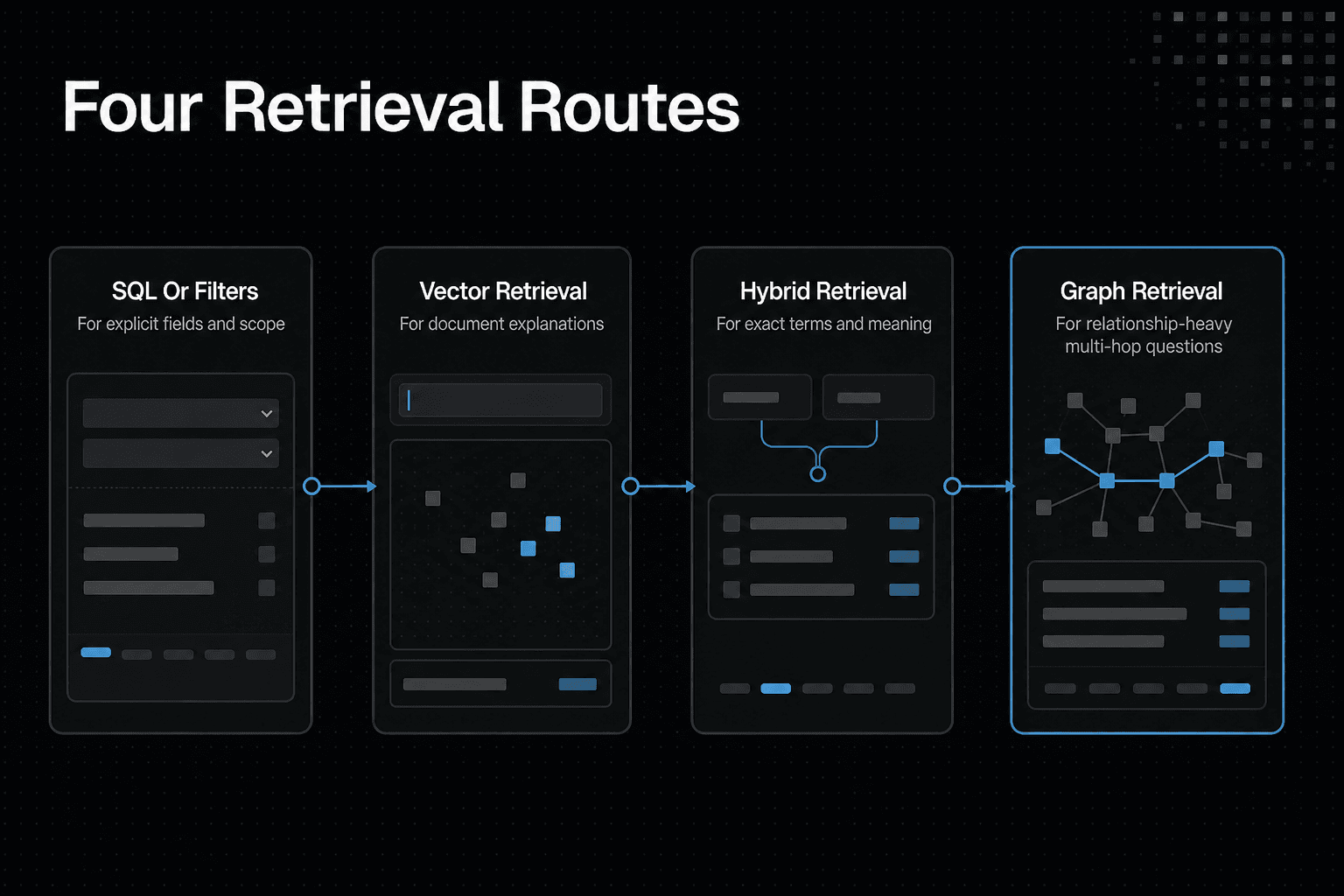
Use rules before model classification. A small set of visible heuristics is easier to tune, audit, and override when the router sends a query down the wrong path.
Route direct lookup questions to SQL, filters, or vector retrieval
Send questions with explicit fields to SQL or metadata filters: "Which open incidents belong to team A?" or "Show documents updated after this date." These systems can enforce tenant, repository, owner, date, and access boundaries before retrieval.
Use vector retrieval for a question that asks for an explanation from a document but does not need a path across records. "How does this service handle retries?" usually needs relevant chunks, not entity extraction and traversal.
Keep the evidence narrow. You avoid paying graph-query work for a direct answer.
Route exact-term and identifier-heavy questions to hybrid retrieval
Identifiers change the route. Function names, error codes, API fields, package versions, ticket IDs, and code symbols often need lexical matching, even when the rest of the question is phrased loosely.
Use hybrid retrieval when both meaning and exact strings matter. A query such as "Why did AUTH-417 break token refresh in v3.2?" can combine keyword search for the ticket and version with semantic retrieval for related design notes or discussion.
Don't depend on embeddings alone here. They may retrieve related material while missing the exact record your user needs.
Route relationship-heavy, multi-hop questions to graph retrieval
Choose graph retrieval when the answer depends on connections rather than one record. Relationship language is a useful signal: "depends on," "owned by," "changed after," "caused," "related to," and "through which service."
Entity count matters too. A question naming several systems, people, tickets, and time periods may need a path through those records. "Which deployment introduced the dependency linked to these customer incidents, and who owns the affected service?" is a graph candidate if those links exist and have provenance.
The main catch is corpus shape. A graph can't recover relationships that were never captured, were extracted badly, or are too stale to trust.
Log route choice, retrieval evidence, latency, cost, and user outcome
Treat the router as a production component. Log the selected route, confidence or rule match, query features, retrieved records, filters applied, graph paths where used, end-to-end latency, and model or database cost.
Also log outcome signals: citations opened, follow-up reformulations, thumbs feedback, correction rate, and human escalation where available. A fast answer with weak evidence is still a routing failure.
Add a fallback. If SQL returns no rows, hybrid search finds no exact match, or graph traversal produces an unsupported path, retry a broader approved route and mark the event for review.
Common misconceptions about GraphRAG decisions
GraphRAG won't inherently improve simple lookup accuracy, fix weak source material, or make vague questions answerable. You still need evidence that its extra work improves the tasks your users actually have.
A knowledge graph does not replace retrieval tuning
A graph is stored structure, not a retrieval strategy by itself. You still need to extract entities, resolve duplicates, rank candidate paths, apply access filters, limit context, and cite source records behind an answer.
If a tuned vector or hybrid baseline misses the right evidence because chunking, metadata, keyword matching, reranking, or query rewriting is weak, adding traversal may make the failure harder to inspect.
More connected data does not automatically mean graph retrieval is useful
Connection density alone isn't enough. It depends on whether your important questions require those connections, whether the links are complete and trustworthy, and whether following them changes the answer.
A repository may contain services, tickets, owners, and pull requests, yet most users may only ask for a function's behavior or a known setup step. Measure the hard questions separately.
A graph database choice is not the same as proving GraphRAG value
Choosing a graph database solves storage and traversal concerns. It doesn't prove that your extraction pipeline captured the right relationships, that the query planner finds the relevant path, or that assembled context helps the model answer correctly.
Compare graph retrieval with tuned vector, hybrid, SQL, and metadata-filtered routes on the same tasks. Keep the graph only where its task-level gain exceeds its latency, cost, and maintenance burden.
Choose the smallest retrieval system that meets the task
Start with the lowest-complexity route that can return complete, permitted, and usable evidence for the question. That might be SQL for explicit fields, metadata filters for scope, vector search for semantic matches, or hybrid retrieval when exact terms matter.
[!tip] For a mixed workload, classify queries by task: send straightforward lookups to vector, hybrid, SQL, or metadata-filtered retrieval, and reserve graph retrieval for relationship-heavy, multi-hop questions.
Don't start with a graph because the data has links. Start one only when a defined set of relationship-heavy questions still fails after you tune simpler routes, and when the missing relationships change the answer rather than merely add background.
A final go, no-go, or hybrid decision checklist
Go with GraphRAG when your important questions repeatedly need multi-hop evidence, the relationships are reliable enough to traverse, and a benchmark shows a meaningful gain over a tuned baseline.
No-go when most requests are FAQs, direct lookups, single-document questions, or queries over explicit fields. A graph won't repair bad chunks, missing metadata, weak sources, or unclear user intent.
Use hybrid routing when only part of the workload needs relationship traversal. Keep direct questions on SQL, filters, vector search, or hybrid search. Send graph-shaped questions to GraphRAG, then log whether its paths and answers justified the extra work.
It depends on your query mix, relationship quality, access rules, latency limit, and maintenance capacity. If you can't name the graph-only failures and measure their improvement, GraphRAG isn't worth the cost for your system.
Frequently asked questions
Is GraphRAG better than vector RAG?
Not for every task. GraphRAG may help with relationship-heavy, multi-hop questions, but it does not inherently improve FAQs, single-document questions, or straightforward lookups.
When should I use GraphRAG instead of vector RAG?
Consider GraphRAG when answering a query depends on relationships across connected information. Benchmark it against a tuned vector or hybrid baseline before choosing it.
Is GraphRAG useful for FAQ systems?
It is not inherently an improvement for FAQ answers. Compare it with a tuned vector or hybrid baseline on your FAQ queries and their supporting evidence.
Can SQL or metadata filters replace GraphRAG?
They can be options for simpler tasks. Route suitable queries to SQL or metadata-filtered retrieval, and reserve graph retrieval for relationship-heavy questions.
What costs should I measure before adopting GraphRAG?
Measure build, serving, update, and human maintenance costs alongside latency, answer quality, and whether the system retrieves the evidence needed to answer.
How do I benchmark GraphRAG against vector RAG fairly?
Use the same representative queries, corpus, access rules, models, and answer conditions. Compare retrieval evidence, answer quality, latency, and cost against a properly tuned vector or hybrid baseline.
Should every AI agent query use graph retrieval?
No. Route simpler tasks to vector, hybrid, SQL, or metadata-filtered retrieval, and reserve graph retrieval for relationship-heavy, multi-hop questions.
Does GraphRAG replace hybrid search or a vector database?
Don't assume it does. Route each query to the retrieval approach that suits its task, then compare GraphRAG with tuned alternatives on the same workload.
About GigaRAG
GigaRAG is a shared memory platform for AI agents that helps developers and teams keep project knowledge available across sessions and tools.
You can connect agents to a central Hive Mind through MCP or the API, with access controls to manage what each agent can use.


