When You Should Not Use RAG for Your AI Application
RAG can support applications that work with fresh, private, or large-scale information needed for a specific interaction. For a small policy, a structured record, or a defined output task, another approach may be simpler.
Many jobs need less: a short prompt for stable instructions, a direct query for current records, fine-tuning for defined tasks, or code-navigation tools for repository work. Match the architecture to the information and task the agent needs.
TL;DR
RAG is not a default requirement. Use it when your application must find relevant external information for each interaction. For static instructions, well-defined classification, or direct data access, start with simpler approaches.
When You Should Not Use RAG: The Plain Answer
The practical question is not whether RAG is modern, but whether retrieval solves the missing capability. The sections below compare prompting, fine-tuning, direct data access, exact search, and long context so you can choose the smallest architecture that meets the requirement.
[!note] Choose retrieval when the requirement is to find relevant external material for the interaction. Use prompting or tuning when the requirement is primarily about instructions, output format, or a defined task.
RAG is retrieval, not a model upgrade
Retrieval addresses an information-finding problem; it does not change a model’s behavior. When the goal is a well-defined task such as classification or producing structured output from free text, supervised fine-tuning is another option to evaluate.
When an application needs a current account balance, stock count, or permission state, use the system of record that provides that value. Use retrieval separately when the task also calls for relevant natural-language material.
Five signs a simpler architecture is the better choice
Choose a simpler path when one or more of these are true:
- Your policy or reference text is small and rarely changes, so you can put it in the prompt.
- Your answer must match an exact ID, path, symbol, or field, where keyword search or a database lookup is clearer.
- You need current transactional data, not a plausible summary of retrieved documents.
- You need to change repeatable output behavior, which is a tuning or prompt-design problem.
- You can't justify indexing, chunking, retrieval evaluation, and source maintenance for the value gained.
Prompt engineering can suit small amounts of static data. Start there when it meets the requirement, then add retrieval only if the application needs to search changing material across interactions.
RAG vs. simpler alternatives: Which fits the job?
| Factor | Option A | Option B |
|---|---|---|
| Small amount of stable information | Put it in the prompt | Use RAG when information must be searched or updated across interactions |
| Frequently updated external information | Use retrieval to find relevant context for each interaction | Fine-tuning is trained on example input-output pairs rather than serving as a per-interaction search step |
| Well-defined classification task | Consider supervised fine-tuning with input-output examples | Use RAG when the answer depends on retrieved information |
| Need answers grounded in external sources | Use RAG to search data relevant to the query and pass the result into the prompt | A prompt can include only the material supplied with that request |
| Complex codebase navigation | Evaluate code-aware navigation tools for the repository | Consider RAG only if natural-language knowledge retrieval is also needed |
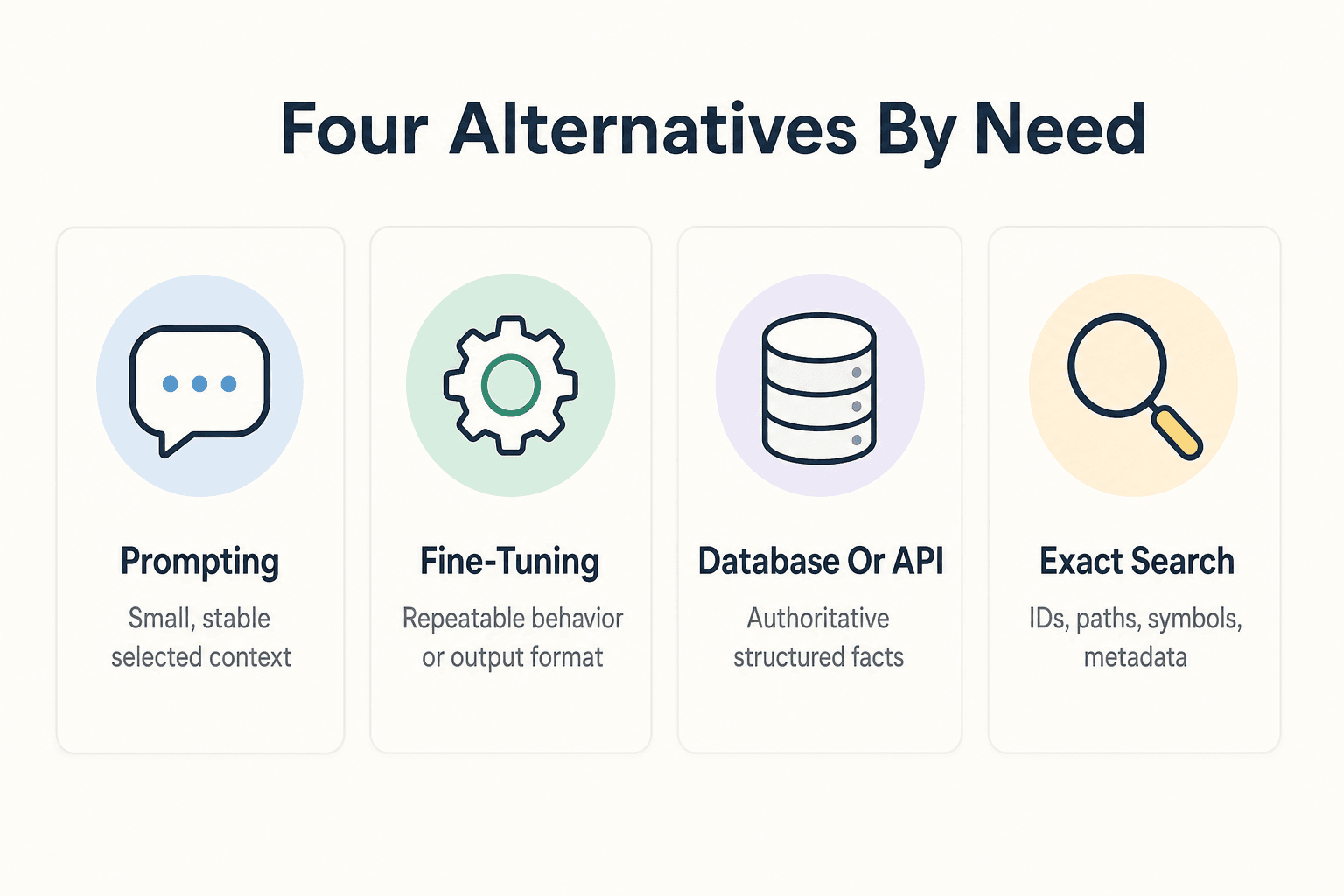
Choose the right RAG alternative for the job
The right choice depends on what is missing: context, behavior, current state, or a way to find a known thing. Don't treat all of them as memory problems. Retrieval helps with changing knowledge you need to discover, but it adds little when you already know exactly what to send or query.
Use prompting for small, stable, hand-selected context
Put a short policy, rubric, or product rule directly in the prompt when it rarely changes and you can choose the relevant text yourself. Frequently updated information needs a process that obtains current data for the interaction rather than relying on a static prompt.
Use fine-tuning to change repeatable behavior or output format
Fine-tuning can support a defined task from examples, such as classifying transcripts or producing structured output from free text. It is a different mechanism from retrieval: supervised fine-tuning learns from input-output pairs supplied during training.
Use a database or API for authoritative structured facts
When a workflow needs a structured record such as an order status, entitlement, balance, or inventory count, query the relevant system of record. Pass the returned record into the workflow that needs it rather than treating document retrieval as the record lookup.
Use keyword or metadata search when exact terms matter
Use keyword search, filters, file paths, and metadata when the task is framed around IDs, error codes, version names, or symbols. For repository work, choose navigation tools that expose the files and code relationships needed for the task, and use retrieval separately for natural-language documentation.
Use long context only when the material is bounded and cost is acceptable
For a bounded set of material, long context may let an application include broader material directly in the prompt. In the SIGMOD Record panel discussion, panelist Xiaofang Zhou noted that very large inputs can increase time to first token and that long-context models rely heavily on GPU resources. Use long context when preserving whole-document context matters more than those trade-offs.
Step-by-step: Decide whether to build RAG
- Identify what the application must provide: instructions, current data, retrieved knowledge, or task-specific behavior.
- Check whether the information is small and stable enough to include in the prompt.
- For changing external information, assess whether retrieving relevant context for each interaction fits the requirement.
- For classification or structured outputs, consider supervised fine-tuning with example input-output pairs.
- If source-grounded answers are required, assess RAG and how the application will retrieve and provide that context.
- Test the simplest suitable approach against your requirements before adding retrieval infrastructure.
[!tip] For a stable policy or a small set of instructions, first test whether including the information directly in the prompt meets the requirement. Static context is often a good fit for prompting.
Why RAG is often the wrong tool for coding agents
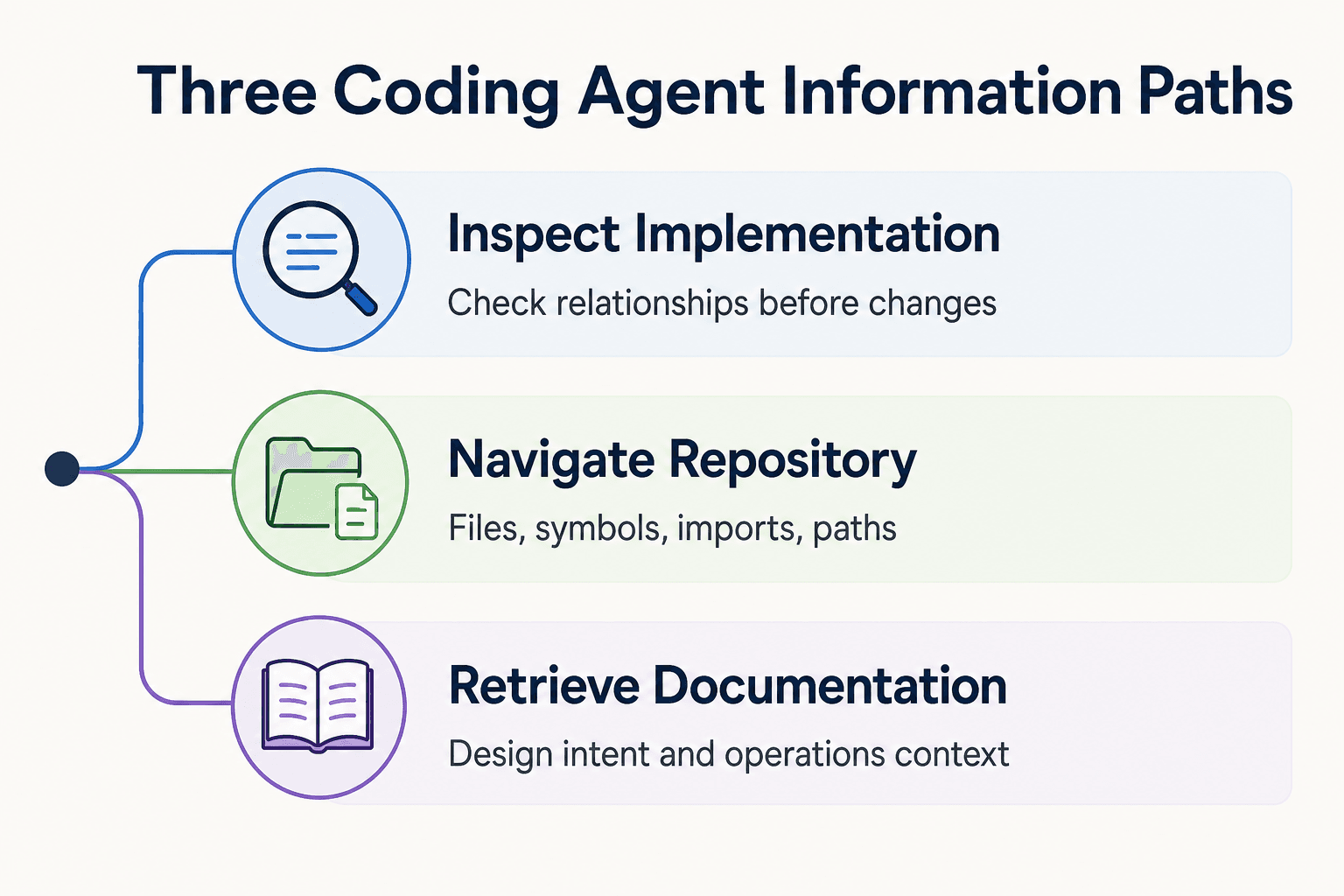
Coding agents may need both repository inspection and documentation search. When a task names a file, symbol, path, import, or call relationship, provide a way to inspect the repository. Evaluate retrieval separately for accompanying natural-language material, such as design notes or runbooks.
Why semantically similar code is not always the relevant code
For a code change, inspect the relevant implementation and its relationships before the agent acts. Semantic similarity can be useful for finding supporting material, but it does not replace repository inspection.
Treat retrieved code explanations as supporting context, not as a replacement for inspecting the implementation and its relationships before an agent changes code.
Prefer file traversal, grep, repo maps, and AST-aware tools for navigation
When a task names a file, module, error message, or symbol, begin with repository inspection. Evaluate file traversal, text search, repository maps, or structure-aware analysis according to the information the task requires.
Match the method to the question. Use repository navigation for a rename, import trace, or subclass search; consider documentation retrieval when the question concerns design intent, policy, or operations.
Keep documentation retrieval separate from code-structure retrieval
Documentation retrieval is a separate job from code navigation. Evaluate it when the task requires an agent to search natural-language project material, such as design notes, runbooks, API guides, or past decisions, for context relevant to the work.
Keep the paths separate: inspect the repository to establish the implementation, then retrieve supporting documentation when the task needs intent, policy, or operational context. GigaRAG can keep that project knowledge available across agent sessions and tools while repository tools handle code navigation.
The real costs and failure modes of a RAG stack
A RAG system has multiple stages rather than a single model call. A review of 48 sources identifies 33 failure modes across seven stages: ingestion, representation, retrieval, generation, evaluation, deployment, and agentic orchestration. Plan for the work needed to operate the stages your design uses.
Bad or stale source material creates a ceiling on answer quality
Source quality sets a limit on what a RAG system can use. The review identifies ingestion failures as a problem that can degrade the knowledge base before retrieval or generation, and it identifies stale data as a cause of responses based on obsolete information. Assign ownership for updating and removing source material.
Retrieval misses and irrelevant chunks can mislead the model
Document preparation and retrieval design deserve their own evaluation. The failure-mode review treats representation and retrieval as distinct pipeline stages, so test whether the material and retrieval results support the tasks the application must perform.
Evaluate retrieved context against the user’s question rather than assuming that a plausible match is sufficient. This matters especially when the application will use retrieved material as the basis for a source-grounded response.
More pipeline stages mean more evaluation and operational work
Evaluate the system across its stages and against real tasks. The review cautions that single-stage evaluation metrics cannot detect the full range of RAG failure modes, so a strong result in one measurement should not stand in for end-to-end testing.
Measure end-to-end latency for the design you choose, including the work completed before the model begins generating a response. Compare that result with the task benefit rather than treating retrieval or larger prompts as free additions.
What RAG cannot guarantee
RAG can provide source context, but source context should still be checked against the answer. Language models lack a built-in factual verification mechanism, and the RAG failure-mode review documents failures across retrieval and generation stages.
Don't treat citations as proof by themselves. Check that the cited passage supports the claim, that the user was allowed to see it, and that it is still current.
RAG is not outdated: Where it still fits for agent memory
RAG remains a useful pattern for applications that need to search connected data for information relevant to a query and add that information to the prompt. It can support fresh, private, or large-scale material that would be difficult to select manually for every interaction.
Match session context, application records, code navigation, and project knowledge to the task
Different tasks call for different information sources. When a task needs a current structured record, retrieve it through the relevant system of record rather than relying on a document summary.
For coding tasks, evaluate repository navigation tools for locating the files and relationships needed for the work. GigaRAG can make project knowledge available across sessions and tools when an agent needs natural-language context from material such as design notes, policy documents, research, or support runbooks.
When a shared knowledge layer becomes worth maintaining
Use RAG when the material changes often, is too large to send on every request, and must be discovered through varied questions. A team handbook with many linked policies is a reasonable case. So is a growing collection of project decisions used by several agents.
With RAG, an application can search fresh or private data for information relevant to the interaction and pass selected material into the prompt. It is less compelling for a small, stable document set that a team can select directly.
Use citations, permissions, and freshness requirements to set the bar
A shared knowledge layer needs rules. Keep source links with retrieved text, apply access controls to the material each agent can use, and establish a process for handling superseded documents. GigaRAG connects agents to a central Hive Mind through MCP or the API and includes access controls to manage what each agent can use.
Long context and RAG can be complementary rather than competing choices. Choose between them based on the source size, the need to search across material, and the latency and infrastructure trade-offs measured for the application.
A simple decision framework before you build RAG
Step 1: Identify whether the missing capability is knowledge, behavior, or state
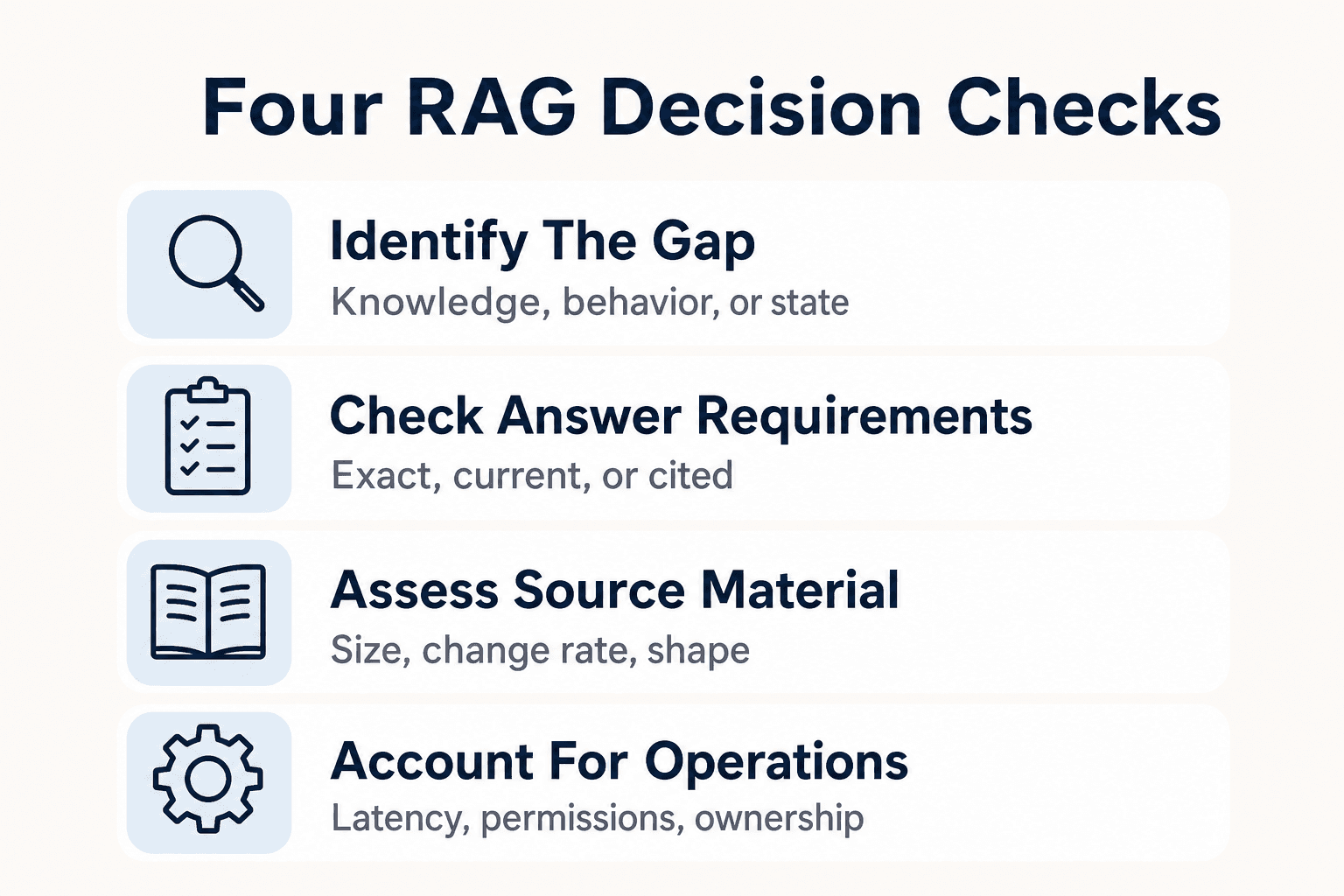
Start with the gap, not the stack. If the model needs a small stable rule, use a prompt. If it needs repeatable classification or output format, consider fine-tuning. If a workflow needs an order status or account balance, call the relevant system of record.
Knowledge is different. It is material the model must find and read.
Step 2: Test whether the answer must be exact, current, or cited
Exact terms, IDs, paths, and values call for exact search, code tools, or structured queries. Don't ask semantic retrieval to be the source of truth when a database can return the record directly.
For changing natural-language material, assess whether retrieval can provide the context and source links your application requires. If access-controlled grounding is part of the requirement, design and test the access rules alongside retrieval.
Step 3: Measure the size, change rate, and shape of the source material
A bounded document set may fit in a prompt or long-context request. A growing collection of policies, notes, and guides may justify RAG. It depends on how much material you have, how often it changes, and whether users ask varied questions.
Use grep, metadata filters, or AST parsing for code and exact labels. Use retrieval for prose people describe in many different ways.
Step 4: Account for latency, permissions, evaluation, and ownership
Every extra stage needs an owner. Check who updates sources, enforces access, tests retrieval quality, and handles stale documents before you add a vector store. For teams using GigaRAG, access controls can manage what each connected agent can use from the shared Hive Mind.
Test bounded long-context prompts and retrieval against the same task set. That comparison shows whether broader source material improves the answer enough to justify the added latency and infrastructure budget.
Step 5: Run a small baseline before adding retrieval
Build the simplest version against real tasks. Compare a hand-built prompt, direct API call, exact search, or repository tool with RAG on accuracy, citations, latency, and maintenance work.
If retrieval does not improve the result you can measure, don't build it.
Build the simplest system that can be proven useful
Start with the failure you can name. A small policy may need a prompt, a live balance may need a direct query, and a symbol lookup may need repository navigation. If source material is incomplete or stale, address that source problem before expecting downstream RAG stages to compensate for it.
Build a baseline around real tasks your users or agents must complete. Check answer quality, exactness, citations where needed, latency, permissions, and the work required to keep the system current. Keep the test set small at first, but include the awkward cases that matter.
Add RAG only when simpler options fail in a clear, repeatable way: your knowledge is growing, changes over time, is mostly natural-language material, and must work across varied questions or tools. If you can't show that retrieval improves those tasks, it isn't worth the stack.
Frequently asked questions
What is RAG in AI?
Retrieval-augmented generation, or RAG, is an approach in which an application searches its data for information relevant to a query and passes that information into the model prompt. This can ground outputs in data outside the model’s training knowledge.
When should you not use RAG?
Use another approach when the information is small and stable enough for a prompt, when the task is a well-defined classification problem, or when you need an exact source-of-truth lookup. RAG is unnecessary if retrieving external context does not solve the actual problem.
What are the cons of RAG?
RAG introduces multiple stages that need to work together, including ingestion, representation, retrieval, generation, evaluation, deployment, and agentic orchestration. The failure-mode review identifies risks across those stages, including stale source data; long-context designs can also add time-to-first-token and GPU-resource trade-offs.
How should I choose between RAG and long context?
Use long context when sending broader document context directly is practical for the task. Use RAG when the application needs to search fresh, private, or large-scale data for each interaction. They can also be complementary, so compare both approaches on the source material, latency, infrastructure cost, and answer quality.
When is prompt engineering enough instead of RAG?
Prompting can be enough when the information is small, static, and easy to include in the instructions. It is less suitable for information that changes often and must be found again for each interaction.
When should I use fine-tuning instead of RAG?
Consider supervised fine-tuning for a well-defined task such as classification or structured output from free text. Fine-tuning learns from example input-output pairs, whereas RAG searches for relevant information to include with an interaction.
Why can RAG be a poor fit for autonomous coding agents?
It can be a poor fit when the agent’s main task requires inspecting a repository rather than searching documentation. For named files, symbols, imports, and code relationships, give the agent navigation or analysis tools that expose the relevant repository material; use retrieval for related natural-language documentation when needed.
When is RAG still the right choice for an AI agent?
RAG is a reasonable fit when the agent must search changing natural-language knowledge and use relevant context in its response. It depends on the size and change rate of the material, the kinds of questions users ask, and whether simpler tools meet the requirement.
About GigaRAG
GigaRAG is a shared memory platform for AI agents that helps developers and teams keep project knowledge available across sessions and tools. It provides a central Hive Mind that agents can access through MCP or the API.
Teams can connect agents to a central Hive Mind through MCP or the API. GigaRAG includes access controls to manage what each agent can use, helping teams scope shared project knowledge to the appropriate agents.


